Eco-friendly products can be a strong category angle for Amazon FBA sellers, but sustainability positioning alone does not make a product profitable. Sellers still need to validate demand, check margins after FBA fees, confirm compliance requirements, and verify that packaging and certifications support the claims they plan to make. This guide covers how to research, evaluate, and prepare eco-friendly products for FBA with an operator-level focus on what actually matters for profitability and account safety.
Key Takeaways
- Eco-friendly positioning should be backed by real materials, certifications, or supply-chain evidence, not marketing copy alone.
- Amazon's Climate Pledge Friendly badge is certification-driven. Products must meet specific program criteria to qualify.
- Standard FBA product research still applies: demand validation, margin analysis, competitive review, and compliance checks come before any sustainability angle.
- Packaging choices affect both customer perception and FBA fulfillment economics.
- Products marketed as sustainable can still fail on Amazon due to weak differentiation, high landed cost, fragile packaging, or unclear compliance.
Why Eco-Friendly Products Deserve a Closer Look
Sustainability is a growing factor in Amazon purchase decisions. Amazon groups sustainability-related seller resources under its Sustainability Solutions Hub, and the Climate Pledge Friendly program highlights products with qualifying certifications in search results and on product detail pages.
For sellers, this creates a real but conditional opportunity. The category angle works when the product itself is sound: good demand, workable margins, clear differentiation, and verifiable sustainability claims. It fails when sellers treat "eco-friendly" as a label to add after sourcing rather than a product attribute to validate before ordering.
The practical question is not "should I sell eco-friendly products?" but "does this specific product pass the same research and profitability filters I would apply to any FBA product, with the additional compliance layer that sustainability claims require?"
How to Research Eco-Friendly Product Opportunities
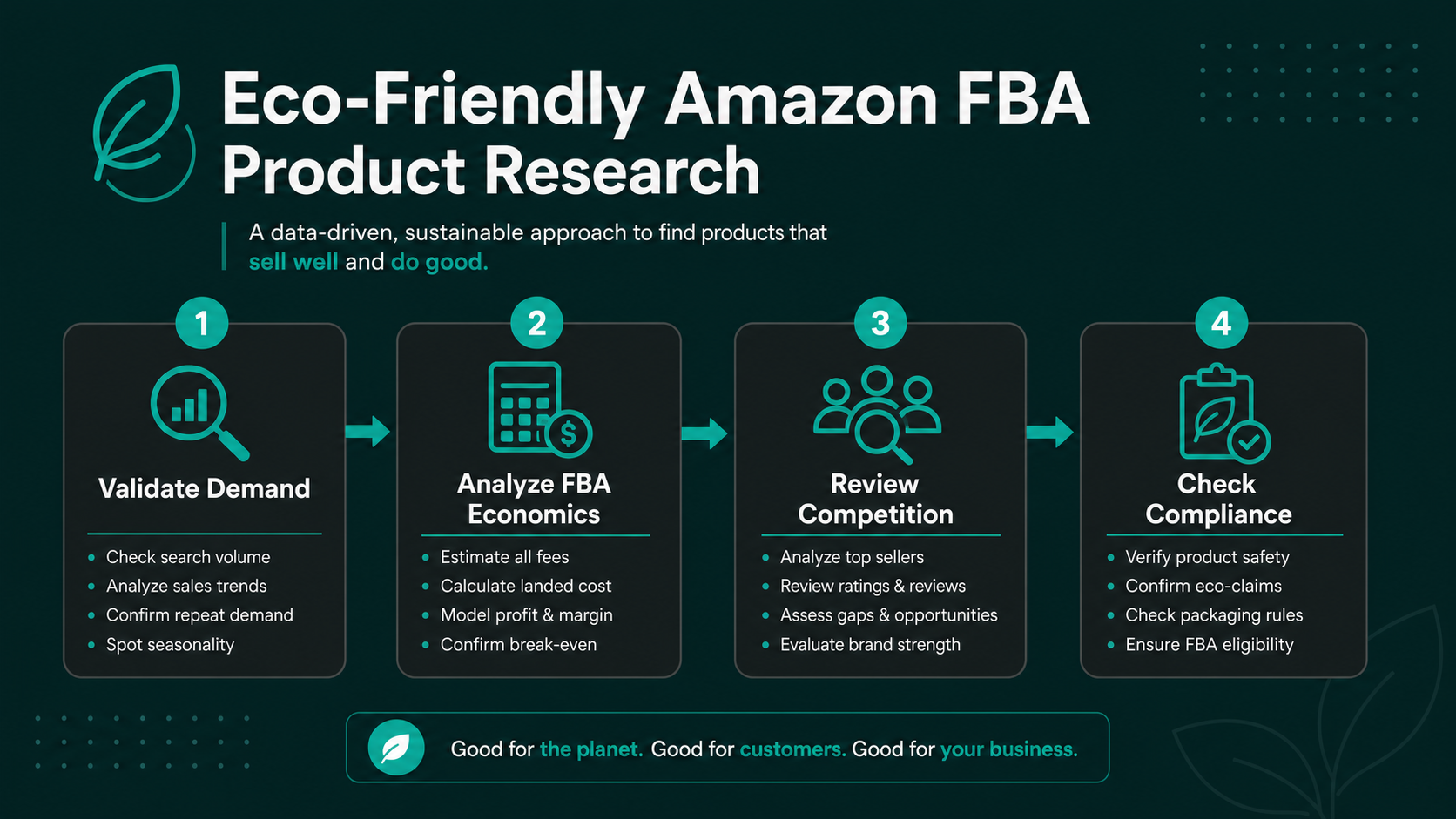
Product research for eco-friendly items follows the same core process as any FBA product selection, with a few additional filters.
Step 1: Validate Demand
Use Amazon's Product Opportunity Explorer (available to eligible sellers) or third-party research tools to check search volume and customer demand for terms related to the product category. Look for consistent demand signals rather than seasonal spikes.
Common eco-friendly search patterns include reusable alternatives (kitchen, personal care, cleaning), biodegradable or compostable materials, and refillable or zero-waste formats. But demand for a broad category does not guarantee demand for your specific product. Narrow your research to the exact product type, size, material, and price range.
Step 2: Analyze FBA Economics
Calculate unit economics before sourcing. Eco-friendly products sometimes carry higher cost of goods due to premium materials, certifications, or specialized packaging. This is manageable if the retail price supports it, but it narrows the margin window.
Check these numbers at the SKU level:
- Landed cost (product, packaging, shipping, duties)
- FBA fulfillment fee (based on size tier and weight)
- FBA storage fee (monthly and long-term)
- Referral fee (category percentage)
- Estimated advertising cost per sale
- Returns rate for the category
If the math does not work after all FBA costs, the sustainability angle will not save the product.
For a faster SKU-level check, use Qubeq's Amazon FBA profitability calculator to pressure-test price, fees, and landed cost before you commit to a sourcing decision.
Step 3: Review Competition and Differentiation
Look at existing listings in the target niche. Eco-friendly categories can be crowded with generic offerings that use similar claims and similar packaging. Strong differentiation comes from verifiable material quality, recognized certifications, packaging design, bundle strategy, or a specific use case that competitors miss.
Weak differentiation, where multiple sellers offer functionally identical bamboo or recycled products with similar price points, leads to price competition and advertising cost pressure.
Step 4: Check Compliance and Category Requirements
Some eco-friendly product categories have specific compliance requirements on Amazon. These may include:
- Product safety documentation or testing for certain materials
- Category-specific listing requirements (especially for personal care, baby, health, and household)
- Restrictions on environmental claims in listing copy (Amazon may flag unsubstantiated claims)
- Packaging and labeling requirements for specific product types
Check Amazon's category requirements and restricted products guidelines for your target category before committing to inventory.
If the product type sits near a regulated or sensitive category, review the current Amazon restricted products list before placing a bulk order.
Understanding Climate Pledge Friendly
Climate Pledge Friendly is Amazon's program that highlights products meeting specific sustainability certifications. Products that qualify display a badge on their listing, which can increase visibility and conversion.
Eligibility depends on the product holding a qualifying certification from one of Amazon's recognized partners. This is not a badge sellers can self-apply by writing "eco-friendly" in their listing. Sellers need to verify their product's certification status and apply through the program.
Certifications commonly recognized under the program include those related to organic materials, fair trade, carbon footprint reduction, and packaging efficiency. The specific list of qualifying certifications and application process should be verified on Amazon's Climate Pledge Friendly page before making sourcing decisions based on badge eligibility.
Ships in Product Packaging
Amazon also has packaging programs aimed at reducing secondary packaging waste. Products that qualify may ship in their own packaging rather than in an additional Amazon box. This can reduce packaging costs and align with an eco-friendly brand story, but qualification depends on product packaging meeting Amazon's testing and certification requirements.
Product Categories Worth Evaluating
Rather than recommending specific products (which would require current demand and competition data), here are category areas where eco-friendly positioning has shown relevance for FBA sellers. Each still requires individual product validation.
Reusable kitchen and household items. Products replacing single-use plastics (storage, cleaning, food prep). Typically small, lightweight, and FBA-friendly. Competition is high in commoditized subcategories.
Personal care and beauty. Bamboo, organic, refillable, and plastic-free formats. Category compliance requirements tend to be stricter. Packaging durability matters for FBA handling.
Cleaning products. Concentrated formats, refill systems, and compostable materials. Watch for restricted product flags on certain cleaning agents.
Pet supplies. Biodegradable, organic, and recycled-material pet products. Pet category has strong repeat purchase rates. Check for any product safety or material restrictions.
Office and stationery. Recycled, plantable, or refillable items. Small, lightweight, bundling-friendly. Lower price points may require careful margin analysis.
Garden and outdoor. Biodegradable planters, composting supplies, natural pest control. Seasonal demand patterns vary. Some subcategories have compliance requirements for pesticide or soil product claims.
Each of these categories includes both well-served niches and underserved gaps. The research process described above applies to every product within them.
Sourcing and Packaging Considerations
Supplier Verification
For eco-friendly products, supplier claims about materials, certifications, and manufacturing processes need verification. Request material data sheets, certification documents, and packaging samples before committing to a bulk order. If the supplier cannot provide documentation for a sustainability claim, that claim should not appear in your listing.
Common certifications that suppliers may hold include FSC (wood and paper products), GOTS (organic textiles), OEKO-TEX (non-toxic textiles), USDA Organic (applicable products), and Fair Trade. The relevance of each certification depends on the product type and the claims you plan to make.
Packaging Alignment
Your packaging should support the product's sustainability positioning. Using excessive plastic packaging for a product marketed as eco-friendly creates a credibility gap that customers notice in reviews.
Practical packaging considerations for FBA:
- Recyclable or compostable materials that still protect the product through Amazon's fulfillment process
- Packaging that meets FBA prep and labeling requirements
- Clear sustainability messaging on the package that is accurate and verifiable
- Packaging dimensions and weight optimized for FBA size tier economics
Listing and Marketing Approach
Listing Copy
Use accurate, specific language for sustainability claims. "Made from FSC-certified bamboo" is stronger and safer than "eco-friendly." Specific material and certification details build trust and reduce the risk of Amazon flagging vague environmental claims.
Include sustainability details in bullet points and description where they help the buyer make a decision. Avoid making sustainability the entire listing focus at the expense of product function, quality, and use-case information.
A+ Content
If you have Brand Registry access, A+ Content is a good place to show the product's sustainability story with visuals: materials, certifications, packaging process, and environmental impact. Keep claims specific and verifiable.
Advertising
PPC campaigns for eco-friendly products should target both product-function keywords and sustainability-intent keywords. A buyer searching for "compostable dish brush" has a different intent than one searching for "dish brush." Covering both expands reach, but monitor performance separately to understand which intent converts better for your product.
Common Mistakes in Eco-Friendly Product Selling
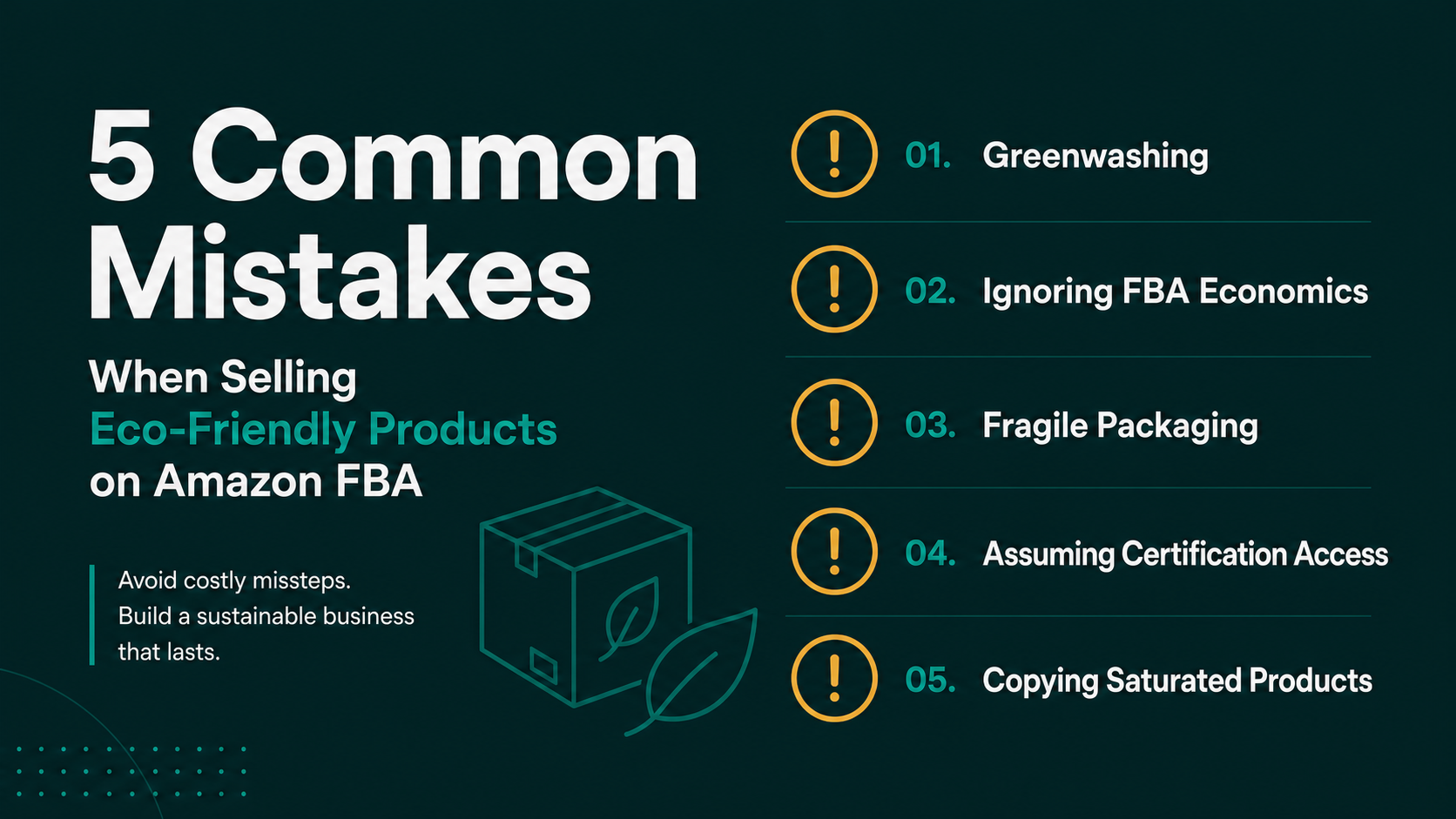
Greenwashing. Making vague sustainability claims without supporting evidence. Amazon and customers both push back on this. If you cannot document the claim, do not make it.
Ignoring FBA economics. Premium materials raise COGS. If the retail price does not support FBA fees plus advertising plus returns, the product is not viable regardless of its sustainability story.
Fragile packaging. Eco-friendly packaging materials sometimes lack durability for Amazon's fulfillment process. Products that arrive damaged generate returns and negative reviews.
Assuming certification access. Do not build a sourcing plan around Climate Pledge Friendly badge eligibility without first confirming your product qualifies under the current program criteria.
Copying saturated products. Entering a niche where dozens of sellers already offer nearly identical eco products at similar prices means competing on advertising spend, not differentiation.
FAQ
Do eco-friendly products automatically get the Climate Pledge Friendly badge?
No. Products must hold a qualifying certification recognized by Amazon's Climate Pledge Friendly program. The badge is not applied based on listing copy or product description alone.
Are eco-friendly products more expensive to source for FBA?
Often yes, due to premium materials, certification costs, and specialized packaging. This is manageable if the retail price supports it, but sellers should calculate full unit economics before committing.
Which eco-friendly product categories work best for FBA?
There is no universal answer. Categories like reusable kitchen items, personal care, and pet supplies have shown relevance, but every product needs individual validation for demand, margins, competition, and compliance.
Can I make sustainability claims in my Amazon listing without a certification?
You can describe product materials and features accurately (e.g., "made from recycled materials"), but vague or unverifiable environmental claims may be flagged by Amazon or challenged by customers. Specific, documented claims are safer.
How do I check if my product qualifies for any Amazon sustainability programs?
Visit Amazon's Climate Pledge Friendly page and Ships in Product Packaging page for current eligibility criteria, recognized certifications, and application processes.
Choosing the Right Eco-Friendly Product for Your Business
Eco-friendly positioning adds a layer of opportunity and a layer of responsibility. The opportunity is real: buyers are looking for sustainable alternatives, and Amazon's programs reward qualifying products with visibility. The responsibility is equally real: unsupported claims, weak margins, or compliance gaps can hurt your account and your brand.
The strongest approach is to treat eco-friendly products the same way you would treat any FBA product decision, with the added step of verifying that every sustainability claim you plan to make is specific, documented, and program-compliant.
If your product research, compliance review, or listing optimization for eco-friendly products needs operational support, Qubeq can help evaluate the product from a catalog, compliance, and FBA economics perspective.
That work usually overlaps with catalog and listing management, because sustainability claims, packaging details, variation structure, and compliance language all have to show up correctly on the live listing.