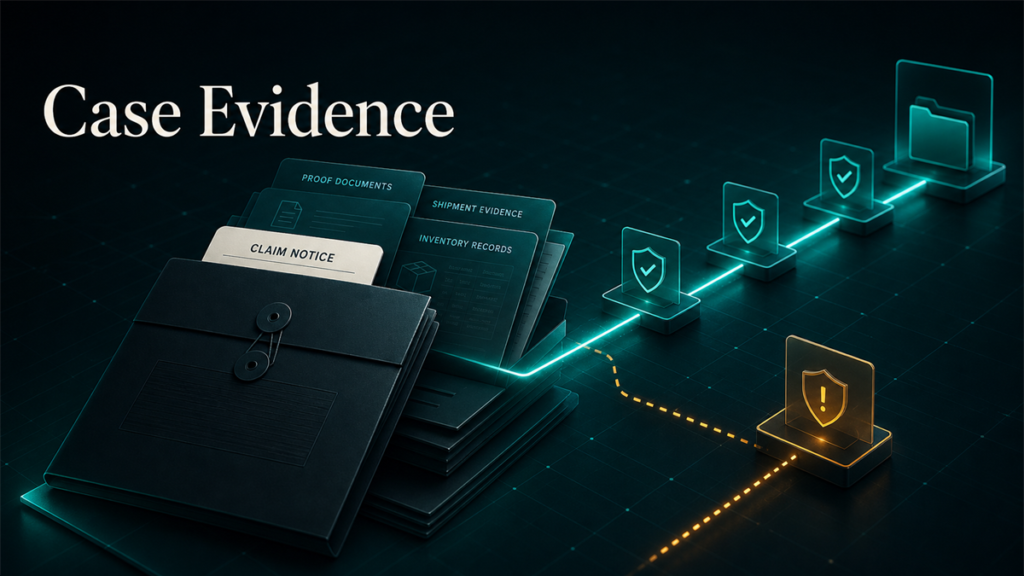
Most denied FBA reimbursement claims fail on evidence, not eligibility: the loss was real, but the case did not prove it in the form Amazon's investigator could verify. Strong reimbursement case evidence means three things matched together: the exact units (identifiers and quantities), the exact events (report rows with dates and reference IDs), and the value basis Amazon can accept.
Key Takeaways
- Every claim needs the same baseline: identifiers (ASIN, FNSKU, SKU), a precise quantity calculation, the relevant date range, and the report rows that document the event.
- Each claim family has one or two decisive documents; attaching everything else does not compensate for missing the decisive one.
- Valuation disputes need sourcing documentation, because Amazon may calculate reimbursement value from its own estimate unless you can substantiate cost.
- Package one claim per case with labeled attachments and a quantity reconciliation the investigator can follow in under a minute.
- Evidence expectations change with policy updates, so verify current documentation requirements before filing high-value claims.
The Evidence Baseline Every Claim Needs
Before any claim-specific documents, assemble the baseline:
- Identifiers: ASIN, FNSKU, and merchant SKU for every affected unit. Mismatched identifiers between your narrative and your attachments are a common silent denial cause.
- Quantity math: a simple statement of expected quantity, actual quantity, and the difference you are claiming, with the source of each number.
- Date range and event reference: when the loss event occurred and the shipment ID, order ID, removal order ID, or adjustment reference that anchors it.
- Report extracts: the actual rows from the relevant report, not a screenshot of a dashboard summary. Filtered exports showing only the relevant rows are easier to verify.
If the case cannot state "X units of FNSKU Y, lost via event Z on date D, supported by attached rows," it is not ready to file.
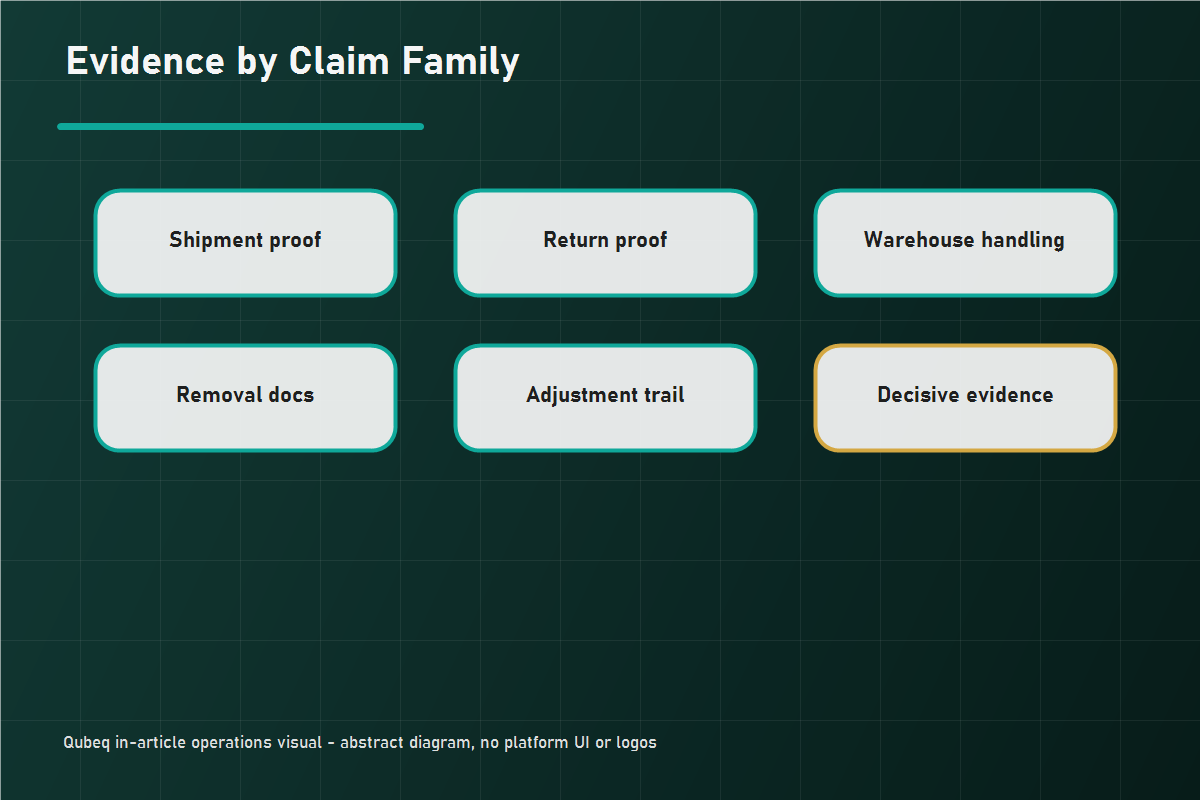
Evidence by Claim Family
Lost in warehouse
The decisive evidence is the Inventory Ledger: a negative adjustment (or balance gap) that was never reversed by a found event. Include the detailed ledger rows for the FNSKU across a range wide enough to show no reversal occurred, plus your quantity math. Claims filed before the loss has settled are routinely rejected because Amazon's own process may still find the units.
Damaged in warehouse or by carrier
The decisive evidence is the adjustment or event row identifying the damage and the disposition change. Include the ledger or adjustment rows showing units moved to an unsellable or damaged state by Amazon's handling (not customer damage), and note whether the units were already reimbursed or disposed automatically.
Inbound shipment shortage
The decisive evidence pairs your proof of what you shipped with Amazon's record of what it received: the shipment ID with shipped vs received quantities, carrier proof of delivery or pickup, and, where requested, supplier invoices or packing documentation proving the shipped quantity existed. Box-level content information strengthens the case when the shortage is disputed.
Customer return not received
The decisive evidence is the refund event paired with the absence of a return event: the order ID, the refund date, and returns-report rows showing the unit never re-entered inventory within the expected return window. Quantity math matters here because partial returns and replacement orders confuse counts quickly.
Removal order losses
The decisive evidence is the removal order detail against your receiving record: the removal order ID, the quantities Amazon shows as shipped, and your documented count of what actually arrived, with dates. Photograph and log removal receipts as they arrive; reconstructed counts weeks later are weak evidence.
Valuation Evidence: Proving What the Units Were Worth
Reimbursement value is calculated by Amazon based on its current policy, and for many sellers the default estimate is acceptable. Dispute value only when you can document it: supplier invoices tied to the exact products, sourcing records, and sale-price history. If you escalate a valuation dispute without cost documentation, expect the original estimate to stand. Current valuation rules and any cost-based options should be verified against the live reimbursement policy page before filing.
Packaging the Case So It Gets Approved First Pass
- One claim per case. Mixed claims get partially investigated and partially denied.
- Lead with the claim statement: units, FNSKU, event, date, requested action, in two or three sentences.
- Include the quantity reconciliation as a short table the investigator can verify against your attachments.
- Label every attachment by content: "Inventory Ledger rows, FNSKU X, Jan-Mar" beats "export(3).csv".
- Reference prior case IDs if this is a refile, and state specifically what new evidence the refile adds.
- Keep the narrative factual. Frustration, policy lectures, and threats lengthen cases; evidence shortens them.
Mini-Scenario: The Shortage Claim That Passed on Refile
A kitchenware brand filed a claim for 48 units missing from an inbound shipment and was denied: Amazon's receiving record stood, and the case contained only a screenshot of the shipment summary. On refile, the team attached the carrier's signed proof of delivery showing the full carton count, the box content information for the two cartons containing the missing FNSKU, and a supplier invoice covering the shipped quantity, plus a three-line reconciliation: shipped 240, received per Amazon 192, claimed 48.
The refiled case was approved without further questions. Nothing about the loss changed; the evidence finally matched what an investigator could verify.
FAQ
Why was my reimbursement claim denied even though units are missing?
Most commonly: the claim was filed before the settling period ended, the evidence did not tie identifiers and quantities together, or the decisive document for that claim family was missing. Refile with the gap closed rather than reopening the same case unchanged.
What documents does Amazon require for reimbursement claims?
It depends on the claim family: ledger rows for warehouse losses, carrier proof and invoices for shipment shortages, refund and returns data for return claims, and receiving records for removal losses. Requirements change with policy updates, so check the current reimbursement policy page.
Do I need invoices for every reimbursement claim?
No. Invoices matter mainly for shipment shortage disputes and valuation disputes. Routine warehouse-loss claims are usually decided on Amazon's own ledger data.
Should I use screenshots or report exports as evidence?
Report exports. Filtered rows from the actual report are verifiable against Amazon's systems; dashboard screenshots often are not. Use screenshots only for things that exist nowhere else.
How long should I wait before filing a lost-inventory claim?
Long enough for Amazon's lost-and-found process to settle, since many losses reverse automatically. The current policy page defines eligibility windows; filing too early is a common avoidable denial.
Build the Evidence Before You Write the Case
A reimbursement case is only as strong as the rows and documents behind it. If your team is sitting on denied claims, unexplained ledger losses, or a backlog of shortage disputes, Qubeq can audit the account, assemble the evidence per claim family, and recover what Amazon owes. No upfront cost for the audit.