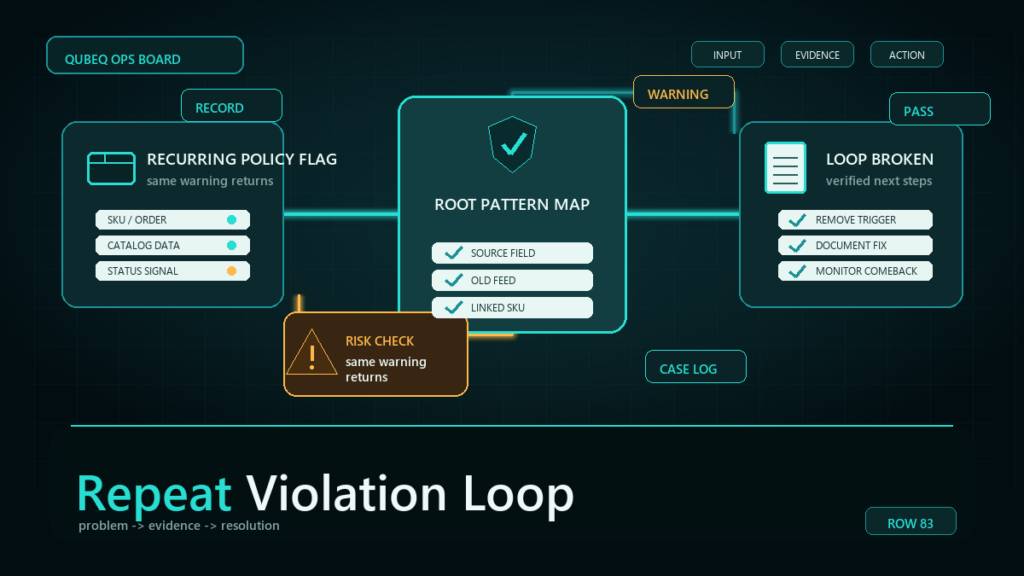
Amazon repeat policy violations, the same policy type appearing on your account record again and again, carry more enforcement risk than the sum of the individual notices, because a pattern signals a seller who hasn't fixed the underlying cause. Appealing each notice one at a time treats the symptom. Ending the pattern means diagnosing why the violation regenerates and building a corrective system Amazon can see.
Key Takeaways
- A repeated violation of the same policy reads as a systemic problem, and Amazon's enforcement appears to weigh patterns more heavily than isolated incidents, though exact thresholds are not published.
- Repeat patterns have three common engines: a root cause that was never fixed, a process gap spread across the team or catalog, and automation that keeps reinserting bad data.
- Diagnosis starts with grouping the violation record by policy type and by ASIN family; the shared input is usually visible once grouped.
- Breaking the cycle takes three layers: the root-cause fix, a preventive control, and documentation of the corrective system.
- Each successful one-off appeal that skips the root cause buys time, not safety.
Why Repeat Violations Escalate Enforcement Risk
A second violation of the same policy is not just one more violation; it is evidence that the first fix didn't hold. Amazon does not publish exact thresholds for when repeated violations trigger harder enforcement, so treat any "three strikes" framing as folklore. But the direction is consistent in how the Account Health Rating is described and in what sellers experience: violation history matters, and a repeating type appears to matter more.
There is also an appeal-side cost. A plan of action that promises a fix loses credibility when the same violation type returns, and each new appeal for a familiar problem starts from a weaker position. The account is asking Amazon to believe a correction story it has already heard.
How Repeat Patterns Happen
Repeat violations almost always trace to one of three engines, and naming the engine is most of the diagnosis.
The root cause was never fixed
The appeal succeeded, the listing came back, and everyone moved on. The supplier whose paperwork triggered the authenticity complaint still ships the product. The copy template with the medical claim still sits in the shared drive. The first notice was treated as an event to survive instead of a defect to remove.
The process gap spans the team or the catalog
One person learned the lesson; the process didn't. A claims-wording violation gets fixed on the flagged ASIN while forty sibling listings built from the same template keep the same phrase. A new hire lists products the way the old listings were built, faithfully reproducing the violation. Without a written control, the fix lives in one person's memory.
Automation reintroduces the bad data
This is the engine teams miss longest. A flat file template, a feed from a listing tool, a PIM export, or a repricer-adjacent integration overwrites the corrected attribute on its next sync, and the bad value returns weeks after someone fixed it by hand in Seller Central. The violation looks new. The data is old.
How to Diagnose the Pattern
Pattern diagnosis is a grouping exercise, and it takes an afternoon, not a quarter.
- Pull the full violation record from the Account Health page and the Performance Notifications page, going back at least twelve months.
- Group the violations by policy type. Three different policies violated once each is a different problem from one policy violated three times.
- Group the repeating type by ASIN family. Repeats concentrated in one variation family or product line point to a shared input: same supplier, same template, same feed.
- For each cluster, name the shared input and test it against the three engines: unfixed root cause, process gap, or automation reinserting data.
- Confirm the engine by checking the listing's change history where available. A corrected value that reverted on a schedule is automation; a value that was never corrected everywhere is a process gap.

Breaking the Cycle
A repeat pattern ends when three layers exist, and most sellers stop after the first.
- Fix the root cause itself: replace the supplier, rewrite the template, correct the source data in the feed or flat file, not just the live listing.
- Add a preventive control: a pre-listing compliance check, a feed validation step that blocks the known-bad attribute, or a review gate on the template the violations came from.
- Document the corrective system: what failed, what changed, who owns the control, and how recurrence would be caught. This record protects you twice, internally as the process memory, and in any future appeal as evidence the account corrects systemically.
What Escalating Enforcement Can Look Like
Escalation paths are not published as a fixed ladder, so this is orientation, not prediction. Sellers with repeat patterns report consequences that can include longer or harder appeals for each new instance, listing removals that extend across related ASINs, loss of selling privileges in a category, and, in serious cases, account-level action. Which step applies in a given case depends on factors Amazon does not fully disclose, including the policy involved and the account's overall history. The practical takeaway is not to map the ladder; it is to get off it while the violations are still listing-level.
Mini-Scenario: The Violation on a Schedule
A kitchenware seller received the same restricted-claim violation on the same product line three times in nine months. Each time, the team edited the bullet in Seller Central, appealed, and won. Each time, the claim came back.
Grouping the record made the pattern obvious: every recurrence followed a catalog sync from the listing tool that held the original copy. The fix that ended the cycle was unglamorous: correct the master record inside the tool, add the banned phrase to a pre-upload validation list, and write a one-page note documenting the failure and the control. The violation type has not returned, and the next appeal the account files on any topic will not have to explain a repeating record.
FAQ
Why do repeat violations matter more than one-time violations?
A repeating type signals an uncorrected system, not bad luck. Enforcement appears to weigh patterns more heavily, and each new appeal for a familiar violation starts from weaker credibility.
How many repeat violations trigger a suspension?
Amazon does not publish a threshold, and any specific number you read is guesswork. Treat every repeat of the same policy type as the warning, and fix the engine rather than counting strikes.
Where do I see my violation history?
On the Account Health page, with the underlying notices on the Performance Notifications page in Seller Central. Pull at least twelve months before grouping by policy type and ASIN family.
Why does the same violation keep coming back after I fix it?
Usually one of three engines: the root cause was never actually removed, the fix never spread past the flagged ASIN, or an automated feed keeps overwriting the correction with the old data.
Should I mention past violations in a new appeal?
Address the pattern rather than hoping reviewers miss it. A plan of action that explains the systemic fix and the preventive control is stronger than one that treats a third occurrence as a first.
End the Pattern, Not Just the Notice
If the same violation type keeps surfacing on your Account Health page, the next appeal is not the problem to solve; the regeneration engine is. Qubeq can run the pattern diagnosis across your violation record, trace the shared input through templates, feeds, and flat files, and build the preventive controls and documentation as part of managing the account.