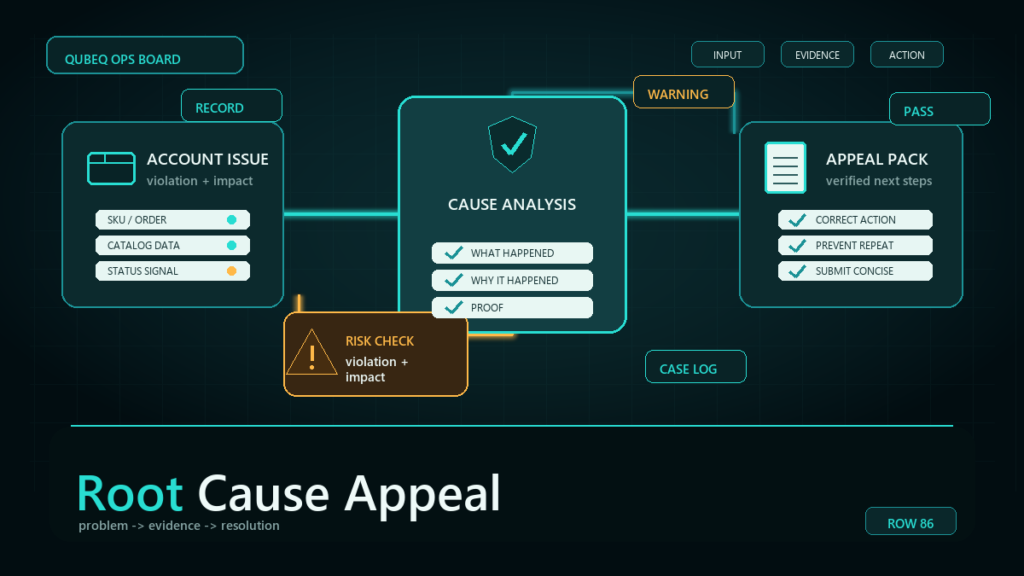
A rejected Amazon appeal usually shares one trait: the root cause was a restatement of the symptom, not an explanation of how the operation produced it. "We received complaints about item condition" is what Amazon told you; a root cause is what your process did to cause it, stated specifically enough that the corrective actions follow logically. The analysis takes a few hours; skipping it costs appeal cycles you may not have.
Key Takeaways
- Amazon's reviewers accept plans whose corrective and preventive actions plausibly flow from the stated cause; generic causes make that flow impossible.
- Work backward from the notice: what was enforced, which ASINs and orders, what window, then pull the operational records for exactly that scope.
- Symptom and cause live at different layers: the complaint is buyer-visible, the cause is in sourcing, handling, listing data, or process gaps.
- A credible cause statement is specific, evidenced, and owned: it names the process that failed, shows the records that prove it, and accepts responsibility without excuses.
- Test the chain before submitting: a stranger reading cause, correction, and prevention should see one continuous line.
Why Generic Root Causes Fail
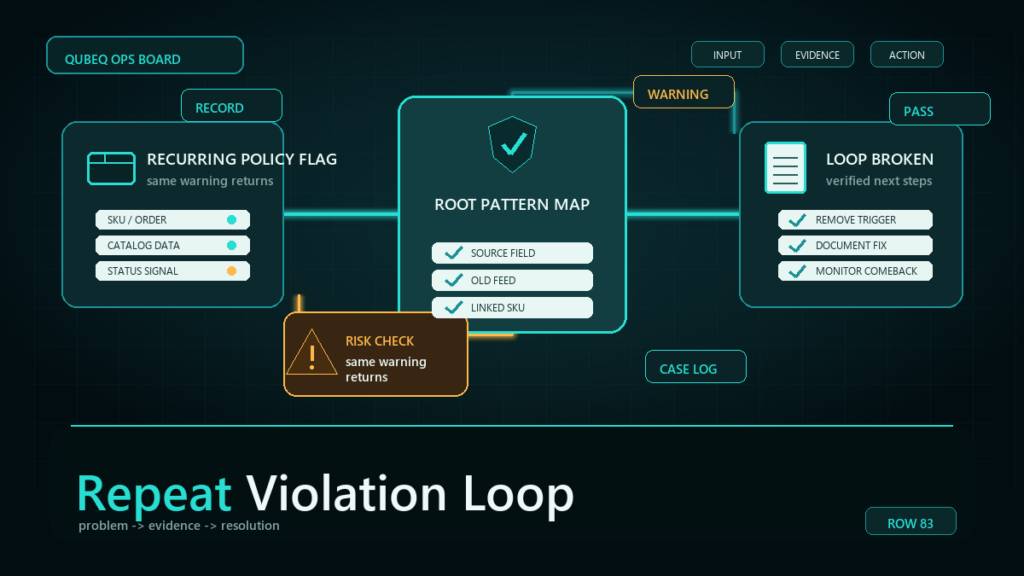
Appeal reviewers read plans all day, and pattern-matched phrases ("we have reviewed our processes," "this was a one-time supplier issue," "we will be more careful") signal that no analysis happened. More practically, a vague cause makes the rest of the plan unverifiable: if the cause is "supplier issue," what exactly do the corrective actions correct? The plan collapses into promises, and promises are not evidence.
The inverse is also true: a precise cause does most of the persuading. When the cause names a specific gap with records behind it, the corrective actions become obvious and checkable, and the preventive measures read as engineering rather than apology.
Step 1: Work Backward from the Notice
Extract the facts from the enforcement notice and Account Health page before theorizing:
- What exactly was enforced: which policy, which ASINs, listing-level or account-level.
- The trigger type: buyer complaints, test buy, automated detection, document request failure.
- The window: when the triggering events occurred, which bounds your investigation period.
- What Amazon asked for: the current notice wording tells you which plan elements and documents it expects.
Then pull the operational records for that exact scope: the orders and returns in the window, the listing change history, the inbound shipments, the supplier lots, the case history. The cause is in those records, not in brainstorming.
Step 2: Separate Symptom from Cause
The notice describes the buyer-visible symptom. The cause sits upstream in one of a few layers:
- Sourcing: the product or lot was not what it should have been.
- Handling and fulfillment: storage, prep, returns processing, or co-mingling put the wrong unit in the box.
- Listing data: the page promised something the product does not deliver (spec, condition, compatibility, contents).
- Process and people: no QA step, an SOP that exists but is not followed, a handoff with no owner.
Ask of every candidate explanation: could a reviewer verify this from records, and would fixing it actually stop the complaints? "Buyers misuse the product" fails both tests. "Our returns process restocked used units as new because rework had no inspection step" passes both.
Step 3: Run the Five Whys on the Records
Adapted to marketplace operations, with the records open:
- Why did buyers complain the item was used? Because some units shipped with opened packaging.
- Why did opened units ship? Because returned units re-entered sellable stock.
- Why did returns re-enter sellable stock? Because the returns workflow defaulted to restock unless flagged.
- Why was nothing flagged? Because no inspection step existed between return receipt and restock.
- Why no inspection step? Because the SOP was written when returns were five a month and never revisited at fifty.
Stop when you reach a process decision someone can change. That is the root cause; everything above it is symptom chain, and it all becomes material for the narrative.
Step 4: Write the Cause Statement
One short paragraph with three properties:
- Specific: names the process, the gap, and the period. Not "supplier issues" but "units from the March restock lot were shipped without the incoming inspection our SOP required."
- Evidenced: each factual claim maps to an attached record (return logs, SOP excerpt, lot dates).
- Owned: no blame-shifting to buyers, competitors, or Amazon. Reviewers read deflection as a seller who will repeat the violation.
Step 5: Make Corrections and Prevention Flow from the Cause
Corrective actions fix the damage that occurred: inspect and remove affected inventory, rework or dispose, correct the listing data, refund or contact affected buyers where appropriate. Preventive measures change the process so the cause cannot recur: the new inspection step, the revised SOP with an owner, the monitoring metric, the audit cadence.
The test before submission: read cause, corrections, prevention in sequence. Every correction should answer damage the cause created; every preventive measure should block the specific why-chain. Anything that does not connect is filler, and filler dilutes credibility.
Mini-Scenario: The Complaint That Was Not About the Product
A consumer-electronics seller's listing was deactivated for used-sold-as-new complaints. The first appeal blamed a packaging supplier and was rejected. The records told a different story: every complaint order shipped within three weeks of a returns-processing backlog being cleared, and the returns log showed dozens of units restocked in one afternoon with no condition notes. The rework step had been skipped to clear the backlog.
The second appeal stated exactly that, attached the returns log and the revised SOP with a mandatory inspection gate and a named owner, and listed the corrective sweep of remaining stock. It was accepted. The product and the supplier were never the problem; the afternoon shortcut was.
FAQ
What does Amazon mean by root cause in an appeal?
The operational reason the violation happened: the process gap, data error, or sourcing failure that produced what buyers or Amazon detected. It is the answer to "what in your operation made this occur," not a restatement of the notice.
Why does Amazon keep rejecting my plan of action?
Most often the root cause is generic, the corrective actions do not follow from it, or claims lack supporting records. Rewrite from the analysis up, not the wording down.
How specific should a root cause be?
Specific enough that the corrective actions are the obvious consequence: name the process, the gap, and the affected period, and support each fact with an attached record.
Should I admit fault in an Amazon appeal?
State accurately what your operation got wrong and what you changed, without self-flagellation and without deflection. Reviewers accept plans from sellers who clearly understand their own failure.
Can one root cause cover multiple violations?
Only if the records genuinely show one cause. Distinct violations usually need their own analysis, and forcing them under one cause weakens both appeals.
Get the Analysis Right Before the Letter
The letter is the last step; the analysis decides whether it works. If your appeal has been rejected, or the enforcement is too costly to risk a generic plan, Qubeq can run the records-based root cause analysis, build the evidence packet, and structure a plan of action that holds together under review.