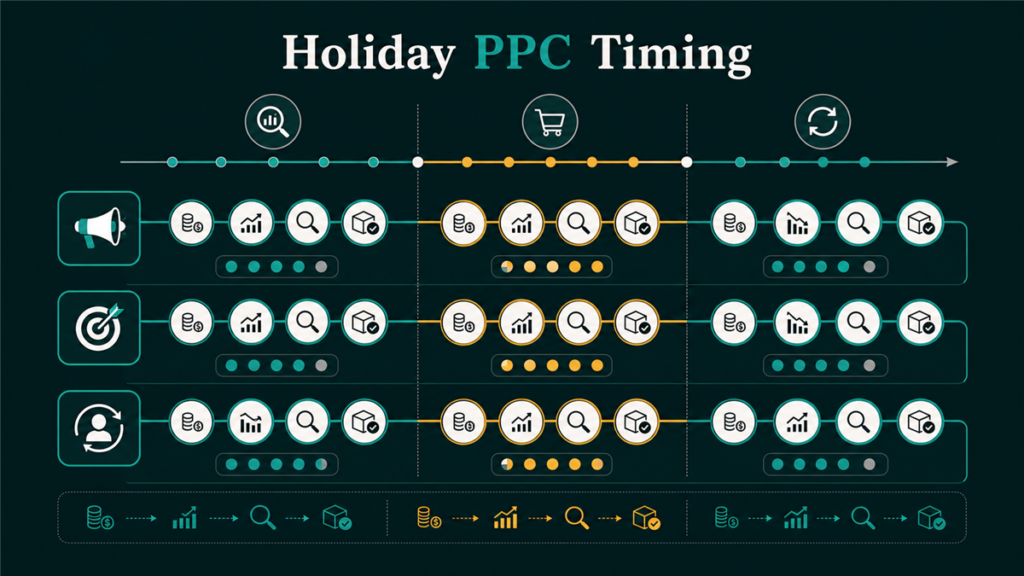
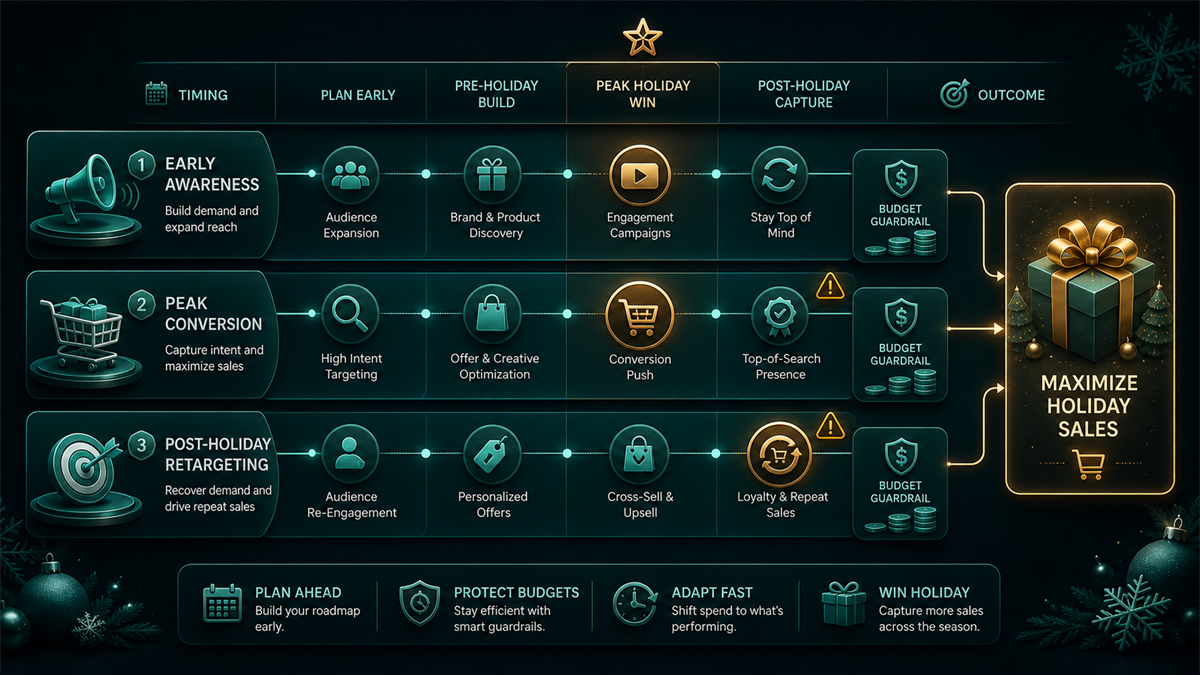
A holiday advertising strategy on Amazon comes down to three coordinated moves: capture high-intent search traffic with Sponsored Products, build brand visibility with Sponsored Brands, and recover lost shoppers with Sponsored Display. The sellers who win peak season are not the ones who spend the most. They are the ones whose campaigns, budgets, listings, and inventory are aligned before the traffic spike arrives.
Key Takeaways
\n* holiday advertising strategy amazon\n
- Holiday PPC only works when inventory, listing quality, and budget planning are handled first. Ads cannot rescue a stockout or a weak detail page.
- Sponsored Products should carry the core of holiday spend, structured by intent: branded, competitor, and high-intent gift or deal terms.
- Sponsored Brands builds discovery and protects brand real estate at the top of search during the most contested weeks of the year.
- Sponsored Display retargets shoppers who viewed but did not buy, and keeps working into the post-holiday gift card period.
- Start testing in October or early November, scale only what proves conversion, and protect budgets on peak days so campaigns do not run out mid-afternoon.
What Is a Holiday Advertising Strategy?
A holiday advertising strategy is a seasonal plan for allocating Amazon ad spend across campaign types, products, and dates during peak shopping events such as Black Friday, Cyber Monday, and the December gifting run-up.
It differs from everyday PPC in three ways. Demand is compressed into short windows, so timing errors cost more. Cost-per-click rises in contested categories, so bid discipline matters more. And shopper intent shifts toward gifting and deals, so keyword targeting and creative need seasonal adjustment.
Amazon Ads' own holiday guidance pushes the same core idea: plan ahead of the event, use multiple ad products together, and keep budgets sustainable so campaigns stay live through peak hours.
Before You Touch Campaigns: The Readiness Layer
Holiday PPC fails most often for reasons that have nothing to do with advertising.
Inventory comes first. If FBA stock cannot cover the demand spike, ads accelerate the stockout and your organic rank suffers afterwards. Confirm inbound shipments are checked in well before the event, and reconcile any partial or missing receipts early.
Listings come second. Peak traffic exposes weak detail pages. Titles, bullets, images, and A+ Content should be finalized weeks before the event, because moderation and indexing delays during November are unforgiving.
Budget protection comes third. A campaign that exhausts its daily budget at 2 p.m. on Black Friday hands the evening's traffic to competitors. Decide ahead of time which products deserve protected spend and which get paused if costs run hot.
Strategy 1: Capture High-Intent Traffic with Sponsored Products
Sponsored Products is the backbone of holiday advertising because it targets shoppers at the moment of search.
Structure campaigns by intent rather than dumping everything into one campaign:
- Branded campaigns protect your own brand terms from competitors bidding on them during peak weeks.
- High-intent campaigns target gift and deal phrasing relevant to your category, built from your own Search Term Report history.
- Competitor campaigns target selected competitor ASINs where your offer compares well on price, reviews, or features.
- Catch-all auto campaigns run at modest budgets to harvest new seasonal search terms.
Bid management should follow data, not the calendar alone. Review the last 60 to 90 days of search term data, double down on terms that convert, and add negatives aggressively so seasonal traffic spikes do not amplify wasted spend. Raise bids gradually into the event on proven terms rather than making one large jump on peak day.
Dynamic bidding (up and down) can help during high-conversion windows, but watch it daily. Holiday CPCs move fast, and automated adjustments compound in both directions.
Strategy 2: Build Visibility with Sponsored Brands
Sponsored Brands placements at the top of search results matter most during the weeks when every shopper is comparing options.
Use them to do what Sponsored Products cannot: present a range. A Sponsored Brands ad showing a gift bundle, a bestseller, and a complementary product gives gift shoppers a reason to enter your Brand Store instead of a single detail page.
Practical moves that hold up year after year:
- Refresh your Brand Store with a seasonal page or gift-oriented collection before the event.
- Test video creative against static banners. Run both and let performance decide; do not assume video wins by default.
- Use seasonal copy where it is accurate: gift framing, bundle framing, and limited-time offers that actually exist.
- Target category and complementary keywords, not just your core terms. Gift shoppers search differently from replacement buyers.
Sponsored Brands spend should support, not replace, Sponsored Products. For most accounts we manage, it is a meaningful minority of holiday budget, sized to the brand's catalog depth.
Strategy 3: Recover and Extend with Sponsored Display
Sponsored Display covers the two ends of the holiday funnel that search ads miss: shoppers who looked and left, and shoppers who come back after the holidays.
Retargeting viewers of your detail pages during the event window catches comparison shoppers in their decision period. Cross-sell placements on your own detail pages can lift order value when gift shoppers are already committed to your brand.
Then keep it running. The first weeks of January bring gift card redemptions and exchange traffic. Sellers who cut all advertising on December 26 leave that demand to whoever stayed live. Keep retargeting campaigns funded for two to three weeks after the holidays, then reassess.
Holiday PPC Planning Checklist
- Confirm FBA inventory coverage and inbound check-in for all advertised ASINs before campaigns scale.
- Finalize listings, images, and A+ Content at least four weeks before the target event.
- Pull 60 to 90 days of Search Term Reports and build the keyword plan from converting terms.
- Launch test campaigns in October or early November at moderate budgets.
- Set negative keywords before scaling, not after the wasted spend shows up.
- Decide peak-day budget caps per product and protect spend on priority ASINs.
- Raise bids gradually on proven terms into the event window.
- Check campaigns daily during peak weeks: budget exhaustion, ACOS drift, and placement performance.
- Keep retargeting live through early January.
- Run a post-season review: which terms, products, and placements earned their spend, and what gets cut next year.
Mini-Scenario
A kitchenware seller entered November with three products and a flat campaign structure: one campaign, all ASINs, one budget. By Black Friday morning the budget was gone before noon, spent mostly on the lowest-margin product. The following season, the same seller split campaigns by product priority, protected the hero ASIN with its own budget, and launched in late October to gather conversion data first. Total spend rose moderately, but the hero product stayed visible through peak evening hours, and the account's ACOS held within target because scaling decisions were based on weeks of real data instead of peak-day guesses.
FAQ
When should I start preparing holiday advertising campaigns?
Start planning and testing six to eight weeks before your target event. October testing gives you conversion data to scale on, and it gives listings time to clear any moderation issues.
How much should I increase my budget during the holidays?
There is no universal percentage. Size budgets to your inventory coverage and proven conversion data. Increasing spend on a product that will stock out, or on terms that never converted, only accelerates losses.
Should I pause ads after Christmas?
Not immediately. Gift card redemptions and exchange traffic continue into January. Keep retargeting and your best-performing campaigns live for two to three weeks, then scale down based on performance.
What if my ACOS spikes during the event?
Diagnose before reacting. Rising CPCs with stable conversion may be acceptable peak-week economics. Falling conversion suggests a listing, price, or stock problem that bids cannot fix. Adjust the actual cause.
Do these strategies work outside Q4?
Yes. The same structure applies to Prime Day and other peak events: readiness layer first, intent-structured Sponsored Products, brand visibility, then retargeting through the post-event tail.
Get Your Account Ready Before the Rush
Holiday advertising rewards preparation more than budget. If your campaign structure, listings, or FBA inventory pipeline are not ready for peak season, the traffic spike will expose it at the most expensive time of year. Qubeq manages Amazon PPC alongside the catalog and FBA operations that ads depend on, one manager, one standard. If you want a pre-season audit of your account, reach out through our Amazon PPC advertising page.