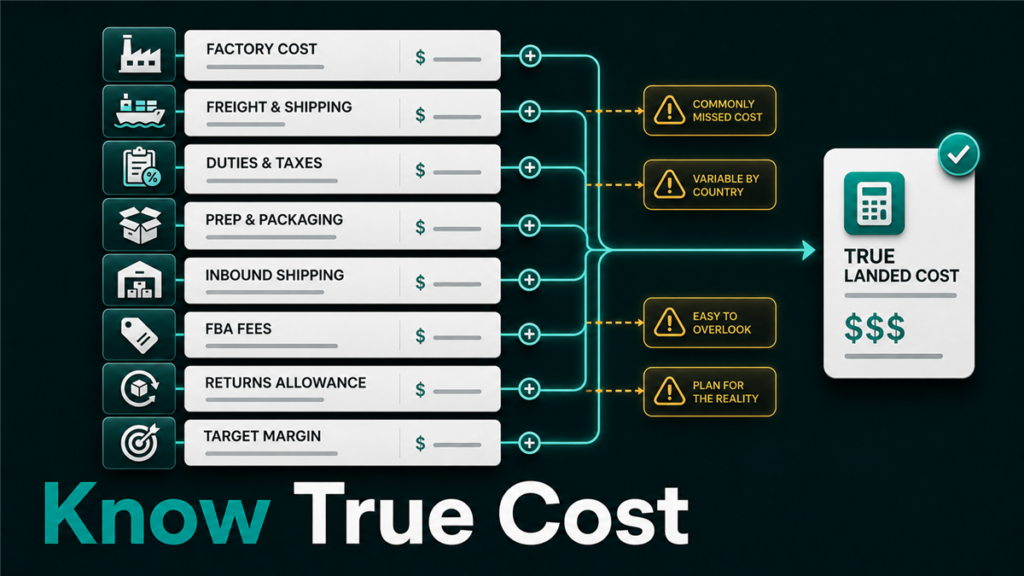
Landed cost is the total per-unit expense of moving a product from the supplier to Amazon's fulfillment center, ready for sale. At its core, your Amazon FBA landed cost is what determines whether a listing is profitable or not. Most Amazon FBA margin problems start here: sellers undercount inputs, price products on incomplete numbers, and only discover the gap when payouts fall short. This guide breaks down every landed cost component, provides a calculation checklist, and explains how to validate your estimate against actual Seller Central data.
Key Takeaways
- Landed cost includes every expense before the first sale: product cost, international freight, customs duties, destination charges, inbound shipping to Amazon, and prep/labeling.
- Amazon fees (referral, fulfillment, storage) are not part of landed cost but must be added separately to calculate true unit economics.
- The most common costing mistake is using an early supplier quote instead of the actual invoice price after final packaging, materials, and quantity adjustments.
- Validate landed cost estimates against real payout data using the Revenue Calculator, Fee Preview, and transaction-level settlement reports.
- Recalculate landed cost for every new shipment, because freight rates, duties, and supplier pricing shift between orders.
What Landed Cost Includes
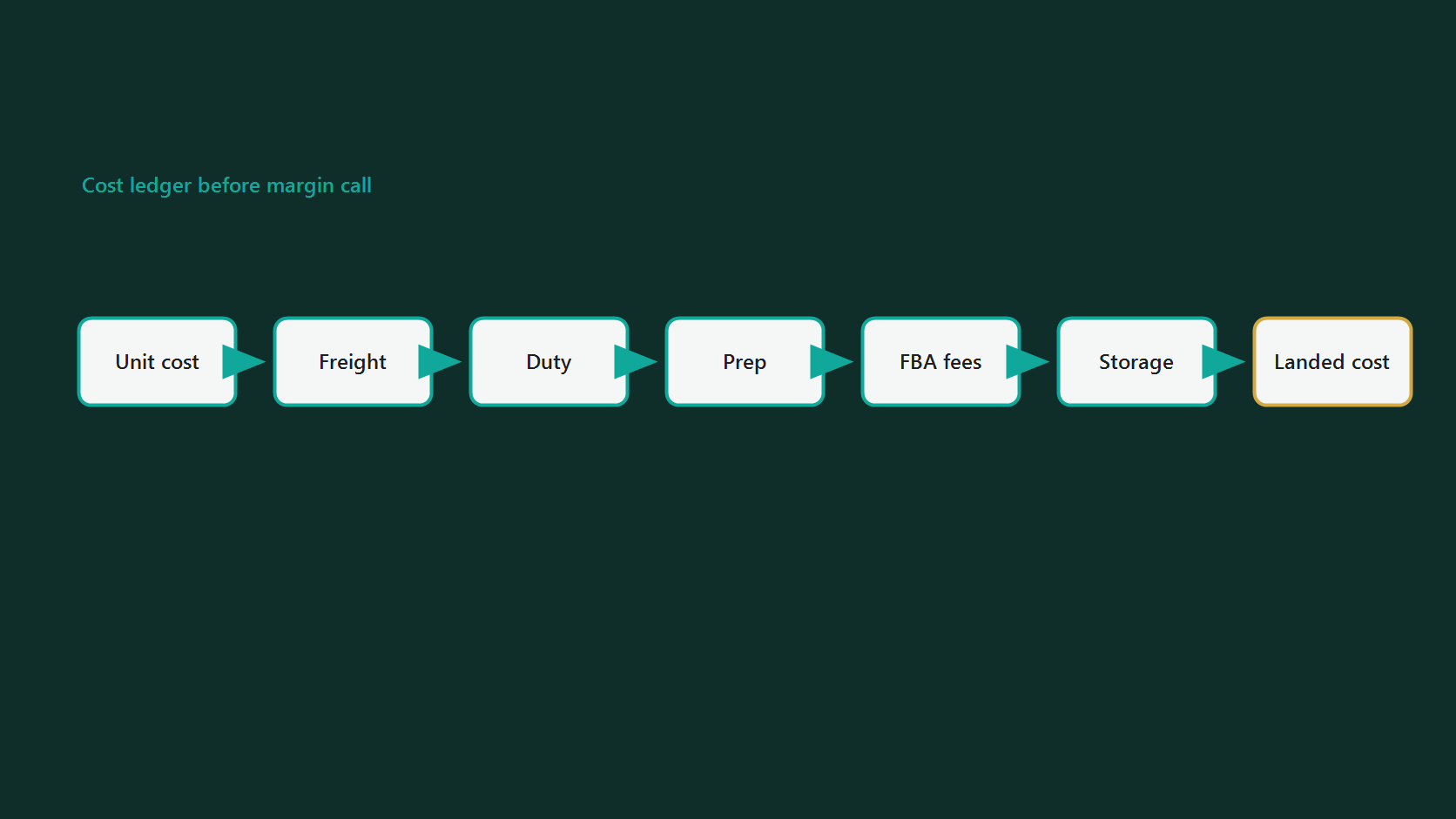
Landed cost covers every dollar spent to get one sellable unit into Amazon's warehouse. It stops at the point where the product is received by Amazon and available for purchase. Everything after that point, including referral fees, FBA fulfillment fees, storage, returns, and advertising, belongs to post-sale cost accounting.
Mixing pre-sale and post-sale costs into a single number is one of the most common costing errors. It creates confusion about where margin is leaking and makes it harder to compare suppliers, shipping methods, or product variations.
The Landed Cost Formula
Landed cost per unit = product cost + international freight per unit + customs duties per unit + destination/port charges per unit + inbound shipping to Amazon per unit + prep and labeling per unit
Each input must be calculated from the actual invoice or charge for that shipment, not from a previous order or an average.
Product Cost
Product cost is the per-unit price on the supplier's final invoice. This is not the Alibaba listing price or an early negotiation quote. Final product cost often changes after packaging specs, materials, labeling, and order quantities are confirmed.
Always use the invoice amount after all adjustments. If the supplier includes basic packaging or inner cartons in the unit price, note that separately so you can compare suppliers on a like-for-like basis.
International Freight
International freight cost depends on shipping method (sea, air, or express courier), shipment weight and volume, fuel surcharges, and route. Sea freight is cheaper per unit but slower. Air freight is faster but can add several dollars per unit for heavier products.
To calculate: divide the total freight invoice by the total number of units in the shipment. Do not estimate freight from a previous order, because rates change with fuel surcharges, carrier capacity, and seasonal demand.
Customs Duties and Import Charges
Products imported into the United States are subject to customs duties based on the Harmonized Tariff Schedule (HTS) code, declared value, and country of origin. Duty rates vary by product category and can change with trade policy.
To calculate: multiply the declared value of the shipment by the applicable duty rate, then divide by the number of units. If additional tariffs or anti-dumping duties apply, include those as well.
Customs brokers typically provide the duty amount on their invoice. Use that number directly rather than estimating from the HTS rate alone, since the broker applies any exemptions, adjustments, or additional assessments.
Destination and Port Charges
Freight forwarders charge destination fees that include port handling, customs clearance, terminal fees, documentation, and local delivery to a prep center or Amazon warehouse. These charges appear on a separate invoice from the international freight cost and are frequently overlooked.
To calculate: divide the total destination charges invoice by the number of units in the shipment.
Inbound Shipping to Amazon
Once inventory reaches the destination country, it must be shipped to Amazon's fulfillment centers. This cost includes Amazon's partnered carrier rates or third-party carrier charges, plus any inbound placement service fees if inventory is sent to a single destination.
To calculate: divide the total inbound shipping cost (including placement fees if applicable) by the number of units shipped.
Prep, Labeling, and Inspection
If a third-party prep center handles FNSKU labeling, polybagging, bundling, or quality inspection, those per-unit charges are part of landed cost. If the supplier handles prep, it is usually included in the product cost, but confirm this explicitly.
To calculate: add all prep, labeling, and inspection invoices and divide by the number of units processed.
Validating Landed Cost Against Seller Central
A landed cost estimate is only useful if it matches reality. Validate the calculation at two points:
Before launch or restock
Use the Amazon Revenue Calculator to input your selling price and landed cost. The calculator shows estimated referral fees, FBA fulfillment fees, and net proceeds. Compare the net proceeds against your landed cost to confirm margin before committing to a shipment.
Check the Fee Preview report inside Manage FBA Inventory to confirm that your product's size tier and fulfillment fee match your assumptions.
After sales begin
Download the Transaction Details report from the Payments section in Seller Central. Compare the actual per-unit payout (after all Amazon fees) against your landed cost. If the actual payout is lower than expected, investigate which fee component changed: size reclassification, storage surcharges, return processing, or referral fee differences.
Recalculate landed cost for every new shipment. Freight rates, duty rates, supplier pricing, and prep costs all shift between orders.
Common Landed Cost Mistakes
- Using an old supplier quote instead of the current invoice price.
- Estimating freight from a previous shipment instead of the actual invoice.
- Forgetting destination charges (port handling, clearance, local delivery).
- Ignoring inbound placement fees when shipping to a single Amazon destination.
- Including Amazon referral and fulfillment fees inside landed cost, which inflates the number and makes margin analysis harder.
- Using a blended average across SKUs instead of calculating landed cost per SKU.
Mini-Scenario: The Freight Estimate That Hid a Margin Problem
A seller launching a new private-label product estimated landed cost at $6.50 per unit using a freight quote from a previous shipment. The actual freight invoice for the new order came in higher due to fuel surcharges and a smaller shipment volume. Combined with a duty rate the seller had not included, the real landed cost was $8.10 per unit. The product was already priced based on the $6.50 estimate, and margins were negative on every unit sold for the first two months until the seller repriced.
The lesson: landed cost must be recalculated from actual invoices for every shipment, not carried forward from previous orders.
FAQ
Does landed cost include Amazon FBA fees?
No. Landed cost covers expenses from supplier to Amazon's warehouse. Amazon referral fees, FBA fulfillment fees, storage fees, and advertising costs are post-sale expenses. Both categories must be accounted for in unit economics, but they should be tracked separately.
How often should I recalculate landed cost?
Recalculate for every new shipment. Freight rates, duty rates, supplier pricing, and prep costs can change between orders. Using an outdated landed cost leads to incorrect pricing and margin assumptions.
Where can I check my estimated Amazon fees before launch?
Use the Amazon Revenue Calculator on sell.amazon.com to estimate referral and fulfillment fees based on product dimensions and selling price. Inside Seller Central, the Fee Preview report shows the estimated fee per unit for active listings.
Should I include advertising cost in landed cost?
No. Advertising cost is a post-sale variable expense. Include it in your total unit economics model alongside Amazon fees, but keep it separate from landed cost. Landed cost is a pre-sale, fixed-per-shipment number.
What if my supplier includes prep in the product cost?
If the supplier handles labeling, polybagging, or packaging as part of the quoted unit price, those costs are already embedded in the product cost line. Confirm this explicitly so you do not double-count by also adding a separate prep cost.
Building Accurate Unit Economics
Landed cost is the foundation, but it is only one half of the unit economics equation. The complete view adds Amazon referral fees, FBA fulfillment fees, estimated storage costs, return rate impact, and advertising cost per unit. Subtract all of these from the selling price to get true contribution margin per unit.
If your contribution margin is thin or negative after accounting for all inputs, the issue is usually traceable to one of three places: landed cost is higher than assumed, Amazon fees are in a different tier than expected, or advertising cost per unit is too high relative to the selling price.
Qubeq helps FBA sellers build SKU-level contribution-margin models that connect sourcing, fees, advertising, and pricing into a single operational view, so margin problems are visible before they compound.