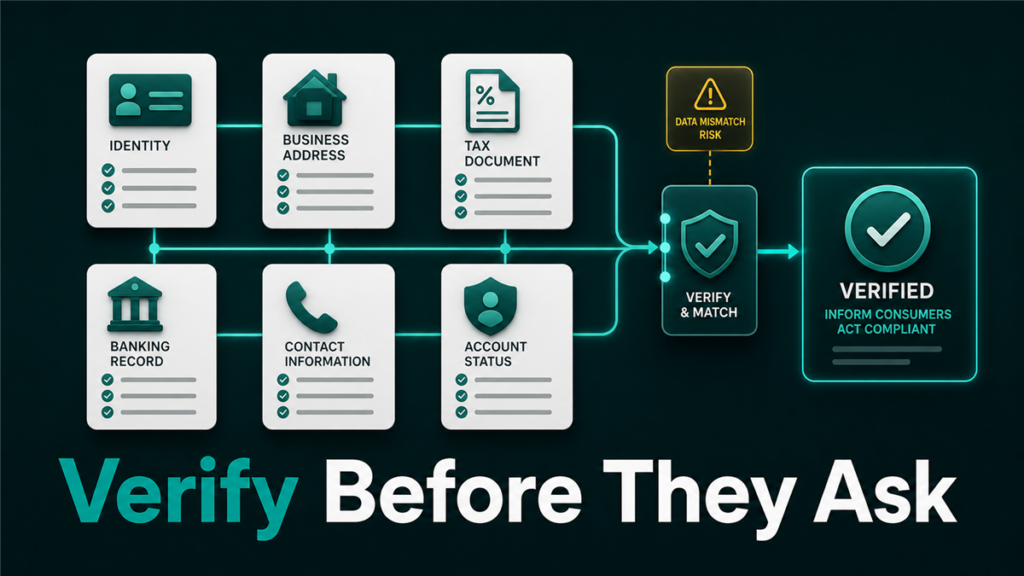
The INFORM Consumers Act is a US federal law that requires online marketplaces to collect and verify identity, tax, and contact information from sellers. Amazon enforces this through its seller verification process. If your information is inconsistent, expired, or incomplete, Amazon may restrict your selling privileges or hold disbursements until verification is resolved.
Key Takeaways
- The INFORM Act requires Amazon to collect verified identity, business, tax, and banking information from sellers.
- Amazon surfaces verification status and outstanding items in Account Health and Account Information.
- Inconsistent information across documents (name, address, entity) is the most common cause of verification failures.
- Disbursement holds and selling restrictions can occur when required verification is not completed.
- Annual re-verification means sellers must keep documents current, not just pass once.
What the INFORM Consumers Act Requires
The law, formally the Integrity, Notification, and Fairness in Online Retail Marketplaces for Consumers Act, took effect in June 2023. It requires marketplaces like Amazon, Walmart, and eBay to:
- Collect verified identity and business information from high-volume sellers
- Verify that information periodically (at least annually)
- Display certain seller details to consumers for transparency
- Suspend or restrict sellers who do not complete verification
The law targets fraud prevention: anonymous sellers who create disposable accounts to sell counterfeit, stolen, or unsafe products.
Who Is Affected
Amazon applies verification broadly. The law specifically defines high-volume sellers as those generating $5,000 or more in annual gross revenue. In practice, this covers nearly every active professional seller on the platform.
Amazon may also request verification from sellers below that threshold when account signals trigger additional checks.
What Information Amazon Collects
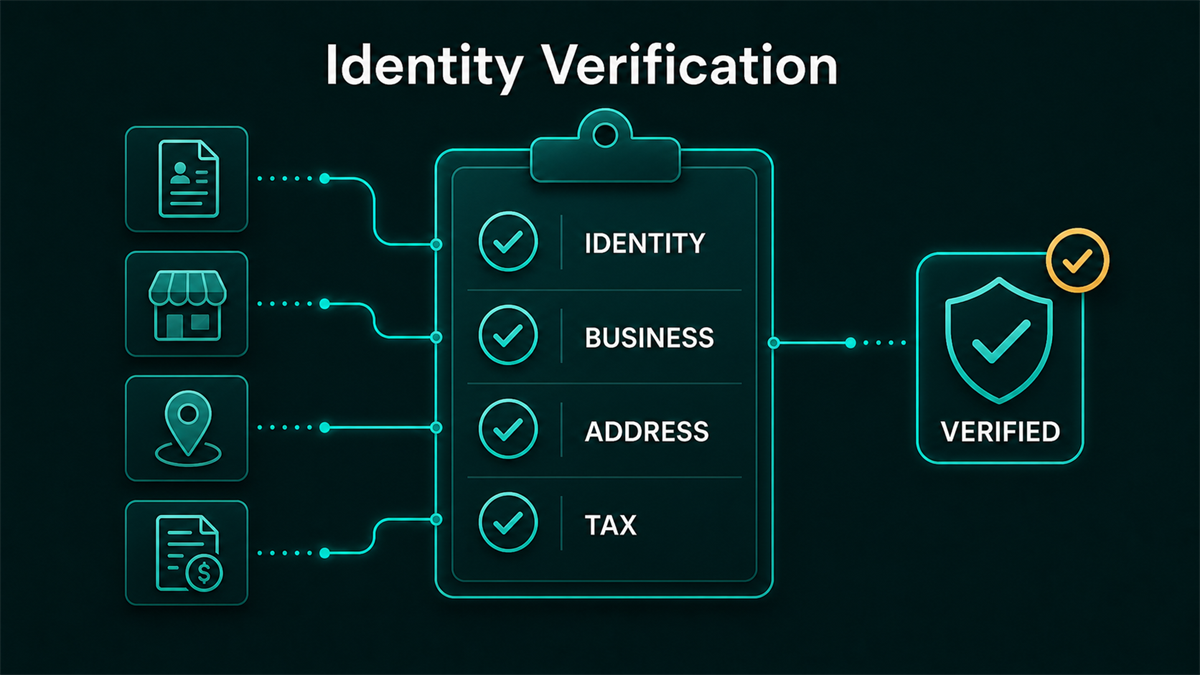
Amazon collects several categories of information as part of INFORM compliance:
- Legal name or business name: Must match across your government-issued ID, tax documents, and Seller Central profile.
- Government-issued identification: Valid, unexpired photo ID for the account holder or authorized representative.
- Business address: A verifiable physical address. Amazon may verify through utility bills, bank statements, or mailed verification codes.
- Tax identification number: EIN for businesses or SSN/ITIN for individuals, matching official tax registrations.
- Bank account information: The account linked to disbursements, with the name matching your legal entity.
- Contact information: Working phone number and email address.
The critical requirement across all these categories is consistency. The legal name, address, and entity type must match across every document and field.
Where to Check Your Verification Status
Amazon surfaces verification requirements in two places:
- Account Health Dashboard: Shows compliance status and any outstanding verification actions.
- Account Information (Settings): Contains Business Information and Business Verification sections where you can view submitted documents and update details.
If Amazon requires action, a banner or notification typically appears in Seller Central prompting you to review your verification status.
Why Verification Fails
Most failures are operational, not intentional:
- Name mismatch: The name on your ID uses a middle name or spelling that does not exactly match your Seller Central profile.
- Address inconsistency: Your registered address changed, but Seller Central still shows the old one.
- Expired documents: Your government ID expired and was not renewed in Seller Central.
- Bank account under a different name: The disbursement account is under a personal name while the seller account is registered to an LLC, or vice versa.
- Poor document quality: Blurry photos, cropped images, or files that appear digitally altered.
- Entity structure changes: You converted from a sole proprietorship to an LLC but did not update all corresponding fields.
What Happens When Verification Is Not Completed
Amazon may take escalating actions:
- Notification banners and emails requesting updated information.
- Temporary listing deactivation while verification is pending.
- Disbursement holds until verification is resolved.
- Account-level deactivation in severe or prolonged non-compliance cases.
The timeline and severity vary. Amazon does not publish a fixed schedule for escalation, so responding promptly to any verification notice is the safest approach.
How to Resolve a Verification Issue
If your account is restricted or disbursements are held due to INFORM verification:
- Open Account Information in Seller Central and review every field under Business Information.
- Compare the legal name, address, and entity type across your ID, tax documents, bank account, and Seller Central profile.
- Fix any mismatches. Even small differences (abbreviations, middle names, suite numbers) can cause rejection.
- Upload fresh, clear copies of documents. Use originals, not screenshots of PDFs.
- If Amazon sent a verification code by mail, enter it promptly.
- If phone verification is requested, ensure the number in your account is current and accessible.
After submitting corrections, allow processing time. If the issue persists, check the specific rejection reason in your Performance Notifications.
Staying Compliant Long-Term
Verification is not a one-time event. Amazon re-verifies at least annually, and any account change can trigger additional checks.
Ongoing compliance habits:
- Update Seller Central immediately when your address, phone, bank account, or entity structure changes.
- Renew government IDs before expiration and upload the new version proactively.
- Keep a consistent legal name and address across tax filings, bank accounts, and Amazon.
- Avoid using VPNs or logging in from locations that conflict with your registered business address.
- Complete re-verification requests early rather than waiting for escalation warnings.
FAQ
Does the INFORM Act apply to sellers outside the United States?
The law applies to high-volume sellers on US marketplaces regardless of their location. International sellers on Amazon.com must complete the same verification process.
What is the $20,000 disclosure threshold?
Sellers generating $20,000 or more annually may have certain business information (name, address) disclosed to consumers on their storefront. Amazon handles this display requirement as part of its compliance, but sellers should be aware their details may become publicly visible.
Can I use a PO Box as my business address?
Amazon generally requires a verifiable physical address. PO Boxes may not satisfy the verification requirement. If you operate from a home address and have privacy concerns, consult with an accountant or legal advisor about registered agent services.
What if Amazon rejects my documents but everything is correct?
Re-read the rejection reason carefully. Common issues include minor name/address formatting differences that look correct to you but do not match exactly. If you believe the rejection is in error, submit a case through Seller Support with a clear explanation and fresh document copies.
Does this affect Amazon Handmade or Merch sellers?
The INFORM Act applies across Amazon's third-party seller programs. The specific verification requirements may vary, but the core identity and business information collection applies broadly.
When to Get Help
If verification keeps failing despite multiple correction attempts, or if your disbursements are held and you cannot identify the mismatch, an operations partner familiar with Amazon's verification process can review your document set, identify inconsistencies, and prepare a clean submission.