Amazon Subscribe & Save can help eligible sellers build repeat purchases, but it also creates a recurring inventory promise. Sellers need to manage eligibility, discounts, FBA stock, and replenishment timing carefully so subscription demand does not turn into stockout pressure.
Key Takeaways
- Subscribe & Save is designed for recurring customer deliveries and discounts.
- Amazon says brand enrollment, Brand Representative access, and product eligibility matter.
- FBA products may be auto-enrolled at a 0% seller-funded discount when eligible.
- Sellers can fund additional discounts, but margin must be checked before increasing them.
- Inventory availability is one of the most important operational controls for subscription products.
What Is Amazon Subscribe & Save?
Subscribe & Save lets Amazon customers set recurring deliveries on a schedule of weeks or months. For sellers, the program can support repeat purchases and brand loyalty when the product naturally fits replenishment behavior.
Good candidates often include:
- Consumables.
- Household products.
- Personal care products.
- Pet supplies.
- Supplements, where compliant.
- Office or business replenishment items.
Poor candidates often include products with irregular demand, one-time use, unstable supply, weak margin, or frequent listing interruptions.
Eligibility And Setup Basics
Amazon's Subscribe & Save page says products need to be part of a brand enrolled in Brand Registry, and the seller needs to be a Brand Representative. Amazon also states that products are eligible based on factors such as category, average selling price, sales performance, fulfillment history, and in-stock rate.
For operations planning, check:
- Brand Registry and role access.
- Product category fit.
- FBA status or direct-fulfillment request path.
- Average selling price and margin.
- Sales performance.
- Fulfillment and in-stock history.
- Product-level compliance and listing stability.
Do not treat enrollment as the final step. Enrollment is the start of an ongoing replenishment workflow.
Discount Planning
Amazon notes that eligible FBA products may be enrolled at a 0% seller-funded discount, with Amazon funding a 5% discount on orders of five or more items. Sellers can fund additional discounts, commonly 5% or 10%, depending on the current program options.
Before increasing the seller-funded discount, calculate:
- Current selling price.
- Referral and FBA fees.
- Product landed cost.
- Inbound and prep cost.
- Expected return or damage allowance.
- Subscription discount.
- Any coupon, promotion, or ad support.
- Required contribution margin.
Do not fund a larger discount just because competitors do. The discount should fit your margin and repeat-purchase strategy.
Inventory Controls For Subscribe & Save
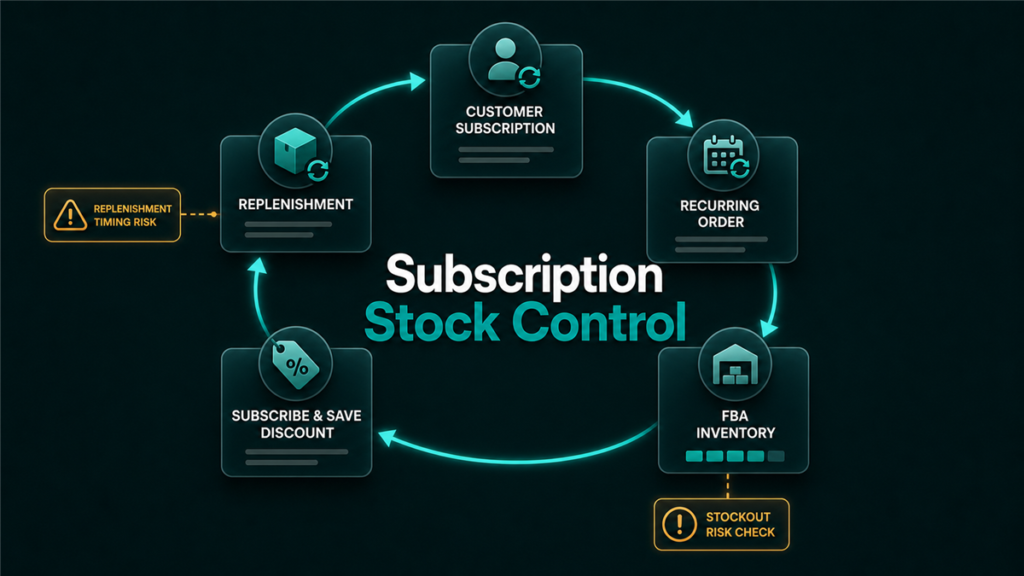
Inventory is the center of the Subscribe & Save operation. A subscription product creates expected repeat demand, which means sellers need earlier replenishment signals than they use for normal one-time purchases.
Track:
| Control | Why It Matters |
| Subscriber demand | Shows recurring order pressure |
| FBA sellable units | Determines current availability |
| Inbound units | Shows what is already on the way |
| Supplier lead time | Prevents late replenishment |
| Seasonality | Helps avoid under-ordering before demand spikes |
| Promotion overlap | Prevents demand spikes that drain stock |
| Listing health | Keeps subscribers pointed to a stable detail page |
If inventory is low, Amazon recommends monitoring from the Subscribe & Save page and sending additional inventory when needed.
Subscribe & Save Operating Rhythm
Use a simple weekly rhythm:
- Review enrolled ASINs.
- Check inventory and inbound status.
- Review discount settings.
- Check whether coupons or promotions overlap.
- Review subscriber-related demand.
- Flag ASINs with stockout risk.
- Plan replenishment before the next demand spike.
- Document any listing, compliance, or supply-chain issues.
This keeps Subscribe & Save from becoming a passive setting nobody owns.
Mini-Scenario
A brand enrolls a replenishable household product and increases the seller-funded discount to drive more subscribers. Orders increase, but the team does not adjust the replenishment plan. FBA stock drops faster than expected, and the seller has to choose between emergency replenishment and going out of stock.
A better setup would connect discount changes to inventory coverage. Before increasing the discount, the team checks margin, subscriber demand, inbound stock, supplier lead time, and promotion calendar.
FAQ
Do sellers need Brand Registry for Subscribe & Save?
Amazon's Subscribe & Save page says products need to be part of a brand enrolled in Brand Registry, and the seller needs to be a Brand Representative. Verify current eligibility before publishing or enrolling.
Does Subscribe & Save require FBA?
Amazon says products must be sold through FBA to be auto-enrolled. Sellers may be able to request enrollment for directly fulfilled products through Seller Support.
Should I add a seller-funded discount?
Only if the margin supports it. Check fees, product cost, fulfillment cost, discount cost, promotions, and expected repeat value first.
What is the biggest Subscribe & Save risk?
Stockout risk. Recurring demand can drain inventory faster than expected if replenishment planning does not adjust.
Can Subscribe & Save help every product?
No. It is best for replenishable products with stable supply, healthy margin, and repeat-purchase behavior.
Treat Subscribe & Save Like A Replenishment System
Subscribe & Save is not just a conversion setting. It changes the demand pattern for eligible products and needs a weekly operating rhythm.
Qubeq helps Amazon sellers manage FBA inventory, catalog health, replenishment exceptions, and Seller Central workflows. If Subscribe & Save is active but unmanaged, the first fix is to connect discounts to inventory planning.