
If you run a catalog on Amazon and you're weighing Walmart Marketplace as a second channel, the question isn't whether Walmart has grown  it has. The real question is whether Walmart's current seller tooling, fulfillment infrastructure, and omnichannel programs are mature enough to support your specific operation without pulling your team's attention away from your Amazon business. This guide walks through what Walmart's AI listing tools actually do, where manual review is still required, how WFS compares to FBA from an operational standpoint, and what the omnichannel opportunity looks like in practice for a third-party marketplace seller.
Key Takeaways
- Walmart Marketplace AI listing tools can accelerate content creation and surface quality issues, but the output still requires seller review before publishing  especially for catalog-sensitive products.
- Walmart Fulfillment Services (WFS) offers two-day delivery badging for Walmart+ members, but eligibility requirements and geographic coverage differ from FBA; verify current program details in Seller Center before building your logistics plan around them.
- True in-store omnichannel access (Buy Online, Pick Up In Store) for third-party marketplace sellers is more limited than Walmart's general omnichannel messaging suggests; most in-store integration requires a separate supplier relationship.
- An Amazon seller's existing product catalog, UPC/GTIN coverage, and brand registry status all affect how smooth the Walmart onboarding process will be.
- Walmart and Amazon use different content standards, attribute sets, and category taxonomies; do not assume a direct listing transfer will produce clean, publishable Walmart listings.
What Do Walmart's AI Listing Tools Actually Do?
Walmart Marketplace has announced AI-powered tools in Seller Center that are designed to help sellers generate listing content, score content quality, and surface gaps in item setup. At a high level, these tools fall into a few categories: AI-generated content suggestions (titles, descriptions, key features), a Content Quality Score that rates how complete and optimized a listing is, and bulk item setup workflows that reduce manual data entry for sellers migrating from other platforms.
The Content Quality Score is the most immediately useful signal for an Amazon seller evaluating Walmart. It functions similarly to a listing completeness indicator  Walmart's system scores each item on title quality, image count, description completeness, and attribute coverage, then flags what is missing. A low score does not necessarily suppress a listing the same way Amazon suppresses an incomplete ASIN, but lower-scoring listings generally receive less visibility in Walmart's search algorithm.
The AI content generation tools are more useful as a starting point than as a final output. They can draft a title or a short product description from basic product data, which reduces time-to-listing for a large catalog migration. An Amazon seller moving 500 SKUs to Walmart should not expect those suggestions to pass without review. Walmart's category taxonomy, attribute requirements, and prohibited content rules differ from Amazon's, and AI-generated copy trained on general data will not automatically account for product-type-specific requirements or your brand's terminology standards.
Where manual review is still required:
- Any category with regulated attributes (food, supplements, electronics, baby products) needs attribute-level review against Walmart's current item spec for that category.
- AI-suggested titles may default to generic structures that do not match your brand's established naming conventions or SEO strategy.
- Key features (the bullet equivalent on Walmart) generated by AI tend to be descriptive but not differentiated; a seller with strong conversion copy on Amazon should rewrite these rather than accept the AI draft.
- Image requirements differ: Walmart has specific main image rules, swatch image standards for variation items, and lifestyle image guidance. The AI tools do not generate images; they only flag missing image slots.
Verify the current state of these tools in Walmart Seller Center before publishing, as Walmart has been rolling out capabilities announced at the Walmart Marketplace Seller Summit in phases.
How Does WFS Compare to FBA for an Amazon-First Seller?
Walmart Fulfillment Services is Walmart's first-party logistics program for Marketplace sellers. When you use WFS, Walmart stores your inventory in its fulfillment network and ships orders on your behalf  structurally similar to FBA. WFS-enrolled items are eligible for two-day delivery badging for Walmart+ members, which affects search ranking and conversion in Walmart's algorithm in ways that parallel FBA's Buy Box influence on Amazon.
For an Amazon FBA seller evaluating WFS, the operational comparison matters:
Inventory split vs. single send: Unlike some third-party fulfillment options, WFS requires you to send inventory specifically to Walmart's network. You cannot use your FBA inventory to fulfill Walmart orders (the FBA export program does not extend to Walmart). This means WFS requires a separate inventory pool and a separate replenishment plan.
Inbound requirements: WFS has its own inbound shipment requirements  labeling, carton content data, and booking processes that are distinct from Amazon's Send to Amazon workflow. An operations team that runs clean FBA inbound shipments will find the concepts familiar but the execution is different enough to warrant a dedicated setup review.
Fee structure: WFS charges fulfillment fees based on item weight and dimensions, similar in structure to FBA, but with different rate tiers. Verify current WFS fee rates in Seller Center before building your unit economics model; fee structures have changed as the program has scaled.
Category and size eligibility: Not all product categories and size tiers are currently eligible for WFS. Oversized, hazmat, and certain regulated categories may face different handling or may not be eligible at all. Check current eligibility before assuming your full catalog qualifies.
WFS vs. self-fulfilled DSV (Drop Ship Vendor) and seller-fulfilled: Walmart also allows seller-fulfilled orders (similar to Merchant Fulfilled on Amazon) and, for some sellers, a DSV relationship with Walmart's own supply chain. These are distinct programs with different eligibility paths. For a Marketplace seller new to Walmart, WFS is typically the fastest path to delivery-speed parity, but it requires a working capital commitment to the separate inventory pool.
Walmart has announced expansion of its WFS network and delivery capabilities, including GoLocal last-mile delivery partnerships. Verify the current geographic coverage and delivery speed commitments before building those claims into your customer-facing operations plan.
What Does the Omnichannel Opportunity Actually Mean for a Third-Party Seller?
Walmart's omnichannel story  over 4,600 US stores, Walmart+, curbside pickup, and a growing digital customer base  is genuinely differentiated from Amazon's position. The practical question for a third-party Marketplace seller is how much of that omnichannel footprint you actually access through a Marketplace account.
The honest answer is: less than Walmart's general marketing language implies.
What a Marketplace seller does get:
- Your products listed on Walmart.com, accessible to online shoppers.
- WFS-enrolled items eligible for Walmart+ two-day or next-day delivery benefits.
- Potential inclusion in Walmart's promotional programs (sponsored products, Walmart Connect advertising).
- Access to Walmart Luminate data tools (verify current seller eligibility and tier requirements).
What typically requires a separate supplier relationship:
- Physical shelf placement in Walmart stores  this is a Walmart buyer/supplier decision, not a Marketplace listing decision.
- Buy Online, Pick Up In Store (BOPIS) fulfillment from store inventory  this uses Walmart's own store inventory, not your Marketplace/WFS stock.
- Walmart's own private label and supplier development programs.
An Amazon seller should not assume that a Walmart Marketplace listing automatically makes their product available for in-store pickup or physically present in stores. The omnichannel value for a Marketplace seller is real, but it comes from Walmart's online customer base and delivery infrastructure  not from store shelf access.
If in-store presence is the goal, that requires a separate Walmart supplier conversation, which is a different process from Marketplace onboarding.
Walmart Marketplace Readiness Checklist for Amazon-First Sellers
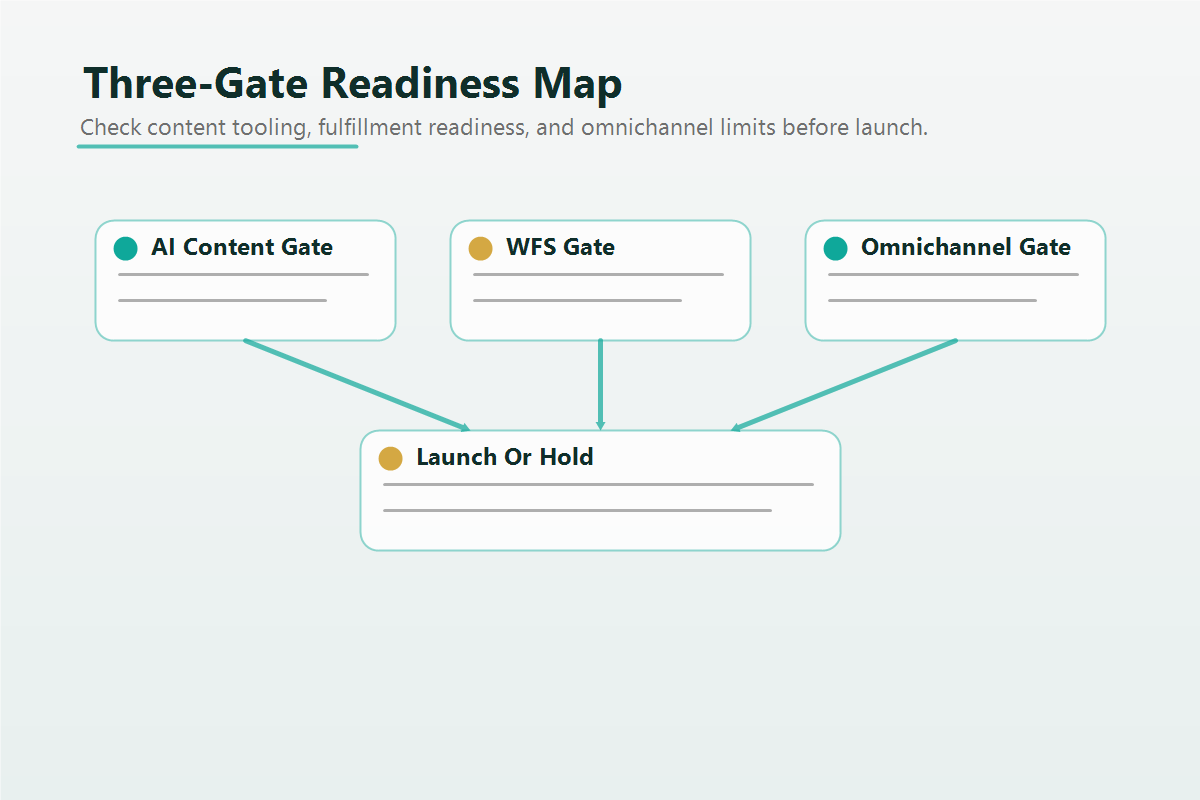
Before committing resources to a Walmart launch, work through this checklist. It is designed to surface the operational questions that matter before you invest in catalog migration and inventory.
Catalog and content readiness:
- Do all your products have valid UPCs or GTINs? Walmart requires product identifiers that match its catalog; invalid or inconsistent GTINs create item setup errors at the same level they do on Amazon.
- Do your product titles, descriptions, and images meet Walmart's current content standards? Run a sample of 10 to 20 SKUs through the Walmart item setup process before committing to a full catalog migration.
- Are any of your products in restricted or regulated categories on Walmart? Review Walmart's prohibited items list and category-specific requirements before onboarding.
- Does your catalog have parent-child variation structures that will need to be rebuilt for Walmart's variation grouping rules? Walmart handles variation items differently from Amazon's parent-child ASIN model.
Fulfillment and logistics readiness:
- Can you support a separate inventory pool for WFS without stretching your existing FBA replenishment? Model the working capital requirement before assuming WFS is viable at your current inventory level.
- Have you reviewed WFS fee rates against your unit economics? Run the numbers on your top 20 SKUs at current WFS rates before generalizing.
- Are your products within WFS size and weight eligibility? Check current program limits in Seller Center.
Business and operational readiness:
- Does your team have bandwidth to manage a second marketplace without degrading your Amazon operations? A clean Amazon catalog and healthy account health should be stable before you add Walmart complexity.
- Do you have a customer service workflow that can handle Walmart-specific order inquiries? Walmart has its own seller performance metrics and customer service response time requirements.
- Have you reviewed the Walmart Marketplace seller agreement and performance standards? Walmart's seller metrics (on-time shipment, cancellation rate, return rate) have their own thresholds and enforcement mechanisms distinct from Amazon's account health framework.
- Is your brand registered or do you have clear brand ownership documentation? Walmart has its own brand-related listing protections; verify current requirements for brand-protected content.
- Have you tested the Walmart Seller Center interface with a small initial SKU set before migrating your full catalog?
A Realistic Scenario: One Brand's Evaluation Process
A seven-figure Amazon seller in the home goods category completed an internal evaluation of Walmart Marketplace before deciding whether to launch. The brand had 300+ active ASINs on Amazon, ran FBA for the full catalog, and had clean parent-child variation structures maintained through regular flat file operations.
The evaluation surfaced three issues that changed the launch timeline:
First, roughly 40% of their SKUs had UPC discrepancies  variations where the GTINs on file with Amazon did not match GS1 records. These had never caused a visible problem on Amazon because the catalog was already live, but Walmart's item setup process flagged them immediately during the test batch. Resolving the GTIN issues added six weeks to the pre-launch timeline.
Second, their variation structure used Amazon's parent-child model with a primary variation attribute and two sub-attributes. Walmart's variation grouping rules for the same category only supported a single variation attribute cleanly. Rebuilding the variation structure for Walmart required a separate mapping exercise.
Third, the unit economics for WFS on their mid-range SKUs (units under a certain weight and size threshold) worked. Their larger items did not meet the WFS size eligibility criteria at the time of evaluation, which meant those products would need to be seller-fulfilled  creating a two-tier fulfillment model that added operational complexity.
The brand launched with a focused initial set of their best-performing, WFS-eligible SKUs rather than their full catalog. That narrower launch produced cleaner performance data before the broader rollout.
FAQ
Are Walmart's AI listing tools good enough to replace manual content review?
No. Walmart's AI content tools are a useful starting point for generating titles and descriptions at scale, but the output requires seller review before publishing. Category-specific attribute requirements, brand terminology standards, and Walmart's prohibited content rules are not reliably handled by the AI drafts alone. Treat the AI suggestions as a first pass, not a final output.
Can I use my existing FBA inventory to fulfill Walmart orders?
No. Walmart Fulfillment Services requires a separate inventory pool sent specifically to Walmart's fulfillment network. Amazon's FBA export program does not extend to Walmart Marketplace orders. You will need a separate inventory allocation and replenishment plan for WFS.
Does listing on Walmart Marketplace put my products in Walmart stores?
Not automatically. A Walmart Marketplace listing makes your products available on Walmart.com. Physical store placement is a separate Walmart buyer and supplier relationship. Buy Online, Pick Up In Store (BOPIS) uses Walmart's own store inventory, not your Marketplace stock. In-store access requires a separate supplier conversation.
How long does Walmart Marketplace onboarding typically take?
Onboarding timelines vary based on application review time, category approvals, and item setup complexity. Sellers with clean product identifiers and straightforward catalogs can move faster. Sellers with large catalogs, regulated categories, or complex variation structures should plan for a longer pre-launch phase. Verify current onboarding timelines and requirements at marketplace.walmart.com.
What seller performance metrics does Walmart track?
Walmart tracks on-time shipment rate, order cancellation rate, return rate, and customer satisfaction metrics. Specific thresholds and enforcement consequences differ from Amazon's Account Health Dashboard framework. Review Walmart's current seller performance standards in Seller Center before launch; performance issues on Walmart can affect listing visibility and seller standing independently of your Amazon account.
Is Walmart Marketplace worth it for a brand already doing well on Amazon?
It depends on the brand's product fit, operational capacity, and catalog readiness. Walmart's customer base and fulfillment infrastructure are genuine assets for sellers whose products align with Walmart's core shopper demographics and price points. The operational overhead of a second marketplace is real, and a poorly managed Walmart launch can pull attention from a healthy Amazon business. The readiness checklist in this guide is designed to help you make that evaluation with clear criteria rather than assumptions.
Is Your Operation Ready to Add Walmart?
Walmart Marketplace has made real infrastructure investments  in AI listing tooling, WFS capacity, and delivery speed  that make it a more credible second channel for Amazon sellers than it was several years ago. The evaluation question is not whether Walmart is growing, but whether your specific catalog, operations team, and working capital position are set up to run a second marketplace cleanly.
Running a clean Amazon catalog with stable account health, solid variation structures, and accurate product data is the foundation that makes a Walmart expansion practical rather than chaotic. If your Amazon operations have unresolved catalog issues, inconsistent GTINs, or account health problems, those need to be addressed before you add Walmart to the workload.
If your team is managing a complex Amazon catalog and starting to evaluate Walmart Marketplace as a next step, Qubeq's marketplace operations service covers the catalog work, item setup, and operational groundwork that makes a Walmart launch run cleanly. You can also contact us to discuss your specific situation before committing to a launch timeline.