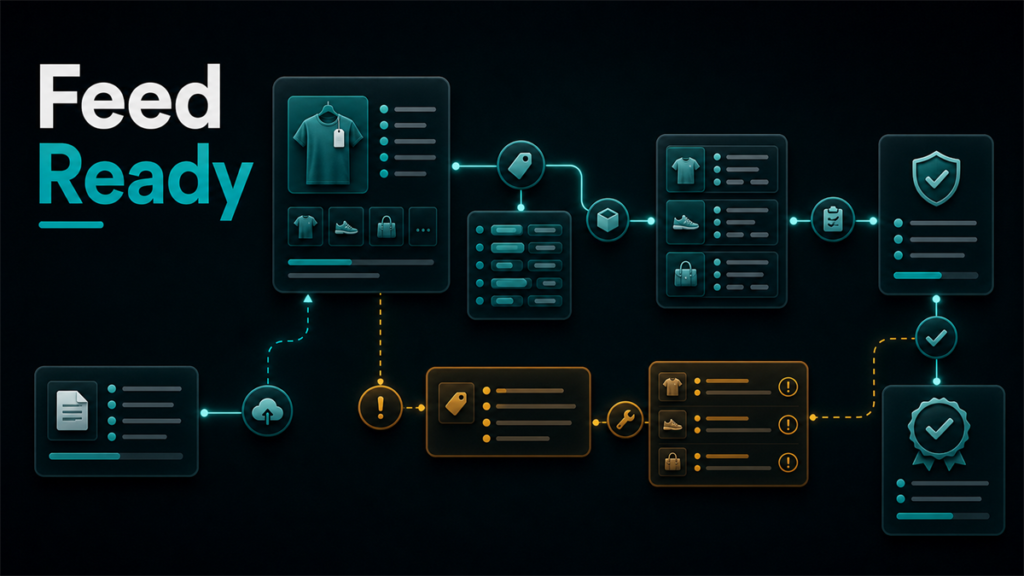
Google Merchant Center feed quality starts before ads, before bids, and before campaign structure. It starts with product data. If the titles are weak, identifiers are incomplete, variants are messy, or schema markup disagrees with the submitted feed, Merchant Center has less chance of understanding the product correctly.
Key Takeaways
- Product feed readiness is a product-data problem before it is a marketing problem.
- Required and suggested attributes help Google understand the item, match it to queries, and validate it more reliably.
- Variant grouping, product identifiers, and structured data alignment often separate clean feeds from frustrating ones.
- Schema markup on the site should support, not contradict, the feed.
- Sellers usually improve faster when they diagnose feed quality at the product-record level rather than only reacting to disapprovals.
What Feed Readiness Actually Means
Merchant Center does not just need products. It needs structured product information that is accurate enough to understand and show. Google's own help documentation frames this clearly through the product data specification, required attributes, and supported structured data guidance.
That means a "ready" feed usually has:
If those foundations are weak, campaign work becomes much less useful.
The Fields That Matter Most
1. ID and product identity
A clean ID is not glamorous, but it is foundational. If product identity drifts, everything else gets harder.
2. Title and description
Titles and descriptions need to help Google understand what the product is, not just echo internal naming habits.
3. Availability, condition, and price-linked data
These fields shape whether the listing is trustworthy and current.
4. Variant grouping
If variants exist, they should be grouped intentionally rather than treated like unrelated product rows. Google's structured-data and product-data guidance both reinforce that grouping logic matters.
5. Product detail and attribute depth
Feeds get stronger when the product record is rich enough to describe the product clearly, especially for complex or specification-heavy items.
Why Schema Alignment Matters
Merchant Center help explicitly connects structured data on product pages to feed quality and automatic item updates. That is important because some merchants treat the feed and the website like separate truth systems.
They should not be separate.
If the site says one thing and the feed says another, Google has to decide which version to trust. Even when disapprovals do not happen immediately, inconsistency makes the system weaker.
The Most Common Feed Problems
Titles that are too vague
If the title does not differentiate the product well enough, the feed starts weak.
Missing or mishandled identifiers
Identifier issues are a common source of feed friction.
Variant confusion
Related products are sometimes submitted as if they are unrelated, or unrelated products are forced together loosely.
Thin attribute depth
This matters more for complex products than many merchants realize.
Website markup and feed disagreement
When the site and feed tell different stories, trust suffers.
A Better Feed-Readiness Routine
Before blaming Merchant Center, review:
- product IDs and variant structure
- title quality and description clarity
- GTIN or identifier handling
- image links and landing-page accuracy
- schema markup consistency with feed data
This process catches many avoidable issues before they grow into larger account noise.
Scenario: The Feed That Looked Complete but Stayed Unstable
A merchant had uploaded a large catalog and assumed the feed was healthy because the required columns were present. But disapprovals and quality friction kept appearing.
The deeper issue was not one missing field. It was pattern quality. Some variants were not grouped cleanly, titles were inconsistent, and structured data on the site still reflected older information on a portion of the catalog. Merchant Center was reacting to a system that looked complete in spreadsheet terms but not in product-data terms.
Once the merchant cleaned the core product record and aligned the site markup more carefully, the feed became easier to maintain.
FAQ
What is the most important part of a Merchant Center feed?
The product data itself. A clean product record improves everything else downstream.
Do variants matter in Merchant Center?
Yes. Grouping related products correctly helps Google understand the product family.
Should my website schema match my feed?
Yes. Merchant Center guidance explicitly connects structured data and feed accuracy.
Is feed readiness the same as campaign readiness?
No. Campaign work comes after the product data is strong enough.
Do all products need the same attributes?
No. Required and applicable attributes vary by product type and destination.
Stronger Feeds Start With Stronger Product Records
The most useful way to improve Merchant Center feed quality is to stop treating the feed like a disconnected marketing file. It is a structured product record. The cleaner the product identity, attributes, variants, and schema alignment are, the easier the channel becomes to trust.
If your team is juggling multiple marketplaces and the feed layer feels harder to manage than it should, Qubeq can help think through those broader other marketplace operations. If you want help finding where your product data is weakening the channel, contact us here.