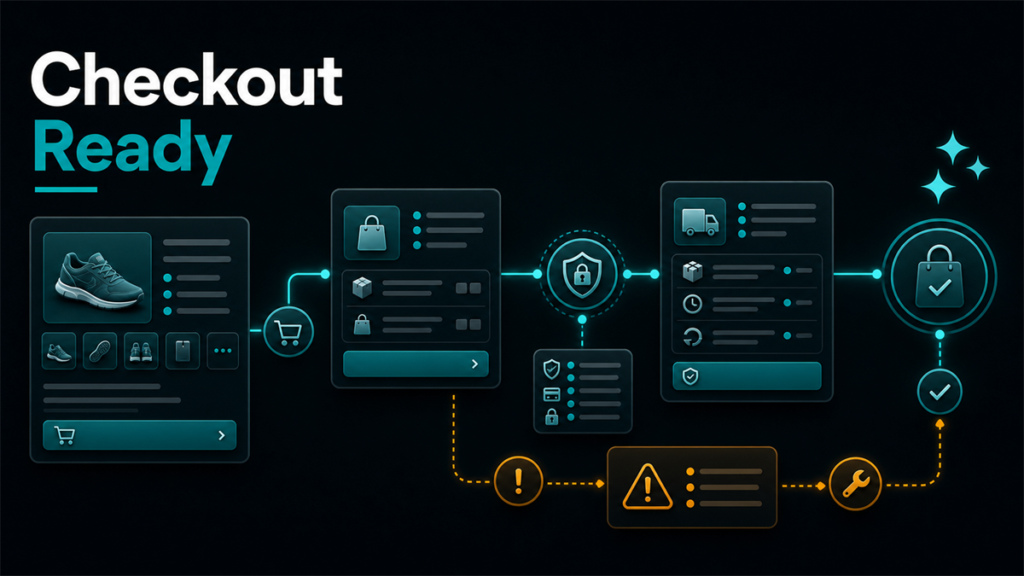
Checkout links can shorten the path from product discovery to purchase, but they also raise the quality bar on the destination path. Real google checkout link readiness means the merchant has reliable URLs, clear product pages, and a buying flow that can support a more direct path without surprising the shopper.
Freshness note: Google shopping participation depends on products being available for direct purchase through the merchant store, so checkout and discount paths should be tested against current Merchant Center requirements before related features are enabled.
Key Takeaways
- Checkout links are a conversion-path decision, not just a feed setting.
- Reliable URL structure and landing-page truth matter before the feature is enabled.
- Checkout readiness is different from general feed readiness because it focuses on the purchase path after the click.
- A direct link is only helpful when the product and cart experience are stable.
- Merchants should verify current scope and eligibility before publishing feature-specific guidance.
What Checkout-Link Readiness Means
Merchant Center help makes it clear that checkout links involve account-level and product-level setup decisions. In practical terms, that means a merchant is defining where shoppers go when a product is surfaced on supported shopping experiences.
That decision seems small, but it changes the standard:
If those pieces are loose, a direct path can create more confusion than convenience.
The Control Points Merchants Should Review
Source note: Google checkout-link availability, supported countries and destinations, URL requirements, and account-level versus product-level setup should be verified in current Google Merchant Center Help before enabling checkout links.
URL quality
The URL has to be accurate, stable, and appropriate for the product experience you want the customer to have.
Product selection
Not every product is equally suited for a more direct purchase path. Some products need more education or variant selection than others.
Landing-page truth
The linked path should match the product information the customer expects based on the shopping surface.
Operational confidence
If cart, checkout, inventory, or variant handling still feel inconsistent, a shorter path does not solve the underlying issue.
Where Merchants Usually Rush
They assume shorter always means better
A shorter route only helps when the route is trustworthy.
They enable the feature before checking product fit
Simple, high-clarity products often make better early candidates than complex or heavily configurable items.
They treat the checkout link like a feed attribute only
It is also a customer-experience decision.
A Better Go-Live Checklist
- Confirm current feature scope and eligibility in Merchant Center help.
- Review whether the destination URL is stable and product-specific.
- Start with products that have simple and reliable purchase paths.
- Make sure the landing-page and checkout experience match the surfaced product.
- Expand only after the initial setup feels trustworthy.
Scenario: The Fast Path Added Friction Instead Of Removing It
A merchant liked the idea of giving shoppers a shorter route to purchase and moved quickly. The setup was technically possible, but some products still had variant complexity and some URLs were not as straightforward as the team assumed. The direct path looked efficient in theory but felt inconsistent in practice.
The merchant got better results after choosing simpler products first and tightening the destination logic instead of forcing the feature across the catalog.
FAQ
Is checkout-link readiness the same as feed readiness?
No. Feed readiness is broader product-data quality. Checkout-link readiness is about the destination path after the click.
Should every product use a checkout link?
Not necessarily. Simpler products are often better early candidates.
Why do URLs matter so much here?
Because the feature depends on sending the customer to the right place with minimal friction.
Does a direct path guarantee better conversion?
No. It only helps when the purchase experience is already solid.
What is the biggest mistake?
Treating a shorter customer path as automatically better without reviewing the product and destination fit.
Direct Purchase Paths Only Help When The Path Is Trustworthy
Merchant Center checkout links can be useful, but only when the URL, product context, and buying flow are already clean. If your team is reviewing that work alongside broader feed and marketplace complexity, Qubeq can help with other marketplace operations. If you want help evaluating the setup before rollout, contact us here.