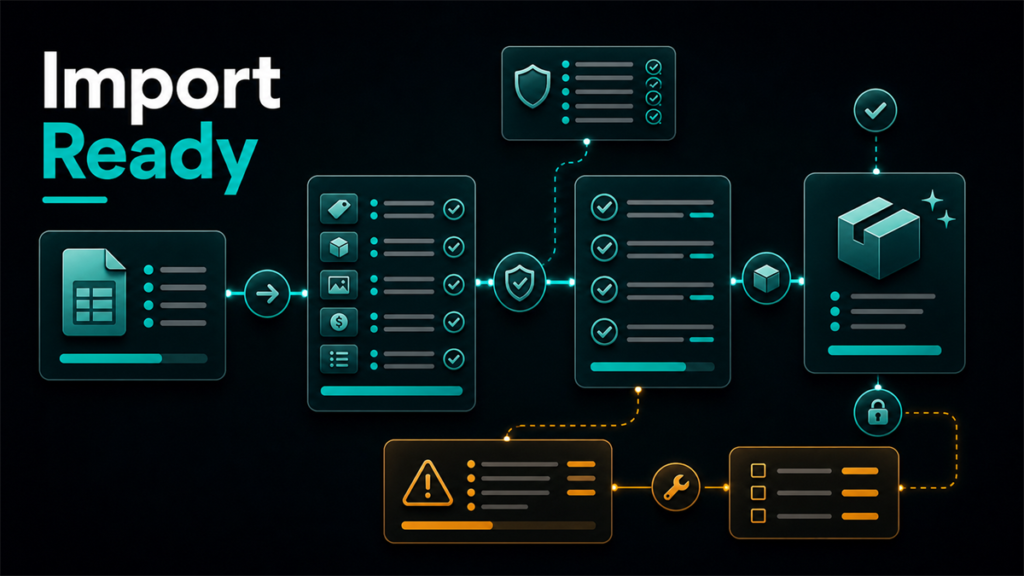
Bulk item setup on Walmart Marketplace is easier when the source data is already clean before anyone opens a template. Real walmart catalog import readiness means choosing the right import path, checking product records carefully, and treating file accuracy like an operating discipline instead of a last-minute spreadsheet task.
Freshness note: Walmart catalog setup should be checked against current Seller Center item setup, import, product ID, variant, and content policy requirements before bulk upload.
Key Takeaways
- A bulk upload is only as good as the source data behind it.
- Sellers should understand the difference between setup approaches before choosing a file path.
- Import readiness is not the same as attribute theory; it is about process quality before submission.
- Content-policy discipline still matters even when the goal is upload speed.
- A smaller controlled import is usually safer than forcing the full catalog through one pass.
What Import Readiness Actually Means
Walmart's item-setup guidance makes one point very clear: there is more than one way to get items live, and the upload path still depends on the quality of the data being submitted. A seller can think of readiness as the answer to three questions:
- Is the source data complete enough for Walmart's requirements?
- Is the chosen import path the right one for this catalog situation?
- Can the team interpret and correct issues after submission?
If any of those answers are weak, a bulk upload becomes harder to trust.
The Pre-Upload Checks That Matter Most
Source note: Walmart item setup path names, bulk-upload templates, setup-by-match availability, and content-policy requirements should be verified in the current Seller Center or current Walmart Marketplace Learn documentation before upload; do not rely only on older QuickStart PDF labels.
Source-record quality
Titles, descriptions, identifiers, images, and attribute fields should be reviewed before they are pushed into a file. The spreadsheet does not make weak data stronger.
Import-path choice
Setup by Match and other item-setup paths are useful, but the seller still needs to choose the route that matches the catalog and data reality.
Content-policy fit
Walmart content policies still apply. Upload scale does not reduce listing-quality expectations.
Error-handling readiness
The team should expect some issues and know who is responsible for fixing them. That is part of the import process, not a surprise after the fact.
The Most Common Bulk-Upload Mistakes
Treating the template like the main job
The file matters, but the bigger job is preparing the data that goes into it.
Importing too much too quickly
A giant first upload can make diagnosis harder if the underlying records are uneven.
Repeating the same source-data weakness across the catalog
One mistake in a spreadsheet workflow can become hundreds of problematic rows.
A Better Catalog-Import Routine
Scenario: The Spreadsheet Was Fast but The Data Was Loose
A seller wanted to move a large catalog onto Walmart Marketplace quickly and focused on completing the upload template as fast as possible. The team succeeded in filling the file, but many source records had inconsistent detail and some product records were not cleanly prepared for the chosen setup path.
The issue was not effort. It was sequence. Once the seller cleaned the source records and treated the first upload as a controlled test instead of a full-catalog sprint, the process became much more manageable.
FAQ
Is catalog import readiness mainly about the spreadsheet template?
No. It is mostly about the quality of the product data before the file is submitted.
Should sellers upload the full catalog first?
Usually no. A smaller initial batch makes troubleshooting easier.
Does bulk upload reduce Walmart's content expectations?
No. Scale does not lower the standard for content quality.
Is this the same as Walmart attribute strategy?
No. This page is import-process focused, while attribute strategy is a separate topic.
What is the biggest readiness mistake?
Using the file as a shortcut around weak source data.
Cleaner Imports Start With Cleaner Source Data
Walmart catalog imports go more smoothly when the seller prepares the underlying records first and treats upload method choice like an operating decision. If your team is managing catalog expansion across several channels, Qubeq can help you think through those other marketplace operations. If you want help reviewing the upload process before it scales, contact us here.