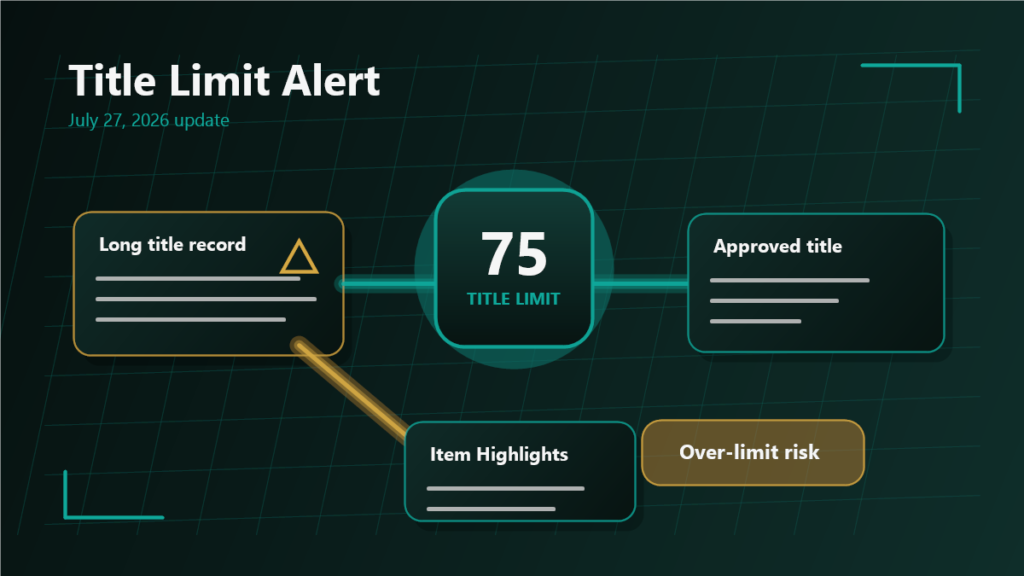
Amazon product title 75 characters is the new number sellers need to plan around. In an Amazon Services email sent on June 10, 2026, Amazon told sellers that starting July 27, 2026, product titles in all categories except media must be 75 characters or less, including spaces.
This is not described as a listing shutdown notice. The email says listings will stay active during the process, but titles that remain over the limit after July 27 may be gradually updated to Amazon's AI recommendations.
Key Takeaways
- Amazon notified sellers by email on June 10, 2026, about a July 27, 2026 product title update.
- Starting July 27, titles in all categories except media must be 75 characters or less, including spaces.
- Item Highlights gives sellers an additional 125 characters for materials, recommended use cases, and other helpful details.
- Sellers can review AI-recommended titles and Item Highlights inside Seller Central through Manage All Inventory, Edit, and View enhancements.
- Brand owners get 14 days before implementation to review, modify, and approve AI-generated recommendations in Review Listings Changes.
What Amazon Announced
Amazon announced that most product titles need to become shorter. The source for this article is an Amazon Services seller notification email dated June 10, 2026, with the subject line "Updates to improve your product titles begin on July 27."
According to the email, Amazon wants product titles to display better on mobile and align more closely with title lengths used by other online stores. The new limit applies to all categories except media.
The important operational point is simple: sellers should review long product titles now instead of waiting for Amazon to update them after the deadline.
What Changes on July 27, 2026
Starting July 27, 2026, Amazon says product titles in all non-media categories must be 75 characters or less, including spaces.
That means sellers need to count every character, not just words. Spaces count. Brand names count. Size, color, pack count, compatibility, material, and model numbers all count.
For many listings, 75 characters is enough if the title is clean. For older listings with keyword-stuffed titles, long compatibility strings, repeated attributes, or overly broad use cases, the new limit will force a real cleanup.
A stronger title under the new limit should usually answer four questions quickly:
- What is the product?
- What is the brand?
- What key variant or size matters?
- What detail must the buyer know before clicking?
Everything else should be moved into the right supporting field when possible.
What Item Highlights Are and Why They Matter
Amazon's email points sellers to Item Highlights as the place to move useful details that do not fit cleanly inside the 75-character title.
Item Highlights provide an additional 125 characters for information such as materials or recommended use cases. Amazon says Item Highlights are searchable and visible below titles in search results and on product detail pages.
That makes Item Highlights more than a cosmetic field. They can help preserve helpful buyer-facing information without forcing every detail into the title.
For example, a long title may currently include material, audience, use case, gift angle, compatibility, and pack count. Under the new limit, the title should carry the most important product identity details. Item Highlights can carry secondary context that still helps shoppers understand the item.
What Happens to Titles Over 75 Characters
Amazon says that after July 27, titles still over 75 characters will be gradually updated to the AI recommendation.
Two guardrails matter here.
First, Amazon says listings stay active during the process. Sellers should treat the email as a title-update notice based on the evidence available.
Second, the updates are described as gradual. That means sellers should not assume every over-limit title will change exactly on July 27. The safer interpretation is that July 27 starts the enforcement/update window, and Amazon will then begin moving over-limit titles toward its AI recommendations over time.
The risk is not only that Amazon shortens a title. The risk is that the AI version may not preserve the seller's preferred phrasing, product hierarchy, or conversion logic. Sellers who care about their title structure should review and edit before Amazon does it for them.
How Brand Owners Should Handle AI Recommendations
Brand owners get an additional review path. Amazon's email says brand owners will have 14 days before implementation to review, modify, and approve AI-generated recommendations in Review Listings Changes.
That window matters because brand owners usually have stronger catalog authority and a larger responsibility to protect brand presentation. If Amazon recommends a title that is technically shorter but not ideal for conversion, brand owners should not wait until the deadline passes.
The workflow sellers should check is:
- Go to Seller Central.
- Open Manage All Inventory.
- Select Edit from the listing drop-down.
- Click View enhancements on the left side.
- Review AI-recommended titles and Item Highlights.
- For brand-owner recommendations, check Review Listings Changes where applicable.
Sellers should treat AI recommendations as a draft, not automatically as the best final answer. The recommendation may be useful, but the seller still needs to check accuracy, keyword priority, variant clarity, brand voice, and compliance.
What Sellers Should Do This Week
Sellers should start with a title-length audit. Export or review active listings and flag every title above 75 characters. Prioritize high-traffic ASINs, top revenue SKUs, parent-child families, listings with many variants, and listings where title wording directly affects buyer clarity.
Then divide titles into three groups:
- Clean titles already under 75 characters.
- Titles over 75 characters that can be manually shortened quickly.
- Titles that need careful rewrite because they include important compatibility, size, material, or use-case information.
Do not only cut characters. A shortened title can still be bad if it loses the product's core identity. The goal is a cleaner title plus better supporting fields.
Sellers should also prepare Item Highlights while they revise titles. If Amazon is giving the title less space and Item Highlights more visibility, the cleanup should happen together.
Practical Title Cleanup Checklist
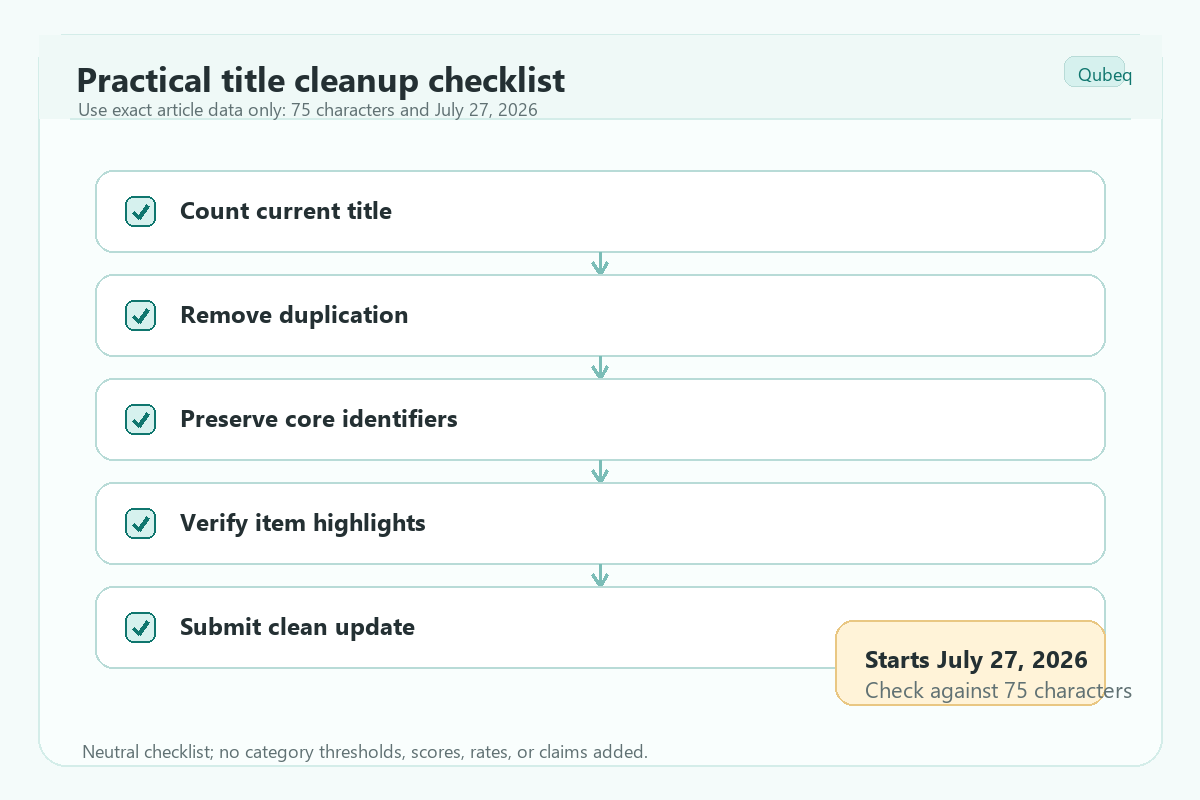
Use this checklist before July 27, 2026:
- Count title characters, including spaces.
- Flag every non-media listing over 75 characters.
- Preserve the brand name and product type.
- Keep the most decision-critical variant detail in the title.
- Remove repeated keywords, filler phrases, and unnecessary promotional language.
- Move secondary materials, use cases, and supporting details into Item Highlights where appropriate.
- Check AI-recommended titles in Seller Central.
- Compare Amazon's AI title against your preferred title.
- Review Item Highlights for clarity and search relevance.
- For brand-owned listings, monitor Review Listings Changes and act within the 14-day review window.
- Recheck parent-child families so child titles stay consistent.
- Document final title rules for your team before new listings are created.
For catalog teams, the best move is to create a short title formula by product type. That prevents every SKU from being rewritten differently.
Example formula:
Brand + Product Type + Key Variant + Size/Pack Count
The exact formula should vary by category, but the discipline should not.
Mini-Scenario: The Title That Looked Fine Until It Was Counted
A seller has a top-selling kitchen accessory with a title that reads naturally on desktop but runs 118 characters. It includes the brand, product type, material, color, size, use case, and a gift phrase.
Under the new limit, the team shortens the title to the brand, product type, material, and size. The use case and material context are rewritten into Item Highlights. The title becomes easier to scan on mobile, and the listing keeps useful secondary details in a field Amazon says is visible and searchable.
That is the right mindset: not "cut the title," but "move each detail to the field where it belongs."
FAQ
Does the Amazon 75-character title limit apply to all categories?
No. Based on Amazon's June 10, 2026 email, the 75-character title limit applies to all categories except media.
Do spaces count in the 75-character limit?
Yes. Amazon's email says the 75-character limit includes spaces.
Will listings stay active if the title is over 75 characters?
Amazon says listings stay active during the process, and over-limit titles will be gradually updated to the AI recommendation after July 27.
What are Amazon Item Highlights?
Item Highlights provide an additional 125 characters for details such as materials or recommended use cases. Amazon says they are searchable and visible below titles in search results and on product detail pages.
Where can sellers review Amazon AI recommended titles?
Amazon says sellers can go to Manage All Inventory, choose Edit from the listing drop-down, and click View enhancements on the left side. Brand owners can also review relevant AI-generated recommendations in Review Listings Changes.
Final Takeaway
Amazon's July 27, 2026 title update is a catalog cleanup deadline, not a reason to panic. Sellers should review long titles now, move secondary information into Item Highlights, and check AI recommendations before Amazon gradually updates over-limit titles.
Qubeq can help sellers review long titles, prioritize high-risk listings, and prepare clean Item Highlights before the July 27 change starts.