

Amazon A+ Content and Brand Story are enhanced listing sections available to brand-registered sellers that replace plain-text descriptions with visual, structured content. Used well, they answer buyer questions before the buyer has to ask them, which is what raises conversion. This guide covers what each section does, which modules matter, and how to avoid the mistakes that quietly hurt results.
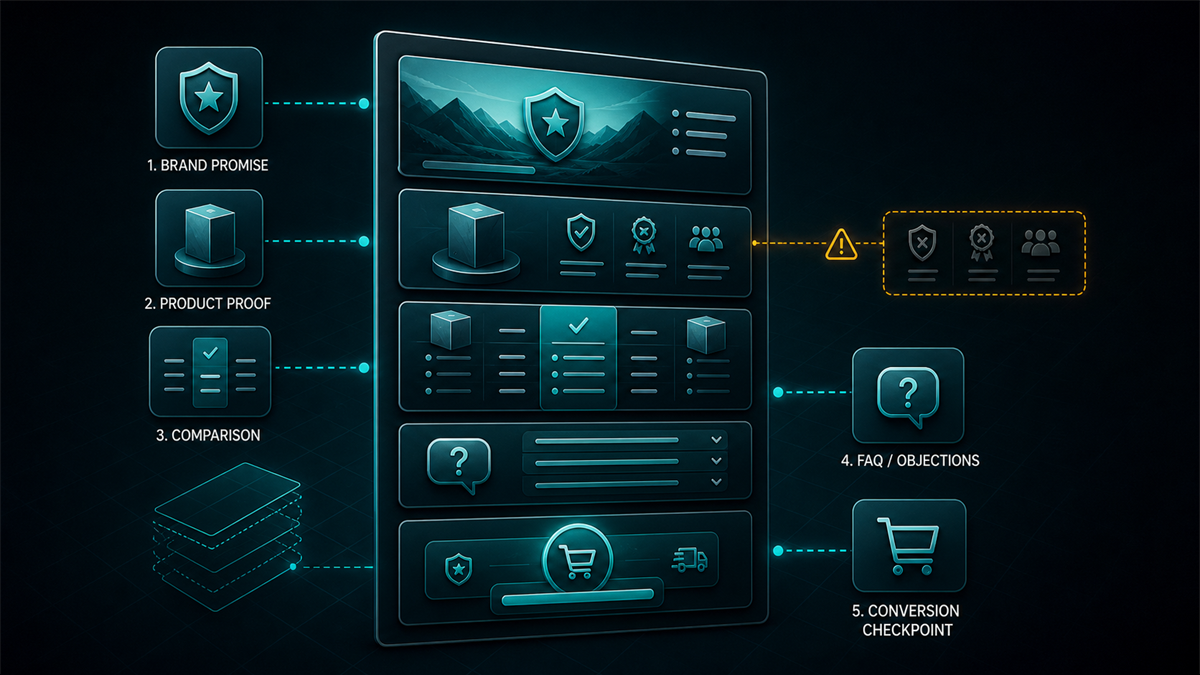
Key Takeaways
- A+ Content is the enhanced product description area; Brand Story is the brand-level section that appears above it. They do different jobs and should not duplicate each other.
- The highest-converting A+ structures answer four buyer questions: how it works, who it is for, what problem it solves, and why it beats alternatives.
- Comparison charts are the strongest cross-sell module because they keep shoppers inside your catalog instead of a competitor's.
- Most A+ failures are design failures: too much text, low-resolution images, and layouts that break on mobile.
- Measure A+ performance with conversion rate, session percentage, return rate, and cross-sell behavior before and after publishing.
What is Amazon A+ Content?
A+ Content is an enhanced product description section available to sellers enrolled in Amazon Brand Registry. Instead of a plain-text description, A+ Content supports high-quality images, comparison charts, lifestyle photography, feature modules, and brand messaging.
Its purpose is practical, not decorative: give shoppers the detail and visual proof they need to make a purchase decision without leaving the page. Typical benefits sellers see include higher conversion rates, fewer pre-purchase questions, lower return rates from clearer expectations, and stronger brand recognition across the catalog.
What is Amazon Brand Story?
Brand Story is a separate, scrollable section that appears above A+ Content on the listing. Where A+ Content sells the product, Brand Story sells the brand: company mission, values, founder background, and product collections.
Treat it as your brand's homepage inside Amazon. Its conversion role is indirect but real — it builds trust for first-time buyers and routes shoppers to other products in your catalog through collection links.
Why A+ Content matters for conversions
A+ Content converts because it removes uncertainty. Most shoppers do not buy on features alone; they buy when they believe the product solves their problem better than the alternatives.
Without A+ Content, a shopper is left wondering whether the product fits their use case, how it compares to competitors, and whether the brand is trustworthy. With A+ Content, those questions get visual answers immediately, which reduces friction at the exact point where buying decisions are made. Amazon has published conversion-lift figures for A+ Content; verify the current figure before citing a specific percentage (see Claims requiring source confirmation).
The psychology behind high-converting A+ Content
Reduce uncertainty
Answer how it works, who it is for, what problem it solves, and why it is better. The fewer open questions a shopper has, the more likely they are to buy.
Build trust
Use real product photography, clear explanations, certifications you actually hold, and brand history. Avoid exaggerated marketing language — it reads as risk, not confidence.
Sell benefits, not features
"Contains 100ml peppermint essential oil" is a specification. "Long-lasting aromatherapy that supports focus through the workday" is a reason to buy. Always connect the spec to the outcome.
Create emotional appeal
People buy emotionally and justify logically. Lifestyle imagery, use cases, and aspirational context help shoppers picture ownership.
Essential A+ Content modules
- Hero banner. The first thing shoppers see. One high-quality image, one clear value proposition, clean design.
- Problem–solution module. Name the problem the buyer recognizes, then show the product as the answer. Consistently one of the highest-converting structures.
- Feature-to-benefit section. Translate each specification into customer value:
| Feature | Benefit |
| Essential oils | Natural aromatic experience |
| Portable design | Easy to use anywhere |
| Leak-resistant cap | Prevents mess and waste |
| Compact size | Travel-friendly convenience |
- Lifestyle images. Real people, relevant environments, everyday situations. Lifestyle photography consistently outperforms product-only renders.
- Comparison chart. Cross-sell your own catalog with images, key benefits, use cases, and sizes side by side. This is the module that grows basket size.
- FAQ module. Answer the questions buyers actually ask — usage frequency, travel suitability, ingredients, lifespan — before they leave the page to ask them elsewhere.
How to create a high-converting Brand Story
Tell the origin story plainly: why the brand exists, the problem it set out to solve, and the mission. Skip corporate jargon. Showcase only values your brand genuinely operates by — sustainability, craftsmanship, wellness — because shoppers detect borrowed values quickly. Use the collection modules to link shoppers to related products, and keep colors, fonts, messaging, and photography style consistent with the rest of your listing assets.
Is Premium A+ Content worth it?
Premium A+ Content adds interactive hotspots, video, enhanced layouts, and scrollable modules. It is most valuable for high-ticket products, competitive categories, and established brands where deeper storytelling differentiates the listing. Check current eligibility requirements in Seller Central before planning Premium modules, as access criteria have changed over time.
Common A+ Content mistakes
- Too much text — keep modules scannable and visual.
- Repeating bullet points — A+ should expand on the listing, not duplicate it.
- Low-quality images — blurry graphics damage credibility faster than no graphics.
- Feature overload — lead with what buyers care about, not the full spec sheet.
- Ignoring mobile — most Amazon traffic is mobile; preview every module on a phone before publishing.
Mini-scenario: when A+ Content fixes a conversion problem
A wellness brand had strong traffic on its hero ASIN but a conversion rate below the category norm. The listing's description was a wall of text, and the most common pre-purchase question — whether the product was safe for daily use — was answered nowhere on the page. The brand rebuilt the listing with a problem–solution module, a feature-to-benefit table, and an FAQ module answering the daily-use question directly. Pre-purchase questions dropped, and conversion rate improved measurably over the following weeks without any change to traffic or price. The fix was not more content; it was answering the right question in a scannable format.
FAQ
Who can use A+ Content?
A+ Content is available to sellers enrolled in Amazon Brand Registry and to vendors. Standard A+ Content is included with Brand Registry enrollment.
What is the difference between A+ Content and Brand Story?
A+ Content is product-level enhanced description content. Brand Story is a brand-level section that appears above A+ Content and focuses on mission, values, and product collections.
Does A+ Content help SEO?
A+ Content primarily improves conversion rather than search ranking, though better conversion can support organic performance over time. Keyword indexing behavior for A+ text has varied, so treat A+ as a conversion asset first.
How do I measure whether A+ Content is working?
Compare conversion rate, session percentage, and return rate before and after publishing, and watch cross-sell behavior from comparison chart modules.
Should every product get Premium A+ Content?
No. Premium A+ is most worthwhile for high-ticket or highly competitive ASINs where richer modules meaningfully differentiate the listing.
Turn your listing content into a sales tool
A+ Content and Brand Story work when every module answers a buyer question, builds trust, or moves the shopper toward checkout. If your listings have traffic but conversion lags, the content stack is usually the first place to look. Qubeq can audit your listing content alongside the rest of your catalog setup and show where the conversion gaps are — start with a free account review.