
You enrolled the brand precisely so you would have leverage when something went wrong, yet a standard support case has gone in circles: a bad detail-page edit will not stick, someone else is claiming authority over your listing, or an infringing offer keeps reappearing. Brand owners have routes that ordinary sellers do not, but only if you use the right one and package the case so it can actually be decided. This is the brand-specific escalation playbook, not a general case-escalation guide.
Key Takeaways
- Brand owners enrolled in Brand Registry have stronger, brand-specific routes than standard seller support; the trick is matching the route to the problem.
- Content and authority problems, contribution disputes, and IP infringement are different routes with different evidence and different teams.
- Brand-owner overrides exist to make your authoritative content win on listings you own; use them before escalating a content fight as a generic case.
- IP infringement reporting is a distinct route with its own requirements; do not file genuine infringement as an ordinary support ticket.
- Package the case once, completely: brand identity, the specific listings, what you want, and the evidence that proves your authority or your rights.
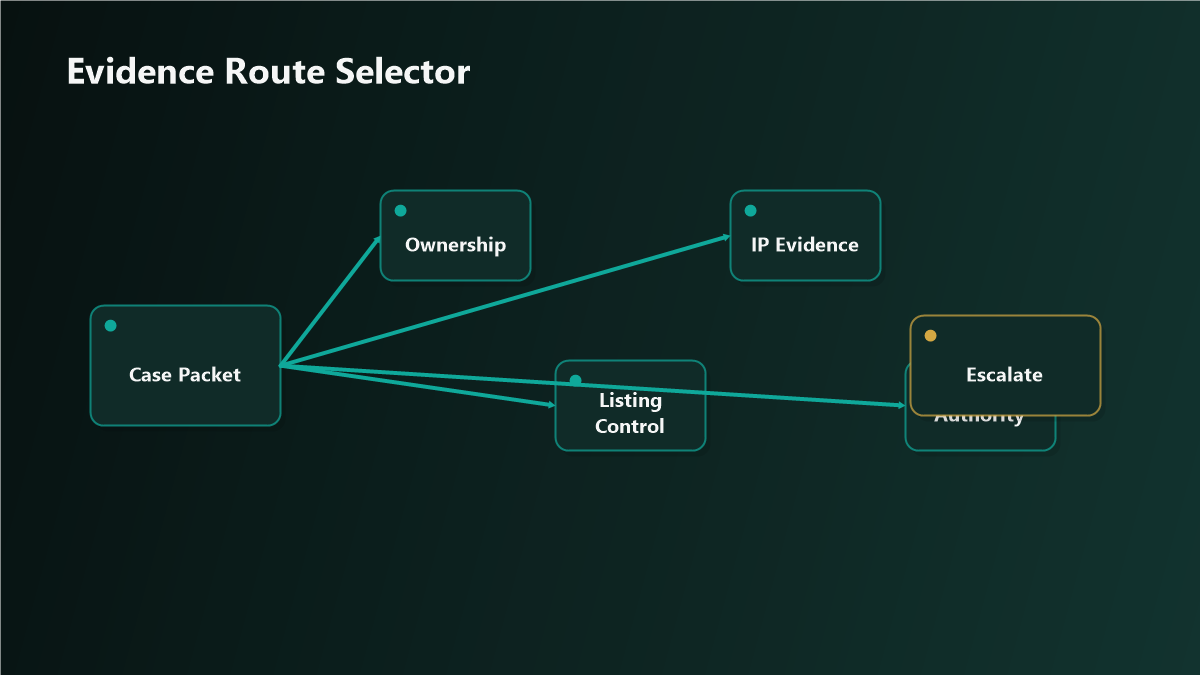
First, Classify the Problem
Brand issues route differently. Name yours before you escalate.
Filing an infringement as a content ticket, or a content fight as an IP claim, is the fastest way to get a case bounced.
Brand-Owner Overrides and Contribution Disputes
Brand Registry exists in part so the brand owner's data is treated as authoritative. When your correct content keeps getting overwritten, the first move is to assert your authoritative contribution through the brand tools, not to argue it as a generic support ticket. If a competing contribution keeps winning, that is a contribution dispute: you are establishing that your data should govern the listing. Document the listing, the incorrect state, your correct values, and your basis for authority, then use the brand route rather than reopening the same support thread repeatedly.
Authority Disputes
Sometimes the issue is not the data but the claim of control: another party asserts authority over listings that belong to your brand, or your own authority is challenged. These disputes turn on evidence of who legitimately controls the brand and the listings: your registration, your role in the brand account, and your authorization chain. Treat an authority dispute as a question of proof, not persuasion. Assemble the documentation that demonstrates legitimate control before you escalate, because the deciding team needs evidence, not assertion.
IP and Infringement Routes
Genuine intellectual-property problems, counterfeit, trademark misuse, and infringing listings, have their own dedicated reporting path with its own requirements. This route is distinct from ordinary support and is where brand enrollment does its most important work. File the specific infringing listings, identify the right of yours being infringed, and provide the evidence the route requests. Keep claims accurate and within the route's scope; over-broad or unsupported infringement reports can be rejected and can undermine your credibility on later, legitimate ones. Do not bury a real infringement inside a generic ticket where it will be triaged as a routine complaint.
How to Package a Brand Case
Whatever the route, a brand case that gets decided shares a structure. Build it once, completely:
- Brand identity: the registered brand, registration reference, and your role and authority within it.
- The specific items: exact ASINs or listings, not a vague description of "our products."
- The problem state: what is wrong now, with dated screenshots or records.
- The desired outcome: stated plainly, what you want changed and why you are entitled to it.
- The evidence: the documents proving authority, ownership, or the infringed right, attached, not promised.
- The history: prior case IDs and what was tried, so the escalation does not restart from zero.
Submit through the correct brand route and record the new case reference. Resist the urge to open multiple parallel cases on the same issue, which fragments the evidence and slows everyone.
Mini-Scenario: The Override That Ended a Two-Week Standoff
A brand owner watched a third party repeatedly overwrite their product titles and bullet points with inaccurate copy. They had spent two weeks reopening the same standard support ticket, getting a fix that reverted within days. The problem was the route, not the effort. They reframed it as a contribution dispute: they documented each affected ASIN, the incorrect values, their correct authoritative values, and their brand authority, and asserted their authoritative contribution through the brand path with that package attached. The authoritative content held, and the reverts stopped. The work was the same evidence they had always had; the difference was sending it down the brand-owner route instead of the generic one.
FAQ
How is brand case escalation different from normal Amazon support?
Brand owners enrolled in Brand Registry have brand-specific routes for content authority, contribution and authority disputes, and IP infringement that ordinary seller support does not offer. Matching the issue to the right route is what makes escalation work.
When should I use a brand-owner override versus a support ticket?
When your correct, authoritative content on a listing you own keeps getting overwritten, assert it through the brand tools first. Reopening the same generic ticket rarely makes authoritative content hold.
How do I escalate an IP infringement on Amazon?
Use the dedicated infringement reporting route rather than a standard ticket, identify the specific listings and the exact right being infringed, and attach the evidence the route requests. Keep the claim accurate and within scope.
What is a contribution or authority dispute?
A contribution dispute is about whose data governs a listing; an authority dispute is about who legitimately controls the brand's listings. Both are decided on documented evidence of legitimate control, not on argument.
What should a brand case include to get resolved?
Brand identity and registration reference, the exact ASINs, the dated problem state, the outcome you want, the evidence proving your authority or right, and the prior case history. Package it once and completely.
Send the Case Down the Right Route
Brand enrollment gives you leverage, but only when you classify the problem correctly and package it so it can be decided. If a brand issue has stalled in standard support, Qubeq can identify the correct brand route, assemble the authority or infringement evidence, and package the escalation so it lands with the team that can actually resolve it.