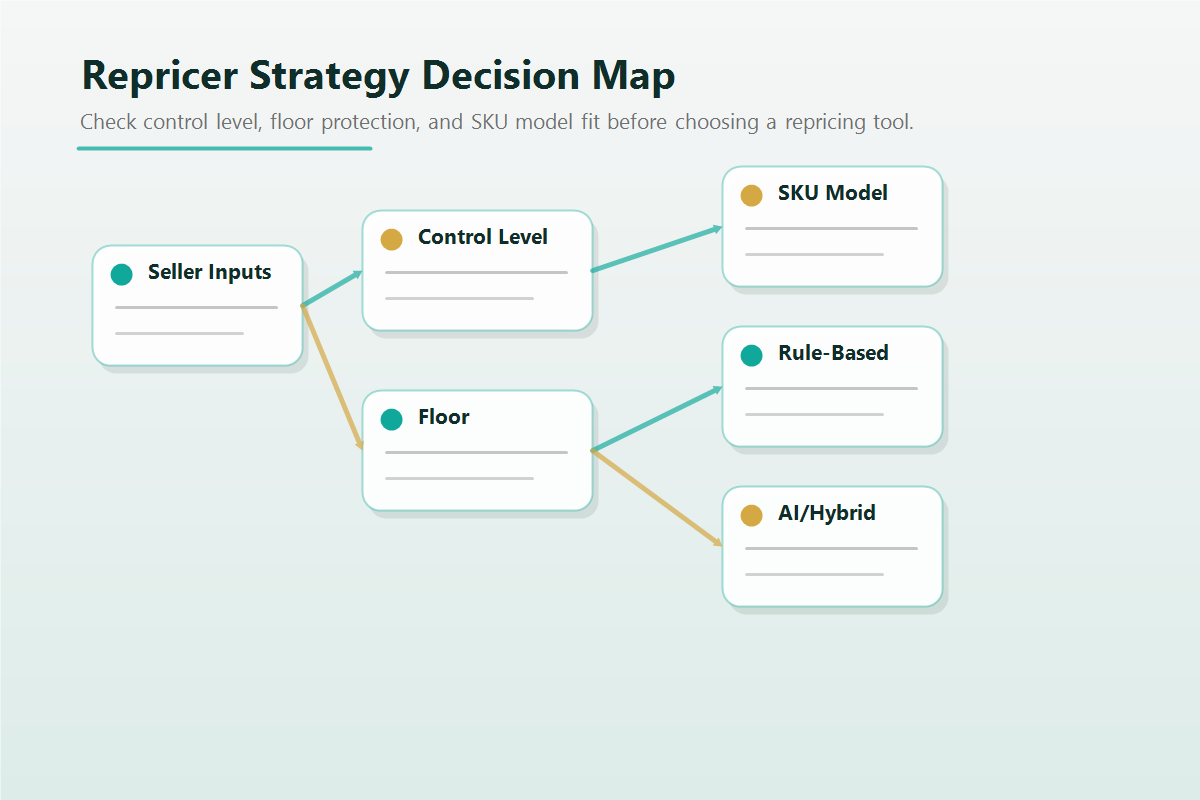
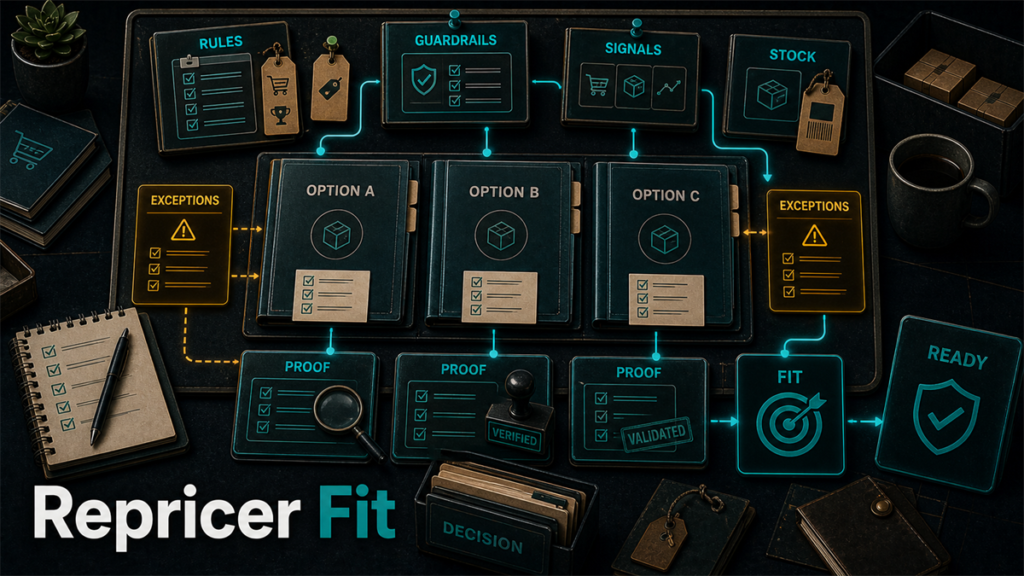
A repricer adjusts your prices automatically as the competitive landscape shifts, the goal usually being to win or hold the Buy Box (featured offer) without giving away margin you did not have to. Informed.co, BQool, and Aura are three commonly compared options, and they differ most in one dimension: how the repricing decision is made. Rule-based and algorithmic approaches suit different sellers and different selling models. This comparison helps you match the engine to your situation.
Key Takeaways
- A repricer's job is to defend the Buy Box and protect margin automatically; the right one depends on your selling model.
- The core divide is rule-based logic (you set the rules) versus algorithmic or AI-driven logic (the tool optimizes toward an outcome).
- Resellers competing for the Buy Box on shared listings have different needs than private-label sellers who own their listing.
- Decide on four axes: rule-based vs algorithmic, Buy Box strategy, reseller vs private-label use, and pricing model.
- Verify each tool's current status, features, and availability before committing; this category changes frequently.
What a Repricer Does, and Does Not
A repricer monitors competing offers and your own constraints (floor, ceiling, target margin) and changes your price within those bounds on a schedule or in near real time. On shared listings, the aim is usually to win the featured offer at the highest defensible price. On listings you own, repricing is more about responsiveness to demand and competition than out-pricing other sellers of the same ASIN.
A repricer does not set strategy or floors for you; bad floors produce a race to the bottom faster. It also does not fix a fundamentally uncompetitive cost position.
The Three, at a Category Level
Tool status, ownership, and feature sets in this category shift over time, so confirm that each tool is currently active and that its described behavior is current before relying on it.
Decision Axis 1: Rule-Based vs Algorithmic
This is the central choice.
Neither is universally superior. Control versus automation is a genuine trade-off.
Decision Axis 2: Buy Box Strategy
Define what winning means before choosing. Do you want to win the Buy Box as often as possible, or hold it only when it is profitable? Aggressive Buy Box pursuit can win share at thin margin; profit-aware strategies hold out for defensible prices. Choose a repricer whose logic can express your actual strategy, including the discipline to not win the Buy Box when it is unprofitable.
Decision Axis 3: Reseller vs Private-Label Use
Match the tool to your model. A reseller-optimized engine and a private-label-oriented approach are not interchangeable.
Decision Axis 4: Pricing Model
Repricer pricing varies by feature tier, listing count, or revenue and changes often. Evaluate how cost scales with your catalog and which tier unlocks the logic you actually need; the cheapest tier may lack the strategy controls that justify a repricer. Confirm current pricing directly.
Who Should Pick Which
Mini-Scenario: The Floor That Saved the Margin
A reseller switched from manual pricing to an aggressive Buy Box strategy and won the featured offer far more often, but profit fell. The repricer was doing exactly what it was told: win the Buy Box. The fix was not a different tool but disciplined floors and a profit-aware rule that declined to chase the Buy Box below a defensible price. Buy Box win rate went down; profit went up. The lesson cuts across all three tools: the repricer executes your strategy faithfully, so the strategy and floors matter more than the brand on the dashboard.
FAQ
What is the difference between rule-based and AI repricers?
Rule-based repricers follow explicit rules you set, offering transparency and control. Algorithmic or AI repricers optimize toward an objective using their own logic, offering less manual tuning at the cost of transparency. The choice is control versus automation.
Which repricer is best for private-label sellers?
Private-label sellers own their listings and are not competing for a shared Buy Box, so they need demand- and competition-responsive logic rather than shared-listing repricing. Confirm a tool's private-label handling before choosing; not all are built for it.
Will a repricer hurt my margins?
It can if your floors and strategy are wrong. A repricer executes faithfully, so aggressive rules without disciplined floors can erode profit. Set floors and a profit-aware strategy first.
Are Informed.co, BQool, and Aura all currently available?
Tool status in this category changes. Confirm each tool is currently active and that its features and pricing are current before relying on this comparison.
How fast do repricers update prices?
Update frequency varies by tool and plan, from scheduled to near real time. Confirm current speed and any limits with each vendor, as faster is not always better if it triggers competitor reactions.
Set the Strategy, Then the Tool
The best repricer is the one whose logic, rule-based or algorithmic, can faithfully execute a strategy and floors you have actually thought through, matched to whether you resell or own your listings. If you want help defining the strategy and choosing the engine to run it, Qubeq can review your catalog and competitive position and recommend the fit.