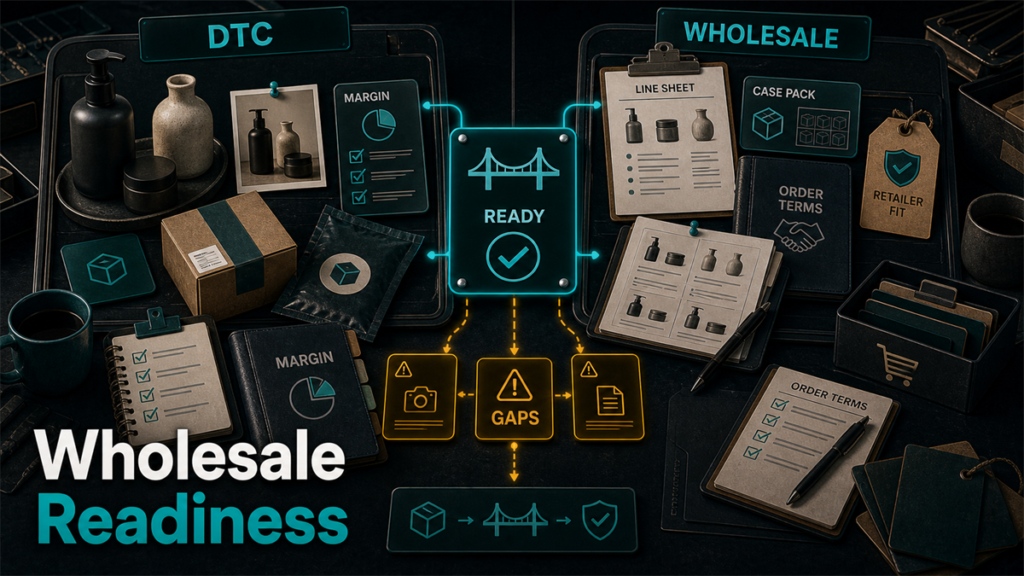
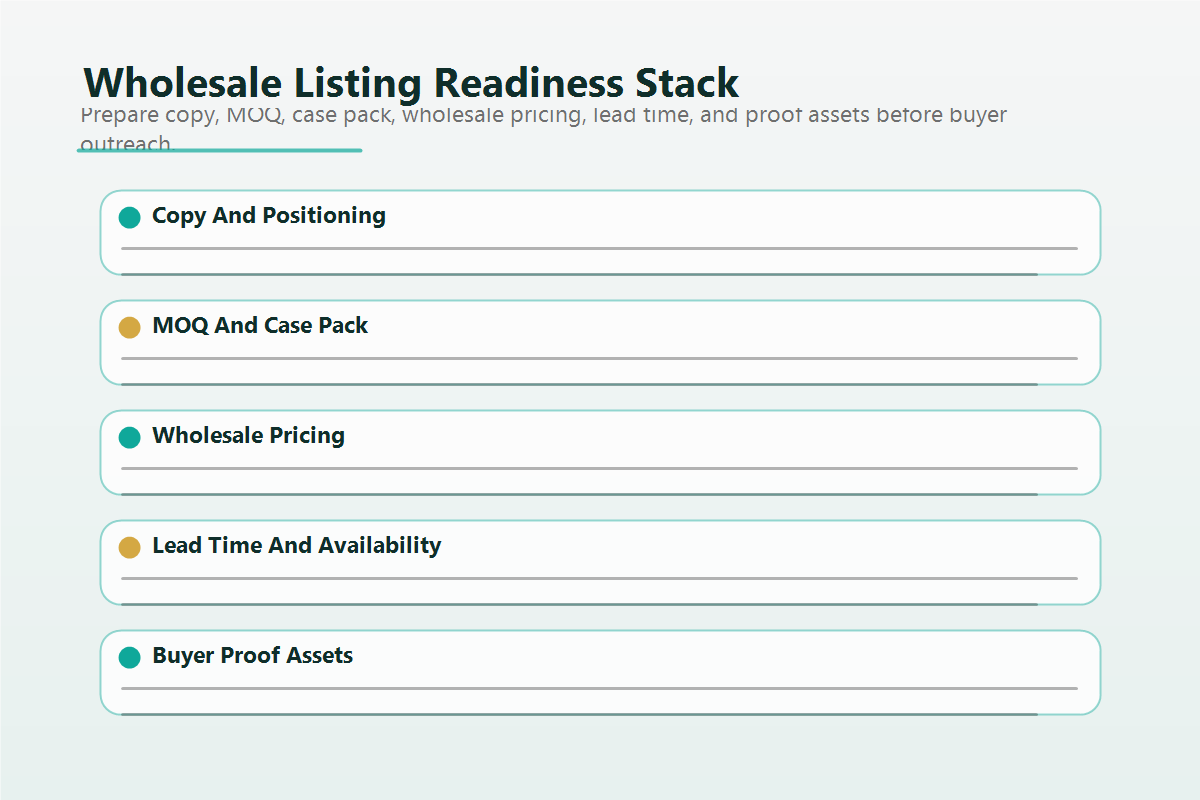
Preparing a faire wholesale listing is not the same job as writing an Amazon product page or a DTC website description. Retail buyers  the store owners and purchasing managers who browse Faire  read your listings with a different set of questions, and if your content is built for a consumer audience, those buyers will scroll past it. This guide walks through every layer of faire wholesale listing readiness: how listings differ from DTC, how to set pack sizes and minimum order quantities, how to price for the wholesale channel, and what assets retail buyers expect before placing a first order.
Key Takeaways
- Wholesale copy on Faire speaks to retail buyers, not end consumers. The tone, information hierarchy, and product context are different from DTC or Amazon listings.
- Minimum order quantities (MOQs) and case pack sizes are core listing fields on Faire. Setting them correctly affects which buyers can order and whether your margins hold.
- Wholesale pricing follows a different margin model than DTC. Understanding the keystone formula and Faire's commission layer before you set prices prevents margin erosion.
- Lead times are a trust signal on Faire. Retail buyers need to plan inventory; a clear, realistic lead time improves your conversion rate with serious stores.
- Retail-buyer proof  lifestyle imagery sized for a retail context, a concise brand story, and reviews from stores  is what converts a browsing buyer into a first order.
How Does a Faire Wholesale Listing Differ from a DTC or Amazon Listing?
A Faire wholesale listing serves a professional buyer making a business decision, not a consumer satisfying a personal need. That difference shapes every element of the listing.
On Amazon or a DTC site, your copy answers consumer questions: what does this feel like, what problem does it solve, how fast does it arrive? On Faire, the retail buyer asks: will my customers want this, does it fit my store's aesthetic, is the margin workable, and what happens if it doesn't sell?
Copy register and information hierarchy
DTC copy focuses on benefits and emotional appeal. Wholesale copy still needs to convey why the product is desirable to end consumers, but it adds a business layer. The retail buyer needs to know:
- What the product is, described clearly enough for them to visualize it on their shelves
- Who the end consumer is (lifestyle positioning)
- What the sell-through story is  why this product moves in a retail environment
- The pack-in details: what comes in a case, what the display options are
- Materials, dimensions, and care instructions, because floor staff and customers will ask
A useful test: read your Amazon bullet points and ask whether a boutique owner would understand how to sell this product to their customers. If the copy speaks only to the end user, it needs a rewrite for the wholesale context.
Product titles and searchability on Faire
Faire's search works differently from Amazon's A9 algorithm. Titles should be descriptive and category-clear, not keyword-dense. A clean, readable title that matches how retail buyers search by style and category outperforms a keyword-stuffed string. "Lavender Hand Cream  2 oz, Natural Ingredients" is more useful to a Faire buyer than "Best Hand Cream Lavender Moisturizer Organic Gift Lotion 2oz."
What Are Pack Sizes and MOQs, and How Should You Set Them?
Minimum order quantity (MOQ) is the smallest order a retail buyer can place for a given product. A case pack (sometimes called a pack size) is the number of units grouped into a single wholesale unit. These two fields are required on Faire and directly affect whether a small boutique can afford to try your brand.
Setting your MOQ
MOQs in wholesale exist for two reasons: to make the economics work at your end and to signal that you are running a real wholesale program. Common approaches:
- Per-SKU MOQ: the buyer must order at least a set number of units of a single product. For smaller lifestyle brands on Faire, per-SKU MOQs in the range of 3–6 units are common, though this varies by category. Verify current Faire guidance at publish time.
- Dollar-value MOQ: the buyer must reach a minimum order value across your catalog, giving buyers flexibility to mix products.
If you have never set MOQs before, start with what your production or packing economics actually require. A MOQ that doesn't hold at margin is a pricing mistake waiting to compound.
Case packs
A case pack groups units for shipping efficiency and shelf presentation. If your product comes in four colors, a standard case pack might be one of each color. If your product is a single item, the case pack is simply a set quantity (e.g., 6 units per case).
On Faire, case packs serve a buyer convenience function: many retail buyers want a ready-made shelf-fill quantity. Being deliberate about your case pack configuration  rather than defaulting to whatever your Amazon FBA carton happens to hold  is part of listing readiness.
How Do You Price a Wholesale Listing for Faire?
Wholesale pricing follows a different margin model than DTC, and it is one of the most common areas where Amazon-first brands run into trouble on Faire.
Keystone pricing
Keystone pricing is the industry term for a wholesale-to-retail markup of 2x. If your wholesale price is $12, the retail buyer typically marks the product up to $24 on their shelves. This is a baseline, not a rule  some categories use different multipliers  but it is the standard that most independent retailers plan around. If your wholesale price does not allow keystone margin for the buyer, many stores will not stock the product.
Working backward from MSRP
Manufacturer's Suggested Retail Price (MSRP) is the price you recommend retailers charge consumers. On Faire, you set both the wholesale price (what the buyer pays you) and the MSRP (what the buyer charges their customer). Working backward:
- Set your MSRP based on your DTC price or intended retail positioning.
- Divide the MSRP by 2 (keystone) to get the maximum wholesale price that still gives the buyer a healthy margin.
- Check whether that wholesale price covers your cost of goods, production, and fulfillment  and leaves you a workable margin after Faire's commission.
Faire's commission layer
Faire charges brands a commission on orders placed through the platform. The commission rate structure varies by order type and brand status  for example, new retailer orders and orders placed through Faire's marketplace discovery may carry different rates than orders placed through Faire Direct, which is Faire's program for brands that bring their own existing wholesale accounts onto the platform. Commission rates should be confirmed against Faire's current brand documentation before publishing or planning margins. [VERIFY: current commission rates for new-retailer orders, returning-retailer orders, and Faire Direct orders  flag as verify-before-publish.]
The practical implication: if your current Amazon or DTC margin is thin, the wholesale math may not work without repricing or reformulating. Better to confirm this before listing than after receiving your first orders.
Avoid repricing your DTC catalog wholesale without adjusting COGS first
A common mistake is halving the DTC price to arrive at a wholesale price without checking whether cost of goods and fulfillment still leave a working margin. Wholesale volume can offset thinner per-unit margins, but only if the baseline economics are sound.
What Lead Times Do Retail Buyers Expect?
Lead time on Faire is the number of business days between when a buyer places an order and when your brand ships it  not the transit time to the store.
Retail buyers often buy 6–12 weeks ahead of a season. A vague or missing lead time pushes cautious buyers toward brands they have worked with before.
Setting a realistic lead time
- If you ship from existing stock (like an FBA brand with a separate wholesale stock pool), a lead time of 3–7 business days is achievable for most brands.
- If you produce to order or batch-produce, lead times of 2–4 weeks are common and acceptable, as long as they are clearly stated and consistently met.
- If your lead time varies by product or season, note this in your product descriptions rather than leaving the field blank or setting a floor that you cannot always meet.
Consistency matters more than speed. A buyer who trusts your lead time reorders. A buyer who gets a late first shipment rarely comes back.
What Retail-Buyer Proof Assets Do You Need?
Retail buyers are assessing your brand as a business partner, not just a product source. Three asset categories carry the most weight on Faire.
Lifestyle imagery for a retail context
DTC lifestyle imagery  the close-up shot of your product on a white background with a lifestyle overlay  works less well in a wholesale context. Retail buyers want to see the product styled as it would live in a store: on a shelf, in a display, next to complementary products. They are visualizing their floor plan, not their own kitchen counter.
Images that perform well with retail buyers:
- Styled shelf or display shots that show how the product fits into a boutique environment
- Flat-lay or group shots showing a full product range or seasonal collection
- Scale reference shots that make dimensions clear without the buyer needing to read spec sheets
- Packaging shots showing the retail-ready presentation (hang tags, labels, gift-ready finish)
Product images on white background are still useful for spec clarity, but they should not be the primary image in a wholesale listing.
Brand story
Faire gives brands a storefront page with a brand story section. This is not a place for marketing copy about quality and passion. It is a place to tell a retail buyer who makes this product, who buys it, and why it sells through in stores. Useful elements:
- Founded when, by whom, and why (two or three sentences)
- Where the product is made or sourced, if that is a selling point
- Who the end consumer is and what context they buy the product in
- Any press, wholesale track record, or sell-through proof
Keep the brand story under 250 words. Retail buyers skim.
Retailer reviews
Reviews from stores that have already bought from you are a powerful trust signal for new retail buyers on Faire. If you have existing wholesale accounts  even informal ones, from farmers markets or small direct wholesale relationships  it is worth asking those buyers to leave a Faire review when they join the platform or place their first Faire order.
If you are brand new to wholesale, you will not have retailer reviews at launch. This is normal and not a disqualifier. The stronger your imagery, brand story, and product content, the less that absence of reviews hurts you at the start.
Faire Wholesale Listing Readiness Checklist
Work through this checklist before submitting your Faire brand application or publishing your first listings. Each item represents a layer of readiness that affects buyer conversion or operational smooth running once orders start.
- Confirm your wholesale margin math. Calculate your cost of goods, your target wholesale price at keystone from your MSRP, and your margin after estimated Faire commission. If the numbers do not work, fix pricing or COGS before listing.
- Set your MSRP on every product. Each listing on Faire requires both a wholesale price and an MSRP. If you sell DTC, your DTC price is typically your MSRP starting point.
- Define your MOQs and case pack configurations. Decide on per-SKU or per-order MOQ and make sure your case packs match your production reality, not just your FBA carton.
- Rewrite product descriptions for a wholesale audience. Convert DTC-register copy to include sell-through context, display information, end-consumer positioning, and retail-relevant details (care, dimensions, materials).
- Prepare retail-context lifestyle imagery. Produce or select images that show the product in a store or shelf setting, at correct scale, and with packaging visible.
- Write a brand story under 250 words. Include founding context, end-consumer profile, and any retail sell-through proof or press.
- Set a realistic and consistent lead time for every product. Match your lead time to your actual stock and fulfillment capacity.
- Identify your existing wholesale accounts. If you have wholesale relationships, plan to bring them onto Faire Direct to reduce commission on those orders. [VERIFY: current Faire Direct eligibility and commission rate.]
- Prepare your packaging for retail-ready presentation. Check that hang tags, barcodes, labels, and pricing structures work for independent retail (some retail buyers remove price tags; others rely on the brand's MSRP label).
- Review Faire's current brand application requirements. Application criteria, category restrictions, and onboarding steps can change. Check Faire's brand help center for current requirements before applying. [VERIFY at publish time.]
- Plan your restock and replenishment cadence. Retail buyers who reorder need confidence that you can fulfill. Know your production lead time and communicate it proactively if a restock window is approaching.
- Collect any existing retailer testimonials. Reach out to current wholesale accounts before applying and ask them to post a Faire review when they interact with the platform.
What the Transition Looks Like: One Brand's First Faire Preparation
A skincare brand that had been selling on Amazon for three years decided to add Faire as a wholesale channel. The brand had strong Amazon imagery but had never produced a wholesale listing.
The first problem they found during their readiness check was that their wholesale math did not hold. Their Amazon price was their DTC price, and halving it for wholesale left a margin of less than 8% after estimated Faire commission. They adjusted their pricing structure  holding their MSRP flat and reducing pack quantity per case to bring the per-unit cost down  before applying.
The second problem was imagery. Their white-background product photos were accurate but gave no retail buyer any sense of how the line would look on a boutique shelf. They produced a simple styled shelf shoot and used those images as the primary listing images on Faire.
At launch they had no retailer reviews. Within two months, three stores had placed and received orders, and two left Faire reviews. Their conversion rate from store views to first orders improved noticeably across that period, which they attributed to the reviews and the shelf-context imagery.
Details represent common preparation patterns, not confidential client information.
FAQ
What is Faire, and how does it differ from Amazon?
Faire is a wholesale marketplace connecting brands with independent retail buyers  boutiques, specialty stores, and gift shops. Unlike Amazon, which sells directly to consumers, Faire sells to retailers who then resell to their customers. The buyer on Faire is a store owner making a business inventory decision, not a consumer making a personal purchase. The listing content, pricing structure, and fulfillment expectations are all different from Amazon.
Do I need a separate inventory pool for Faire?
You do not need a dedicated warehouse, but wholesale orders ship directly from your location or 3PL in case packs  not through FBA. You need to plan stock across both channels, particularly during peak seasons when a large wholesale order could deplete inventory you also need for FBA replenishment.
What is Faire Direct?
Faire Direct is Faire's program for brands to bring their existing wholesale accounts onto the platform. Orders through Faire Direct may carry a different commission rate than open-marketplace orders. If you already have wholesale relationships, confirm current Faire Direct terms in Faire's brand help center before setting margin expectations. [VERIFY: current rates before publishing.]
How do I handle returns on Faire?
Faire has historically offered new retailers a first-order free-returns window  a risk-reversal feature designed to encourage stores to try new brands. If the retailer returns the order within the window, the brand may bear the cost depending on the current program terms. The details of this program, including window length and cost allocation, should be confirmed against current Faire brand documentation before publishing. [VERIFY: current first-order free-returns terms.]
Can an Amazon brand apply to Faire without any prior wholesale history?
Yes. Faire does not require prior wholesale history for brand applications. Having existing retail accounts is helpful but not required. What carries more weight in buyer conversion is the quality of your listings, your brand story, and your pricing structure. The operational readiness checklist in this article applies equally to brands with zero wholesale history and to those transitioning existing wholesale accounts.
What product categories does Faire support?
Faire covers a wide range of categories common to independent retail: home and gift, wellness and beauty, food and beverage, apparel and accessories, baby and kids, stationery, and specialty goods. Category support and any restrictions can change. Check Faire's current application page for the category list at the time you apply. [VERIFY: current supported categories at publish time.]
Ready to Expand Beyond Amazon? Start With the Operations Layer First
Adding a wholesale channel like Faire is a channel expansion decision that runs through your operations, not just your marketing. The listing setup, the pricing structure, the imagery, the MOQ configuration, and the fulfillment workflow all need to be correct before your first retail buyer places an order.
If your brand is preparing to move into Faire or other marketplace channels and you need help getting the listing operations layer right  product content built for a new audience, channel-specific pricing structures reviewed, or a readiness audit before you apply  Qubeq's Other Marketplaces service is where that work sits. For brands where the creative and content layer needs attention alongside the operational setup, our Creative and Conversion work covers that as well.
If you want to talk through whether your current catalog is ready for a wholesale expansion, get in touch.