
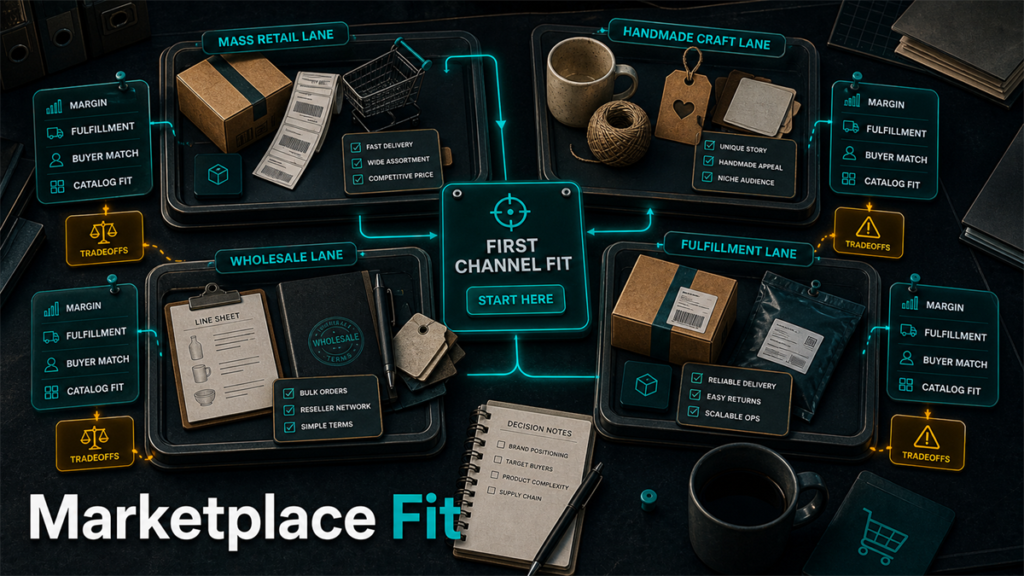
Picking the wrong marketplace first costs real money  in setup time, fulfillment infrastructure, and customer acquisition that does not transfer when you eventually switch. The right starting channel depends on your product type, margin structure, fulfillment readiness, and the kind of buyer you are trying to reach. This framework walks through each marketplace's ideal use case and gives you a scored decision matrix to identify your best first move.
Key Takeaways
- Amazon suits high-volume, commodity-adjacent products with strong margins and fulfillment capacity; it rewards operational discipline more than brand story.
- Walmart Marketplace fits brands that already run FBA successfully and want a second channel with similar operational patterns.
- Etsy works for handmade, vintage, and craft-supply products where buyer intent is discovery-driven and brand personality carries weight.
- Faire is a wholesale B2B channel, not a direct-to-consumer play; it belongs in the plan only if independent retailer distribution is part of the business model.
- Launching on all four channels simultaneously almost always dilutes execution quality  sequence your channel expansion instead.
What Actually Determines Marketplace Fit?
Marketplace fit comes down to five variables: product type and category, gross margin after fees, fulfillment readiness, operational complexity tolerance, and buyer intent alignment.
Product type and category sets the floor. Amazon's catalog covers almost every category, but its fee structure penalizes low-price or fragile products. Etsy has explicit product eligibility rules around handmade, vintage, and craft supplies  a mass-produced consumer electronics brand has no natural home there. Faire restricts access to wholesale-ready brands with retail-appropriate packaging and minimum order quantities.
Gross margin after fees is the real filter. Every marketplace takes a referral fee or commission on top of fulfillment costs and optional advertising spend. A product with a 30% gross margin on paper can run negative after Amazon FBA fees, Etsy transaction fees plus payment processing, or Faire's commission on new retailer orders. Before committing to any channel, model the landed unit economics with current fee rates from the official seller help center for that marketplace.
Fulfillment readiness determines whether a channel is even accessible at launch. Amazon FBA requires prep, labeling, and inbound shipment compliance. Walmart Fulfillment Services (WFS) has its own inbound requirements. Etsy and Faire are merchant-fulfilled by default, which means your own pick-pack-ship operation handles every order.
Operational complexity tolerance varies across teams. Amazon's Seller Central backend  catalog management, variation structures, compliance flags, account health monitoring  demands ongoing operational attention. Walmart Seller Center mirrors much of that complexity. Etsy and Faire have lighter catalog overhead but still require active order management and customer communication.
Buyer intent alignment is the least-discussed variable and often the most important. Amazon buyers arrive with a specific product already in mind and compare options on price, reviews, and Prime eligibility. Walmart.com buyers behave similarly, with a strong value-price orientation. Etsy buyers are browsing for something unique, handcrafted, or gift-appropriate. Faire buyers are independent retail store owners purchasing wholesale inventory  a completely different transaction model.
A Profile of Each Marketplace's Ideal Seller
Amazon: High-Volume, Operations-Ready Brands
Amazon's ideal seller has a product with broad mass-market demand, a competitive price point, clean margins after FBA fees, and the operational capacity to manage a complex backend. Categories like health and household, kitchen, sports and outdoors, and tools perform well. Niche artisan products with high price points can succeed, but only if the brand has reviews and conversion data to compete against established listings.
What Amazon rewards: operational consistency, inventory availability, listing compliance, and competitive pricing. What it does not reward: brand story, artisan provenance, or relationship-based selling. The Amazon buyer's decision path is almost entirely driven by search ranking, reviews, and price.
Fulfillment options: FBA (Fulfilled by Amazon) is the standard for Prime eligibility and buy-box competitiveness. FBM (Fulfilled by Merchant) is available but typically disadvantaged in search visibility. Amazon Multi-Channel Fulfillment (MCF) allows FBA inventory to fulfill orders from other channels.
Fee structure: Amazon charges a referral fee that varies by category (ranges vary; verify current rates in Seller Central's fee schedule before citing specific figures), plus FBA fees based on package size and weight. Optional advertising spend (Sponsored Products, Sponsored Brands) is effectively a cost of acquisition for most categories.
Operational load: High. Catalog management, variation structures, inbound shipment compliance, account health, and case management all require regular attention. Brands that treat Amazon as a set-and-forget channel routinely lose ground.
Walmart Marketplace: The Second-Channel Play for Amazon-Ready Brands
Walmart Marketplace is not a beginner channel. Its seller tools, catalog requirements, and fulfillment program (WFS) closely parallel Amazon's operational patterns, which means the learning curve is much shorter for a brand already running Amazon successfully than for a brand coming in cold.
Walmart.com's buyer intent is value-oriented. Price competitiveness matters significantly. The platform has historically had lower seller density than Amazon in many categories, which means less competition for search placement  but also lower total buyer volume in most niches.
What Walmart rewards: price competitiveness, in-stock rates, clean product data, and fulfillment reliability. Walmart Fulfillment Services (WFS) is required for Pro Seller badge status, which functions similarly to Amazon Prime eligibility in driving conversion. WFS fee rates differ from FBA; verify current rates in Walmart Seller Help before any direct comparison.
Walmart Marketplace requires an application and approval process. Not all brand types or product categories are accepted, and the review timeline can vary. Check current eligibility criteria and the application process in Walmart's official seller help center.
Fee structure: Referral fees vary by category (verify current rates in Walmart Seller Help before publishing specific figures). WFS adds fulfillment fees on top of referral fees.
Operational load: High, similar to Amazon. Sellers experienced with Seller Central will find Walmart Seller Center familiar, but it is a distinct system with its own setup requirements, content standards, and compliance rules.
Etsy: Discovery-Driven Products With a Brand Personality
Etsy's marketplace contract is fundamentally different from Amazon's. Buyers arrive at Etsy to find something they cannot easily find anywhere else  handmade items, vintage goods, personalized products, and craft supplies. The platform's search algorithm and buyer psychology both favor uniqueness, aesthetic presentation, and seller personality.
Etsy has explicit product eligibility rules. Items sold as handmade must be made or designed by the seller. Vintage items must be at least 20 years old. Mass-produced products marketed as handmade violate Etsy's policies. Before listing, verify current eligibility requirements in Etsy's official seller policy documentation.
What Etsy rewards: strong product photography, descriptive listings that explain the making process or materials, a coherent shop aesthetic, and responsive seller communication. Shops that build repeat customer relationships and earn five-star reviews compound their search visibility over time.
Fulfillment options: Etsy is merchant-fulfilled by default. Etsy does not operate a fulfillment program. Sellers manage their own pick-pack-ship or use a third-party logistics provider integrated with the Etsy API. Etsy Shipping offers discounted label rates through integrated carriers.
Fee structure: Etsy charges a listing fee per item, a transaction fee on each sale, and payment processing fees through Etsy Payments (the required payment system in markets where it operates). Etsy Ads is an optional cost-per-click advertising product. Verify current fee rates in Etsy's official help center  fee structures have changed in recent years and specific percentages require confirmation before publishing.
Operational load: Moderate. Catalog management is simpler than Amazon or Walmart, but order volume at scale can stress a manual fulfillment operation. Etsy's review and message response expectations are high  the platform penalizes shops with slow response rates or frequent order cancellations.
Faire: Wholesale B2B, Not DTC
Faire is not a consumer marketplace. It is a wholesale platform connecting product brands with independent retail buyers  boutiques, gift shops, specialty stores, and similar small retailers. If your business model does not include wholesale distribution to independent retailers, Faire does not belong on your channel roadmap.
For brands that do sell wholesale, Faire offers a large, curated network of independent retail buyers and a streamlined ordering experience. The platform handles net payment terms for retailers (Faire pays brands on a defined schedule; verify current payment timing in Faire's brand help center), which removes some of the cash-flow friction of traditional wholesale.
What Faire rewards: retail-appropriate product packaging, a coherent brand identity, strong product photography, competitive wholesale pricing with healthy retailer markup room, and responsiveness to buyer inquiries.
Fee structure: Faire charges a commission on orders. The commission rate differs for new retailer relationships versus returning retailer reorders (verify current commission rates in Faire's official brand help center before publishing specific percentages). Faire's commission structure is a significant cost factor in wholesale margin modeling.
Operational load: Moderate. Order fulfillment is merchant-managed. Minimum order quantities, lead times, and packaging requirements need to be clearly defined. Brands managing both DTC and wholesale channels need inventory allocation discipline to avoid stockouts on either side.
The Decision Matrix: Score Your Product Against Each Channel

Use this matrix to identify your best first channel. Score each variable (1 = poor fit, 2 = moderate fit, 3 = strong fit) based on your product and business situation. The highest-scoring channel is your starting point.
| Variable | Amazon | Walmart | Etsy | Faire |
| Product has broad mass-market demand | 3 | 3 | 1 | 1 |
| Product is handmade, vintage, or highly differentiated | 1 | 1 | 3 | 2 |
| Product is wholesale-ready with retailer markup room | 1 | 1 | 1 | 3 |
| Gross margin absorbs 15–20%+ in fees/commissions | 3 | 3 | 2 | 2 |
| Fulfillment operation is prep-and-compliance-ready | 3 | 3 | 1 | 1 |
| Team can manage complex catalog backend | 3 | 3 | 1 | 1 |
| Buyer intent is price-and-availability driven | 3 | 3 | 1 | 1 |
| Buyer intent is discovery or gift driven | 1 | 1 | 3 | 1 |
| Buyer is a retail store owner (B2B) | 1 | 1 | 1 | 3 |
| Brand already runs Amazon FBA successfully | 2 | 3 | 1 | 1 |
Scoring guidance:
- Score 20 or above on any single marketplace: strong fit, prioritize this channel first.
- Score 15 to 19: workable fit, proceed with realistic margin and ops modeling.
- Score below 15: proceed with caution or defer until the business is operationally ready.
This matrix is a directional tool, not a formula. Use it alongside real unit economics and an honest assessment of your team's operational bandwidth.
How to Use the Framework: A Five-Step Decision Process
- Model your unit economics for each candidate channel. Take your product's current cost of goods, apply estimated fees from the official help center for each marketplace, and identify what gross margin remains before advertising. If the margin is below 20% after fees on any channel, that channel requires either a price increase or a volume model to work  both of which need to be validated before launch.
- Assess your fulfillment infrastructure honestly. If your team cannot prep FBA-compliant shipments reliably, Amazon FBA will produce receiving errors and stranded inventory before you generate any revenue. If you do not have a reliable pick-pack-ship operation, Etsy and Faire orders will generate late-shipment penalties. Match the channel to your actual fulfillment capability, not your aspirational one.
- Score the decision matrix above. Use the table to get a directional read on fit. Do not score yourself higher than warranted  every overestimate here becomes an operational problem after launch.
- Identify the channel where buyer intent matches your product's natural search behavior. If buyers typically search for your product by brand name or category keyword and compare on price, Amazon or Walmart fit. If buyers typically stumble across products like yours while browsing aesthetically curated results, Etsy fits. If your buyers are retail purchasing managers sourcing seasonal inventory, Faire fits.
- Pick one channel. Launch it well. Expand only after operations are stable. The most common multi-marketplace mistake is splitting limited operational attention across three or four channels simultaneously. Listing quality suffers, account health flags appear, and the brand earns mediocre results across all channels instead of strong results on one.
Sequencing Channels: Why Launching Everywhere at Once Hurts
Brands that launch on Amazon, Walmart, Etsy, and Faire simultaneously at limited team capacity consistently underperform compared to brands that own one channel before expanding.
The reason is operational compounding. Every marketplace has its own catalog standards, compliance requirements, fulfillment rules, and performance metrics. Learning one system well enough to run it cleanly takes time and active management. Running four systems at once means four sets of compliance risks, four separate inventory allocation problems, and four customer service queues.
A practical sequencing approach:
- Phase 1: Launch on the single marketplace where your product-buyer intent fit is strongest. Build clean operations, accumulate reviews, and stabilize fulfillment before any expansion.
- Phase 2: Add a second channel only after Phase 1 operations are stable  meaning in-stock rates are consistent, account health is clean, and the team is not firefighting catalog or fulfillment issues weekly.
- Phase 3: Evaluate a third channel based on what the first two channels have taught you about your product's actual buyer profile and margin behavior. By this stage, the brand has real data instead of projections.
For most Amazon-first brands, the natural sequence is Amazon, then Walmart, then either Etsy or Faire depending on product type. Attempting Faire before owning a DTC or B2C channel is usually premature  wholesale buyers want to see market validation before stocking a new brand.
Qubeq's multi-marketplace operations service is designed for exactly this transition point: brands that have stabilized Amazon and are ready to build a second or third channel without rebuilding their operations team from scratch. See multi-marketplace operations for how that works in practice.
Comparison Table: Four Marketplaces at a Glance
| Amazon | Walmart Marketplace | Etsy | Faire | |
| Buyer type | Consumer (B2C) | Consumer (B2C) | Consumer (B2C) | Independent retailer (B2B) |
| Buyer intent | Search/price-driven | Value/price-driven | Discovery/gift-driven | Wholesale purchasing |
| Fulfillment options | FBA, FBM, MCF | WFS, seller-fulfilled | Merchant-fulfilled only | Merchant-fulfilled only |
| Fee structure | Referral fee (category-based) + FBA fees (varies; verify) | Referral fee (category-based) + WFS fees (varies; verify) | Listing fee + transaction fee + payment processing (varies; verify) | Commission on new and reorder transactions (varies; verify) |
| Ops complexity | High | High | Moderate | Moderate |
| Product eligibility | Broad (most categories) | Broad (requires application approval) | Handmade, vintage, craft supply (policy-restricted) | Wholesale-ready brands (invitation/application) |
| Best for | High-volume, commodity-adjacent, margin-positive products | Amazon-ready brands seeking a second channel | Unique, artisan, personalized, or gift products | Brands pursuing independent retailer wholesale distribution |
| Entry barrier | Moderate (account setup, prep compliance) | Moderate-high (application required) | Low-moderate (account setup, policy compliance) | Moderate (brand application and eligibility review) |
All fee references in this table are high-level; verify current rates in each marketplace's official seller/brand help center before publishing or relying on them for margin modeling.
Mini-Scenario: The Cost of Starting on the Wrong Channel
A consumer goods brand selling premium candles spent its first six months building out Amazon operations. The product photographed well, the listings were clean, and the brand invested in Sponsored Products advertising to drive initial sales velocity. After six months, the advertising cost of sale had consumed most of the margin, and the product's average selling price could not support FBA fees and ad spend simultaneously.
The same product, launched on Etsy with the same photography and a story-driven listing approach, would have faced a fraction of the advertising cost because Etsy's discovery-driven algorithm rewards organic visibility for products that match the platform's aesthetic. The brand eventually added Etsy as a second channel and found it contributed comparable revenue at significantly lower acquisition cost.
The lesson was not that Amazon was wrong forever. It was that a product with strong brand differentiation, a high-margin price point, and a visually compelling story belongs on a discovery-driven channel first, where organic search behavior and buyer intent align with how the product actually sells. Amazon can be the second channel once the review base and brand recognition are established.
The brand identity and product type here are anonymized; this scenario reflects a common pattern rather than a specific client account.
FAQ
Can I sell on Amazon and Etsy at the same time?
Yes, there is no policy that prevents selling on both platforms simultaneously. The practical question is whether your team can manage two separate catalog systems, two fulfillment queues, and two compliance requirements without quality suffering on either. Most early-stage brands do better owning one channel before adding a second.
Does Walmart Marketplace accept all product categories?
Walmart Marketplace does not accept all sellers or all categories automatically. The platform uses an application and approval process. Certain categories may have additional requirements or restrictions. Check the current eligibility criteria and application process at Walmart's official seller help center before planning a launch timeline.
What fees does Etsy charge sellers?
Etsy charges a listing fee per item, a transaction fee on each sale, and payment processing fees through Etsy Payments (which is required in markets where it operates). Optional Etsy Ads costs are separate. Specific current fee rates require verification in Etsy's official help documentation  Etsy has updated its fee structure in recent years and percentages cited in third-party articles are frequently outdated.
Is Faire worth it if I only sell direct-to-consumer?
Faire is designed for wholesale distribution to independent retail stores. If wholesale is not part of your current business model  meaning you do not sell to retail buyers in bulk at wholesale pricing  Faire is not a natural fit. Consider Faire only when you are ready to build a wholesale program with retail-appropriate packaging, minimum order quantities, and the margin room to support retailer markup.
How do I know when I'm ready to add a second marketplace?
A useful baseline: your primary channel has stable in-stock rates, a clean account health record, and the operations team is no longer reacting to catalog or fulfillment emergencies weekly. Adding a second channel before that point typically means the new channel gets inconsistent attention and underperforms relative to its potential.
Does Amazon FBA inventory automatically fulfill Walmart or Etsy orders?
Amazon FBA inventory can fulfill orders from other channels through Amazon Multi-Channel Fulfillment (MCF), which is a separate program with its own fee structure. MCF does not connect to Walmart or Etsy automatically  an integration through the MCF API or a third-party tool is required. Verify current MCF eligibility, fee rates, and integration options in Seller Central's help documentation.
Ready to Map Your Marketplace Sequence?
Choosing the right first channel is an operational decision, not just a marketing one. The wrong starting point wastes setup time, burns ad budget against misaligned buyer intent, and creates fulfillment infrastructure that may not transfer cleanly to the channel where your product actually belongs.
If your brand is evaluating a second or third marketplace and you want operational support for the transition, Qubeq manages multi-marketplace backend operations for established brands. We handle catalog setup, compliance, fulfillment coordination, and account health across channels so the expansion does not become a firefighting exercise. See how we work or get in touch to talk through your channel roadmap.