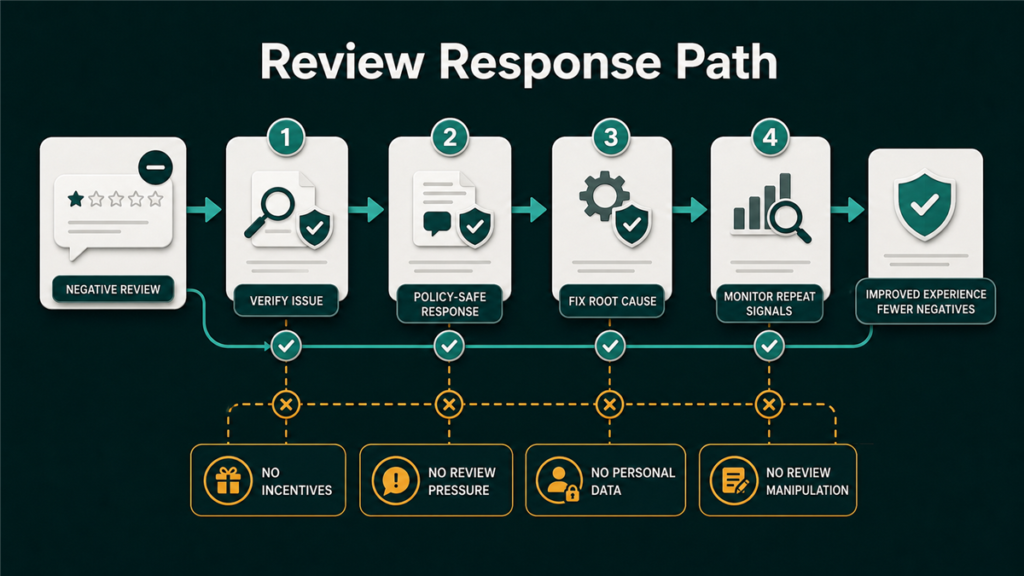
To handle negative reviews on Amazon, work with the levers policy actually gives you: fix the root cause the review points at, request reviews only through approved channels, report genuine abuse, and accept that fair criticism cannot be removed. Sellers get into account trouble when they fight reviews through back channels; sellers protect their listings when they treat reviews as operational data. This guide covers both halves: what helps, and what crosses Amazon's lines.
Key Takeaways
- You cannot remove a negative review for being negative, and any tactic aimed at pressuring or incentivizing reviewers risks the account, not just the listing.
- Most negative reviews encode a fixable operations problem: expectations set wrong by the listing, packaging, quality control, or fulfillment condition.
- Review requests are fine through approved channels, applied uniformly. Selective or incentivized requesting is where policy breaks.
- Report reviews that violate content rules; do not expect removal of honest criticism, and never promise yourself outcomes from reporting.
- The volume cure for occasional bad reviews is more honest sales velocity, not review engineering.
What Amazon's Rules Actually Allow
The boundaries matter more than the tactics, so start there. Sellers may not offer refunds, discounts, gifts, or anything of value in exchange for reviews or review changes; may not ask buyers to revise or remove reviews; may not contact buyers outside Amazon's approved channels for review purposes; and may not selectively solicit reviews from buyers believed to be satisfied. Violations in this area are account-health events, not listing-level slaps.
What remains allowed: requesting a review through approved mechanisms uniformly, responding to the underlying order problems through proper channels where available, reporting reviews that violate Amazon's content guidelines, and improving the product and listing so the next hundred buyers review a better experience. Exact tool names and features change; check current Seller Central help before building a process around any specific mechanism.
Read the Review Before Reacting to It
Negative reviews sort into categories, and each has a different correct response:
- Accurate product criticism: the product underdelivered. This is product development input, not a reputation problem.
- Expectation mismatch: the product is fine but the listing oversold or under-explained. Fix images, bullets, and size/spec clarity.
- Fulfillment damage: the product arrived damaged or late. Investigate packaging, prep, and carrier patterns; FBA condition issues have their own remediation paths.
- Wrong-product confusion: variation mix-ups or catalog errors put the wrong expectations on the page. This is catalog work.
- Policy-violating content: profanity, personal attacks, off-product rants about shipping on FBA orders, competitor sabotage patterns. These are candidates for reporting.
Tally recurring themes monthly. One bad review is noise; the same complaint three times is a work order.
Fix the Root Cause First
The only review strategy that compounds is making the complaint obsolete:
- Map each recurring complaint to its owner: product spec, listing content, packaging, or fulfillment.
- Fix the cheapest true cause first. Many "quality" complaints are actually expectation problems a listing edit resolves.
- Where the product itself needs revision, queue it for the next production run and note the change honestly in the listing when it ships.
- Re-check the theme sixty to ninety days after the fix. If the complaint continues on post-fix inventory, the diagnosis was wrong.
Request Reviews the Safe Way
Occasional negative reviews hurt most on thin review bases. The legitimate volume lever is uniform review requesting through approved channels on your orders, applied to all buyers rather than hand-picked happy ones. Brand-registered sellers may also have program options for earning reviews on newer products; check current availability and rules in Seller Central rather than assuming a specific program's terms.
What this lever does not do: bury a fair pattern of criticism. If recent reviews keep saying the same negative thing, more requests just collect the same message faster.
Report Abuse, Without Expecting Miracles
Reviews that violate content guidelines can be reported through the listing or through Seller Central's reporting paths. Reasonable candidates: reviews with prohibited content, reviews clearly about a different product, and patterns consistent with competitor abuse. Document patterns when reporting, and keep expectations calibrated: Amazon evaluates against its guidelines, and honest negative opinions stay up. Repeated frivolous reporting helps nobody, including your case the one time it is real.
Know When to Let a Review Go
Some reviews are simply the cost of selling at volume: an unlucky unit, an unreasonable expectation, a taste mismatch. A listing with uniformly perfect reviews reads as curated anyway; shoppers trust a page that shows real variance and a strong overall pattern. Spend energy where it compounds, on the product, the listing, and the next thousand orders, not on the one-star review from eight months ago.
Mini-Scenario
A cookware seller watched a strong listing drift from high ratings toward the middle as a recurring complaint appeared: a handle that loosened after weeks of use. The first instinct was reputational, more review requests to dilute the negatives. It did not work; new reviews repeated the complaint. The durable fix was operational: a hardware revision in the next production run, an updated bullet honestly describing the new fitting, and an image showing the assembly. The complaint stopped appearing on post-revision inventory, and the rating recovered over two quarters. The reviews were never the problem; they were the diagnostic.
FAQ
Can I get a negative review removed?
Only if it violates Amazon's content guidelines. Honest criticism does not qualify, and pressuring the reviewer to change it violates policy.
Can I respond publicly to a negative review?
Amazon's mechanisms for seller responses to reviews have changed over time. Check what your account currently offers in Seller Central; where contact options exist for order problems, they run through approved channels only.
Is it against the rules to ask customers for reviews?
Asking is allowed through approved channels, applied uniformly. Asking only happy customers, or attaching any incentive, is where it becomes a violation.
How do I deal with a suspected fake or competitor review?
Report it with whatever pattern evidence you have (timing clusters, reviewer behavior, content mismatches). Amazon decides; treat removal as possible rather than expected, and keep selling while it processes.
Do a few negative reviews really hurt sales?
A few, on a healthy review base, rarely move much. A recurring complaint theme does, because shoppers read the recent and the critical reviews first. The theme is the thing to fix.
Turn the Complaints Into the Roadmap
Negative reviews sting, but they are the most honest product feedback you will ever get for free. If a recurring complaint traces back to catalog errors, listing mismatches, or fulfillment condition problems, Qubeq's account health and catalog teams can find the operational root cause and fix the thing the reviews keep pointing at.