The 3PL vs FBA hybrid question is not about which network is better; it is about which orders and which SKUs each network should carry. FBA earns its fees on fast-moving Amazon demand with Prime expectations. A 3PL earns its keep on everything FBA handles poorly: non-Amazon channels, slow movers, oversized goods, custom packaging, and buffer stock. This guide covers the signals that say a hybrid setup will pay, and how to roll one out without breaking your operation.
If you are still weighing the two networks head-to-head, start with the basic comparison and come back when the question becomes "both, but how."
Key Takeaways
- Hybrid means assignment, not duplication: each SKU and channel gets the network that fits its economics.
- The strongest hybrid signals are FBA capacity limits, meaningful non-Amazon volume, and SKUs whose storage or prep economics fight FBA's fee structure.
- A 3PL as upstream buffer lets you feed FBA in small replenishments while bulk inventory sits in cheaper storage.
- Hybrid adds coordination cost: two systems, two inventory pools, and reconciliation between them. The gains have to clear that overhead.
- Pilot with a small SKU set and real cost data before committing the catalog.
What Each Network Does Best
FBA is built for Amazon demand: Prime delivery promise, marketplace trust, and integrated handling of returns and customer service for Amazon orders. Its trade-offs are equally structural: capacity limits, storage fees that punish slow movers and bulky goods, prep requirements, and no control over branding inside the box.
A third-party logistics provider (3PL) stores and ships inventory under your instructions. Strengths: channel-agnostic fulfillment for your DTC site and other marketplaces, flexible storage economics for bulk and slow movers, custom packaging and kitting, and contractual rather than algorithmic capacity. Trade-offs: you manage the relationship and the integration, delivery speed to Amazon customers does not carry Prime by default, and quality varies widely between providers.
The hybrid insight is that these strengths barely overlap. Most growing catalogs contain demand both networks serve badly alone.
Seven Signals a Hybrid Setup Will Pay
- You keep hitting FBA capacity or restock limits. A 3PL buffer upstream of FBA turns capacity management from a crisis into a replenishment schedule.
- Non-Amazon volume is real. Once your DTC or other-marketplace orders are a meaningful share of units, fulfilling them all through Amazon's network (or by hand) usually costs more than a 3PL lane.
- Some SKUs fight FBA economics. Oversized, heavy, slow-turning, or season-tailed products can accumulate storage and aged-inventory costs that a 3PL stores for less.
- Long-term storage fees keep appearing on your statements. That is the fee structure telling you which SKUs do not belong in FBA full-time.
- You need branded unboxing, kitting, or custom packaging that FBA does not do.
- Single-network risk has bitten you: a capacity cut, a fee change, or an account issue that froze your entire fulfillment at once.
- You import in bulk. Containers unloading into a 3PL, with FBA fed in measured slices, beats sending whole containers into Amazon's fee clock.
One or two weak signals do not justify the overhead. Two or three strong ones usually do.
The Standard Hybrid Architecture
The pattern most sellers converge on:
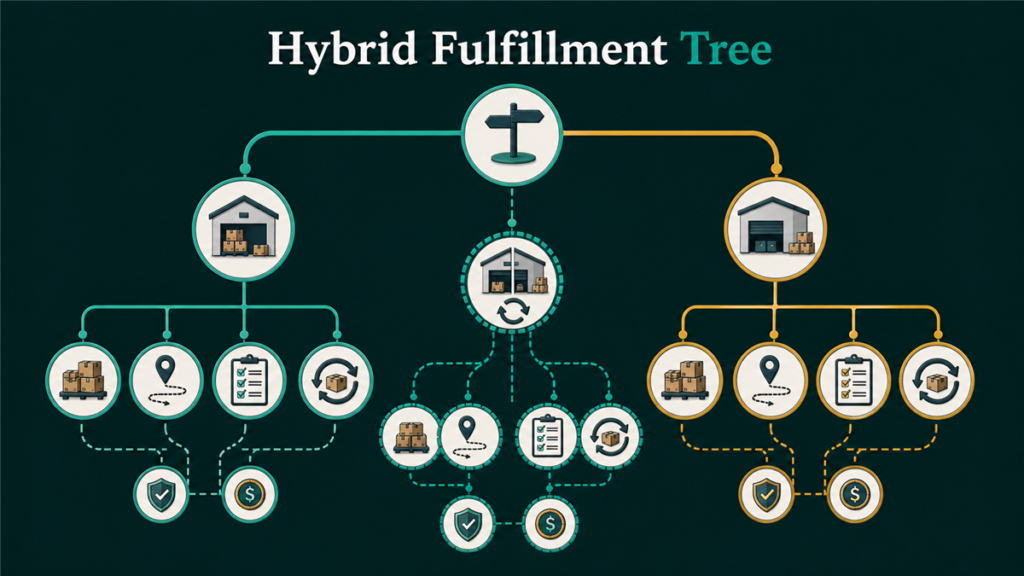
- FBA carries Amazon's fast movers, sized to a defined cover window (for example, several weeks of forecast demand), replenished on a schedule.
- The 3PL holds bulk inventory and feeds FBA replenishments, absorbing import timing and protecting against capacity swings.
- The 3PL fulfills non-Amazon channels directly: DTC, Walmart seller-fulfilled, B2B, retail.
- Slow movers and oversize SKUs live at the 3PL, with Amazon orders for them either fulfilled by merchant from the 3PL or selectively placed in FBA when velocity justifies it.
Amazon's Multi-Channel Fulfillment can serve as a partial alternative for non-Amazon orders; whether it fits depends on current MCF costs, branding constraints, and the receiving platform's policies. Verify those details against current documentation before building a channel on it.
How to Decide Per SKU
Run the math per SKU, not per philosophy:
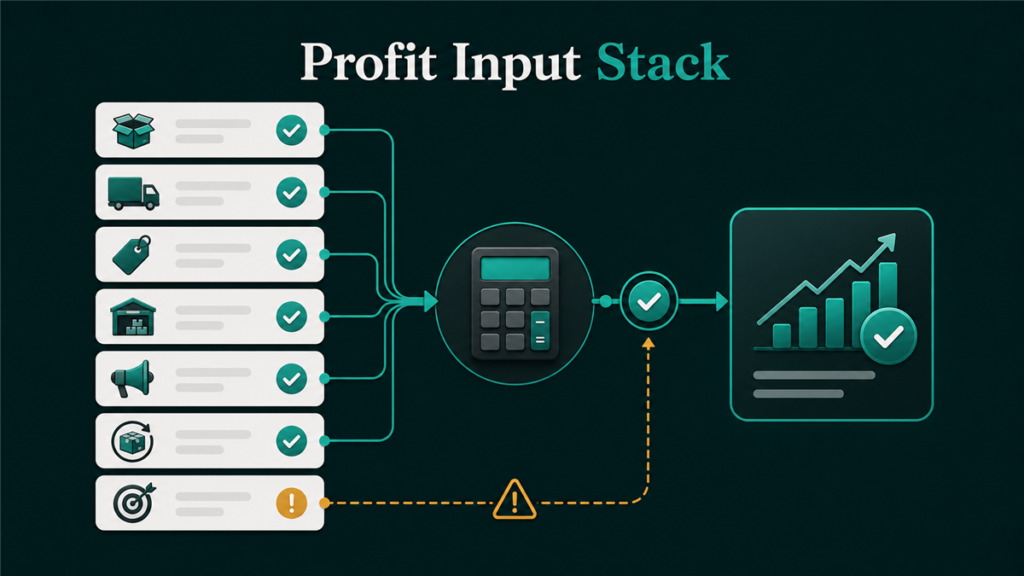
- Pull twelve months of velocity, storage cost, and fee history per SKU from your Amazon reports.
- Get real 3PL quotes for storage, pick and pack, and shipping for the same SKUs. Do not model from directory averages.
- Compare landed cost-to-serve per unit per channel in each network, including the aged-inventory and capacity costs FBA hides in its corners.
- Add the coordination overhead honestly: integration software, reconciliation time, extra freight legs between warehouses.
- Assign each SKU and channel to a network, and mark borderline SKUs for the pilot rather than guessing.
Rolling It Out Without Breaking Things
- Pilot with a handful of SKUs that show the strongest signals.
- Pick the 3PL against your actual requirements: channel integrations, receiving speed, error rates, and references from sellers your size.
- Connect inventory systems before moving stock; a hybrid run on spreadsheets fails at the first busy week.
- Define the replenishment trigger from 3PL to FBA and the owner of that decision.
- Review after a full quarter with real invoices on both sides before scaling the split.
Mini-Scenario
A houseware brand ran everything through FBA, including a bulky slow-turning product line that generated long-term storage fees every cycle, while its growing Shopify orders shipped expensively through MCF. The pilot moved the bulky line and all DTC fulfillment to a regional 3PL, keeping FBA stocked with the fast movers on a weekly replenishment from the 3PL's bulk store. Two quarters later the brand's aged-inventory fees had largely disappeared, DTC unboxing carried its branding, and an FBA capacity cut during Q4 became a non-event because bulk stock simply waited upstream. The cost win was real but secondary; the resilience was the point.
FAQ
Is hybrid fulfillment worth it for small sellers?
Usually not before the signals appear. A single-network setup is simpler, and simplicity is worth real money when volume is small. Revisit when capacity limits, channel growth, or storage fees start costing you.
Can a 3PL ship my Amazon orders instead of FBA?
Yes, as seller-fulfilled orders. The trade-off is delivery speed expectations and Prime eligibility, which by default belongs to FBA. Programs for seller-fulfilled Prime have their own demanding requirements; verify current status before planning around them.
Should the 3PL or FBA hold my bulk inventory?
For most importers, bulk belongs at the 3PL (or a bonded/overflow warehouse) with FBA fed in slices. FBA storage is priced for turnover, not warehousing.
How do I keep inventory counts straight across two networks?
Through integration software or a disciplined operations workflow that reconciles both pools on a schedule. This is the hidden cost of hybrid; budget for it before moving stock.
Does MCF replace the need for a 3PL?
Sometimes, for modest non-Amazon volume. Compare current MCF rates, packaging constraints, and the receiving channel's policies against a 3PL quote for your actual order profile.
Build the Architecture Before You Need It
Hybrid fulfillment is what growing catalogs adopt when one network's weaknesses start showing up as fees, freezes, or missed channels. If your team wants the per-SKU math done properly, from FBA fee history through 3PL quotes to a rollout plan, Qubeq's operations team builds exactly these fulfillment architectures with sellers.