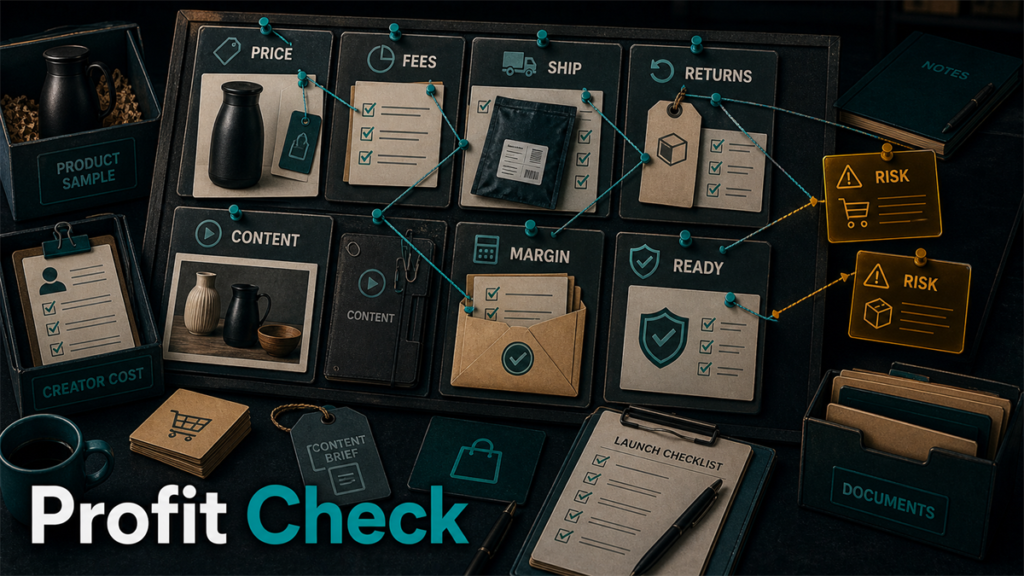
A TikTok Shop profitability checklist covers eight cost and readiness areas every operator should work through before listing a single product: platform fees, affiliate and creator commission costs, sample and seeding spend, return exposure, fulfillment readiness, margin math, cash flow timing, and a go/no-go threshold. Running these checks before launch is what separates a profitable TikTok Shop from a fast-moving channel that sells at a loss.
Key Takeaways
- TikTok Shop has a layered fee structure. The platform commission fee, transaction fees, and any fulfillment fees all stack on top of each other before creator commissions are applied.
- Affiliate/creator commissions are a variable cost that sellers set. They can be significant, especially during early seeding campaigns when conversion volume is low.
- Sample and seeding costs are a pre-revenue line item. Budget for them as a fixed launch cost, not as part of the unit margin calculation.
- Return rates on social commerce can differ from search-intent marketplaces because many buyers are impulse-driven. Model a realistic return rate before projecting net revenue.
- The go/no-go decision should be made on contribution margin after all platform costs, not on gross margin at the product level.
What Does a TikTok Shop Profitability Check Actually Cover?
A TikTok Shop profitability check is a pre-launch audit of every cost that sits between a sale and net proceeds to the seller. It is not the same as a setup checklist. Setup checks confirm that your account is registered, your products are listed, and your shipping profile is configured. A profitability check asks a different question: after the platform takes its fees, creators take their commissions, returns come back, and fulfillment costs are paid, is there margin left?
Many sellers skip this step. They see strong content performance from a competitor or a viral product in their category, assume TikTok Shop is a high-margin channel, and launch without stress-testing the unit economics. The cost structure of TikTok Shop is meaningfully different from Amazon or Walmart because the affiliate-driven sales model adds a variable cost layer that does not exist in the same way on search-based marketplaces.
The eight areas below form the complete profitability check. Work through each one before you publish your first product.
What Are TikTok Shop's Platform Fees?
TikTok Shop charges sellers a referral/commission fee on each completed order, calculated as a percentage of the total sale price (including shipping, where applicable). The exact fee rate varies by product category. On top of the referral fee, there is a transaction/payment processing fee.
Verify before publishing: TikTok Shop has adjusted fee rates during promotional periods, including reduced or waived introductory rates for new sellers. The current fee schedule for US sellers is published in TikTok Seller Center under the fees section. Always confirm the live rate at the time of launch, not the rate you saw in a third-party article or video, because the numbers change.
What to do with this information:
- Pull the current referral fee rate for each product category you plan to sell.
- Note whether a reduced introductory rate applies and when it expires.
- Calculate the fee as a hard dollar amount per unit at your expected selling price, not as a percentage you will address later.
A referral fee of even a few percentage points compounds quickly at scale. If your product sells for $40 and the platform fee is 6%, that is $2.40 per order before any other cost. Model this at your target volume.
How Much Do Affiliate and Creator Commissions Cost?
Affiliate commissions are the cost sellers pay to creators who generate a sale through a tagged product link or LIVE shopping event. The seller sets the commission rate within TikTok Shop Affiliate, and creators can browse products and apply to promote them.
This is a fundamental difference from advertising spend. With paid ads, you pay for traffic regardless of whether it converts. With affiliate commissions, you pay only on conversion, but the rate is typically higher than an ad cost-per-order because the creator is taking on the distribution risk.
What ranges look like (verify current rates): Commission rates vary by category, product price, and how competitive your product is among creators looking for items to promote. Higher commissions attract more creators. Lower commissions may mean fewer videos get made. The right rate for your product depends on your margin, your category benchmarks, and whether you are also running a seeding program alongside the affiliate offer.
Factors that affect your real creator cost:
- Commission rate: The percentage you offer per sale. This is your direct cost per converted order.
- Open vs targeted collaboration: Open collaboration lets any eligible creator promote your product. Targeted collaboration invites specific creators. Targeted typically means higher-volume but also potentially higher commission negotiations.
- LIVE shopping: LIVE sessions can produce concentrated sales volume but the creator's time cost is higher, and commission expectations may differ.
- Gifted vs purchased samples: Some creators expect free product before they promote. This intersects with your seeding budget (covered next).
For the margin calculation: treat creator commission as a percentage deducted from net revenue, not as a marketing line item to be recovered later from blended ROAS. It is a direct cost of each sale on this channel.
What Does Seeding and Sampling Cost?
Seeding is the practice of sending free product to creators before a campaign starts. It is how most TikTok Shop sellers generate initial content and social proof. The seeding cost is a pre-revenue, fixed launch expense.
A seeding budget covers:
- Product cost of units sent to creators (cost of goods, not retail price)
- Outbound shipping for each seeded unit
- Any packaging or inserts specific to the creator send
- Tracking and follow-up costs if you are managing a large seeding roster
Seeding costs do not appear in the per-unit margin calculation for sold orders. They are a launch overhead line item. But they are real cash out of pocket before a single sale is made, and they need to be included in your payback period and break-even analysis.
A realistic pre-launch question: if you seed 50 units at $8 cost of goods each plus $5 shipping per unit, that is $650 in pre-revenue spend. How many units at your net contribution margin does it take to recover that seeding investment? Calculate this before deciding whether the channel justifies the launch cost at your volume expectations.
What Is the Return Exposure on TikTok Shop?
Returns are a real cost that many sellers underestimate on social commerce channels. TikTok Shop has a buyer-friendly return policy designed to encourage purchase confidence. The specific terms, including who bears the return shipping cost and what happens to returned units, depend on your product category and the seller account type.
Verify before publishing: Current TikTok Shop return window terms, restocking fee eligibility, and return shipping cost responsibilities are documented in TikTok Seller Center. These terms can change, and category-specific rules apply. Check current policy before finalizing your return exposure model.
Why social commerce return rates deserve attention:
- A significant share of TikTok Shop purchases are impulse-driven, triggered by a LIVE event or a viral video rather than a researched buying decision. Impulse buyers return at different rates than intent-based buyers.
- Product condition on return can be unpredictable, especially for categories like beauty, apparel, and electronics. A returned unit may not be resellable at full price.
- If the seller bears return shipping costs, those costs add up on lower-price-point products and can tip a marginally profitable product into a net negative per returned order.
How to model return exposure: Estimate a return rate percentage appropriate for your category. Calculate the total cost of a return: the refund amount, the inbound return shipping cost (if seller-borne), and any loss in product resale value. Express this as a weighted cost per unit sold. Subtract that weighted cost from your contribution margin per unit.
What Are Your Fulfillment Options and Readiness?
TikTok Shop offers two primary fulfillment paths for US sellers: seller-fulfilled shipping (you ship from your own warehouse or 3PL) and a TikTok-managed fulfillment option (SFTK: Shipped by TikTok Shop). The cost structures, speed requirements, and operational implications differ.
Seller-fulfilled: You control fulfillment costs, use your existing carrier rates, and manage the shipping timeline. TikTok Shop sets shipping speed requirements that your orders must meet. Failure to meet those requirements can affect your seller performance metrics.
Platform-fulfilled (SFTK): TikTok manages inbound storage, picking, packing, and shipping. This adds a fulfillment fee per order but reduces operational complexity and may improve your product's eligibility for platform promotion. Verify current SFTK fee rates in Seller Center before building this into your margin model.
Readiness questions to answer before launch:
- Can your current fulfillment setup meet TikTok Shop shipping speed requirements consistently?
- Do you have sufficient inventory depth to support a LIVE shopping event where order volume can spike sharply within a short window?
- If you use a 3PL, is it integrated with TikTok Shop's order management, or will orders require manual processing?
- For SFTK, have you prepared inbound shipments that meet TikTok's packaging and labeling requirements?
An underprepared fulfillment operation will show up as late shipments and negative reviews, which affect your seller metrics and your product's visibility in the shop algorithm.
How Do You Run the Margin Math?
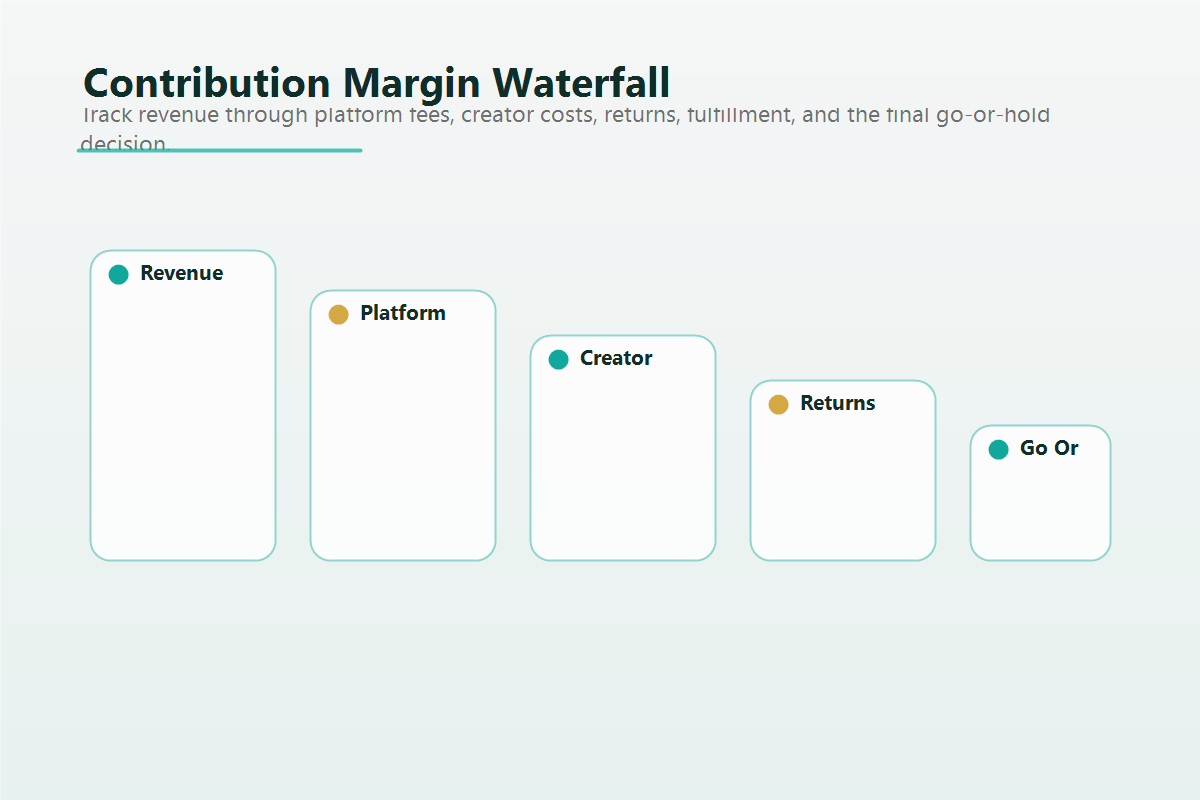
The margin framework below uses illustrative, placeholder numbers. These are not benchmarks, industry averages, or claims about typical TikTok Shop economics. They are an example of how to structure the calculation for your own product numbers.
Illustrative example only. Not a benchmark. Replace every figure with your actual verified costs.
| Line Item | Illustrative Example |
| Selling price (customer pays) | $35.00 |
| Platform referral fee (verify rate) | – $2.45 (illustrative 7%) |
| Transaction/payment fee (verify rate) | – $0.70 (illustrative 2%) |
| Affiliate creator commission (your set rate) | – $3.50 (illustrative 10%) |
| Cost of goods (your product cost) | – $8.00 |
| Fulfillment / shipping cost | – $5.50 |
| Return cost (weighted per unit sold) | – $1.40 (illustrative 4% return rate) |
| Net contribution margin per unit | = $13.45 |
| Net contribution margin % | 38.4% |
This illustrative example assumes a 10% affiliate commission, a 7% platform referral fee, a 2% transaction fee, and a 4% return rate. Change any one of those inputs and the margin shifts materially. A 15% affiliate commission in this same example drops the net contribution margin to $11.70 (33.4%).
The key discipline: Run this model at your actual selling price, your actual product cost, and at several different affiliate commission rates. Identify the commission floor below which the product stops being profitable. Set your commission strategy with that floor in mind.
What the margin model does not include (add as relevant to your business):
- Platform advertising spend (TikTok Ads for Shop, Spark Ads)
- Content production costs beyond seeding
- Account management or operations overhead
- Amortized cost of the seeding program over projected sales volume
- Storage fees (if using SFTK)
The Go/No-Go Checklist: 12 Checks Before You Launch
Work through each item. A "no" or "unsure" on any of the first seven items is a reason to pause the launch, not to proceed and hope for the best.
Economics and Fees
- I have pulled the current TikTok Shop referral fee rate for my specific product category from Seller Center (not from a third-party source or old article).
- I have confirmed whether a promotional/introductory fee rate applies to my account and when it expires.
- I have calculated the platform fee and transaction fee as a hard dollar amount per unit at my planned selling price.
- I have modeled net contribution margin at three creator commission rates: my target rate, a rate 5 percentage points higher, and my break-even floor.
Creator and Seeding
- I have a realistic seeding budget approved and separate from my per-unit margin calculation.
- I have identified whether I am running open collaboration, targeted collaboration, or both, and my commission rate is competitive for the category.
Fulfillment
- My fulfillment setup can meet TikTok Shop's shipping speed requirements without operational changes.
- I have enough inventory depth to handle a demand spike from a LIVE event or a high-performing video.
Returns
- I have reviewed the current TikTok Shop return policy for my category and know who bears the return shipping cost.
- I have modeled a return rate and calculated the weighted return cost per unit sold.
Operations
- I have a process for monitoring seller performance metrics (on-time shipment rate, product quality rating) from day one, not after problems appear.
- I have a plan for what "success" looks like at 30 days, 60 days, and 90 days, including the sales volume needed to recover the seeding investment.
If all 12 checks are complete and the margin model shows positive contribution at a realistic commission rate, you are operationally and economically ready to launch. If the margin model only works at a commission rate that leaves no room for creator costs, stop and reprice, renegotiate your product cost, or defer the channel.
Mini-Scenario: The Health Supplement Brand That Reworked Its Numbers
An established supplement brand with a strong Amazon presence decided to test TikTok Shop. They had good product photography, a functional Seller Center account, and a list of 30 creators they had identified for outreach.
What they had not done was run the full cost model. Their Amazon contribution margin was approximately 35% after FBA fees and advertising. They assumed TikTok Shop would perform similarly because "fees are lower."
Before launch, they built the margin framework. Their product sold for $32. When they factored in the platform referral fee, a 12% creator commission rate they had set to be competitive, seller-fulfilled shipping costs, and a conservative 6% return rate estimate, their net contribution margin came out at approximately 21%. That was still positive, but lower than expected.
The more significant finding: at the creator commission rate needed to attract mid-tier creators in the supplements category (which in their research was 15% to 18%), the margin dropped to 14%. At 18%, it dropped further.
They did not abandon the channel. They revised three things: raised the selling price by $3, committed to targeted collaborations rather than open collaboration (fewer creators, higher volume per creator), and budgeted the seeding program as a 90-day marketing investment rather than expecting payback in 30 days. With those changes, the model worked at 15% commission and a realistic return rate.
The detail that changed the most: running the numbers before launch rather than after the first month of data came in.
FAQ
What is the TikTok Shop platform fee for US sellers?
TikTok Shop charges sellers a referral fee that varies by product category, plus a transaction/payment processing fee. The exact rates are published in TikTok Seller Center and are subject to change, including promotional reductions for new sellers. Always pull the current fee schedule from Seller Center before building a margin model, and note when any introductory rate expires.
How much should I set my affiliate commission rate on TikTok Shop?
The commission rate you set determines how attractive your product is to creators browsing the affiliate marketplace. Higher rates attract more creators but directly reduce your margin per sale. The right rate depends on your product margin, your category's competitive rate environment, and whether you are also running a paid seeding program. Model your break-even commission floor before setting any rate, and test creator responsiveness before locking in a long-term rate.
Do I have to use TikTok Shop's fulfillment service?
No. Sellers can choose between self-fulfilled shipping (using their own warehouse or 3PL) and TikTok's platform-managed fulfillment option (SFTK). Self-fulfillment gives you control over shipping costs and operations, but requires you to meet TikTok Shop's shipping speed requirements consistently. SFTK adds a per-order fee but can simplify operations. The right choice depends on your existing logistics infrastructure and your volume expectations.
Are TikTok Shop return rates higher than on Amazon?
There is no universally published comparison, and return rates vary significantly by product category. What matters operationally is that social commerce purchases are often more impulse-driven than search-intent purchases, which can affect return behavior. Model a realistic return rate for your specific category, verify who bears the return shipping cost under current TikTok Shop policy, and include that weighted cost in your per-unit margin calculation.
What does "contribution margin" mean in the TikTok Shop context?
Contribution margin per unit is what remains from the selling price after all direct, variable costs are paid: platform fees, transaction fees, creator commissions, cost of goods, fulfillment costs, and a weighted return cost. It does not include fixed overhead, advertising, or amortized seeding costs. A positive contribution margin means each sale covers its own costs. Whether the channel is profitable overall depends on whether the total contribution across all sales is large enough to recover fixed costs and seeding spend.
Should I launch on TikTok Shop if I'm already selling on Amazon?
TikTok Shop is a different operational system with a different cost structure and a different buyer behavior profile. Running both channels well requires operational capacity for each. Before launching, assess whether your current team can manage additional order management, creator partnerships, and performance monitoring without degrading your Amazon operations. The margin question is necessary but not sufficient: the operational readiness question matters equally.
Is TikTok Shop Right for Your Brand Right Now?
The TikTok Shop profitability checklist points to a straightforward answer: launch when the margin model is positive at a realistic commission rate and your operations can handle the channel without strain. Do not launch because a competitor is on TikTok Shop or because a LIVE video went viral in your category. Those are signals about demand, not signals about your unit economics.
If you are managing multiple marketplace channels and want to assess where TikTok Shop fits in your broader operations, Qubeq works with established brands on multi-channel marketplace operations and expansion decisions. You can learn more about how Qubeq approaches other marketplace channels at https://qubeq.com/other-marketplaces/, or reach out directly if you want to talk through the operational implications for your specific catalog and fulfillment setup.