On Walmart Marketplace, a cancellation is not just a lost order. It is a broken customer promise and a performance signal. If the seller cancels after accepting an order, Walmart can treat that as an account-health problem, especially when it happens repeatedly.
The best cancellation strategy is prevention. Once an order is already in trouble, the options are limited. The real work happens earlier: inventory accuracy, warehouse rules, listing availability, and exception monitoring.
Freshness note: Walmart cancellation and fulfillment performance metrics should be verified in Seller Center before quoting thresholds, and exact threshold claims should be avoided unless a current source confirms them.
Key Takeaways
- Seller-initiated cancellations can hurt customer experience and seller performance.
- Out-of-stock cancellations often point to inventory sync or warehouse availability problems.
- Cancellation prevention should be managed before promotions, peak periods, and channel expansion.
- Weekly cancellation reason review helps identify whether the issue is inventory, fulfillment, supplier, or catalog setup.
- A low cancellation rate is usually a byproduct of a reliable order operation.
Why Walmart Cancellations Matter
Source note: Walmart Marketplace Learn identifies cancellation rate as a seller-performance consideration, so sellers should check current cancellation and seller-performance guidance before changing workflows or interpreting account risk.
When a customer places an order, Walmart has already made a promise on the seller's behalf. Canceling that order can damage trust, delay the buyer, and trigger negative operational signals. Walmart's seller performance documentation includes cancellation rate as one of the metrics reviewed for account health.
That means cancellations should not be treated as an ordinary cleanup tool. They should be treated as exceptions that require root-cause review.
The Common Causes
The biggest cause is inventory mismatch. The item appears available, but the warehouse cannot fulfill it. This can happen because another channel sold the unit first, a feed did not update, safety stock was too low, or the item was assigned to the wrong fulfillment node.
Another cause is supplier dependency. If a seller lists products that require supplier confirmation after the sale, cancellations become more likely. The same applies to bundles, oversized products, hazmat-like handling, or products with inconsistent prep requirements.
Catalog confusion can also create cancellation risk. Wrong variants, wrong pack counts, or mismatched product identifiers can lead to orders the warehouse cannot confidently ship.
Cancellation Prevention Checklist
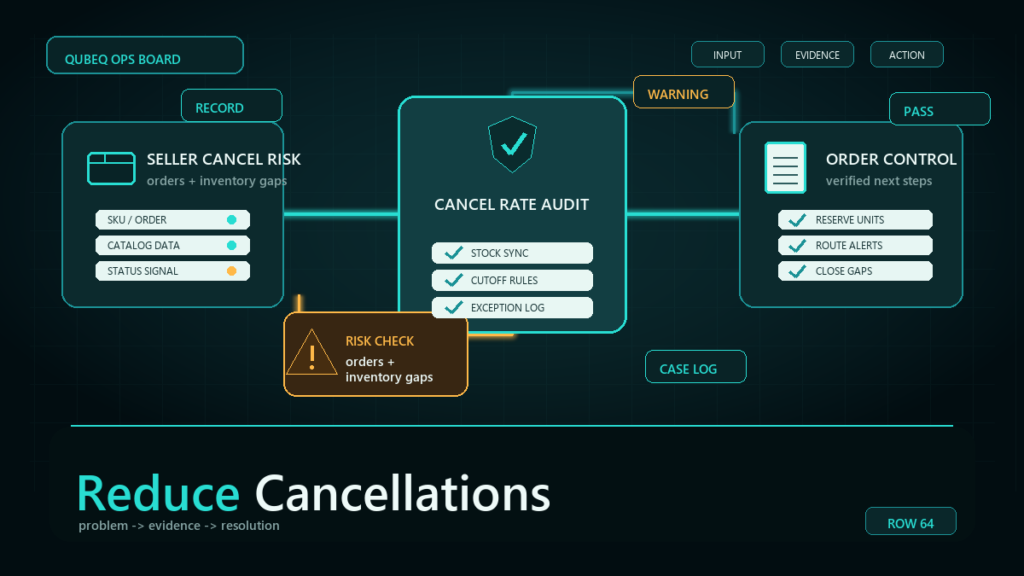
Start with inventory buffers. If the same stock is shared across Walmart, Amazon, Shopify, eBay, or wholesale, do not expose every unit to every channel. Reserve enough safety stock to absorb sync delays.
Next, review warehouse availability rules. A SKU may exist, but if it is not assigned correctly to a sellable warehouse, the order can still fail. Check item status, warehouse status, and channel availability together.
Then review high-risk products. Custom items, slow supplier items, fragile products, bundles, and multi-pack listings deserve tighter controls. If a product regularly forces manual review before shipping, it should not be treated like a standard same-day SKU.
Finally, set a weekly cancellation review. Export canceled orders, group by reason, and tag each one as inventory, supplier, warehouse, catalog, or customer-driven. The pattern matters more than the individual order.
What To Do When Cancellation Risk Spikes
If cancellations rise suddenly, pause the affected SKU or reduce available quantity before more orders arrive. Check whether a promotion, feed delay, supplier outage, or warehouse issue created the spike. Do not wait until the next performance review.
If the issue is recurring, fix the upstream control. More manual order review is not a durable solution. Sellers need cleaner inventory feeds, better SKU mapping, clearer warehouse rules, or a more realistic assortment.
FAQ
Why do Walmart cancellations matter?
Seller-initiated cancellations can hurt customer experience and may be reviewed as part of seller performance. The safest operating goal is to prevent avoidable cancellations before orders are placed.
What usually causes avoidable seller cancellations?
Common causes include inaccurate inventory, weak warehouse sync, missed cutoffs, unavailable items, wrong fulfillment assumptions, and poor exception handling when demand changes quickly.
How can sellers reduce cancellation risk?
Keep inventory feeds accurate, confirm warehouse availability, monitor cancellation reasons, review cutoff discipline, and investigate recurring out-of-stock or fulfillment issues before they become a pattern.
Bottom Line
Walmart cancellation rate is a lagging indicator. By the time it appears in reporting, the operation has already disappointed customers. The fix is not better cancellation technique; it is fewer situations where cancellation becomes necessary.