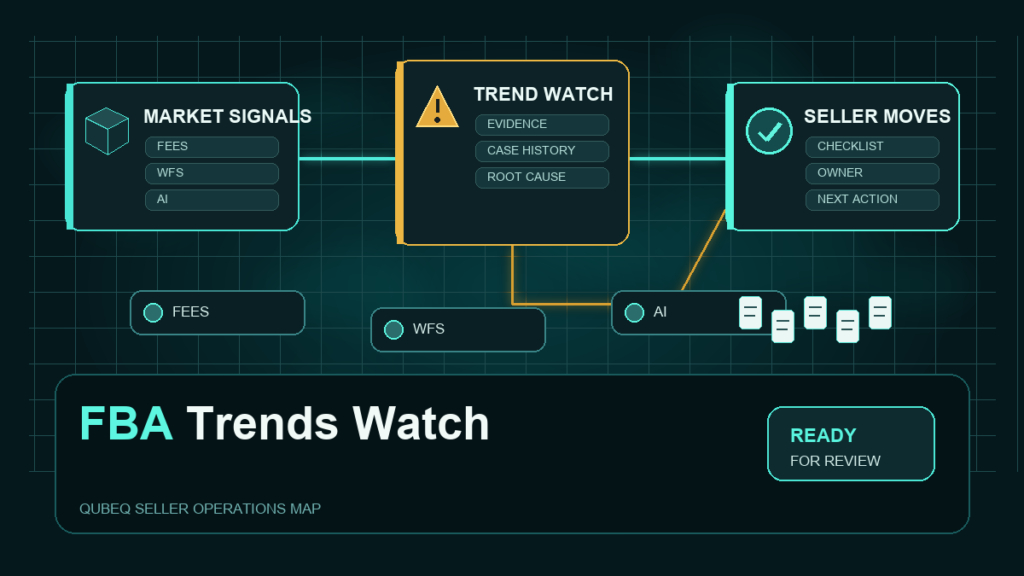
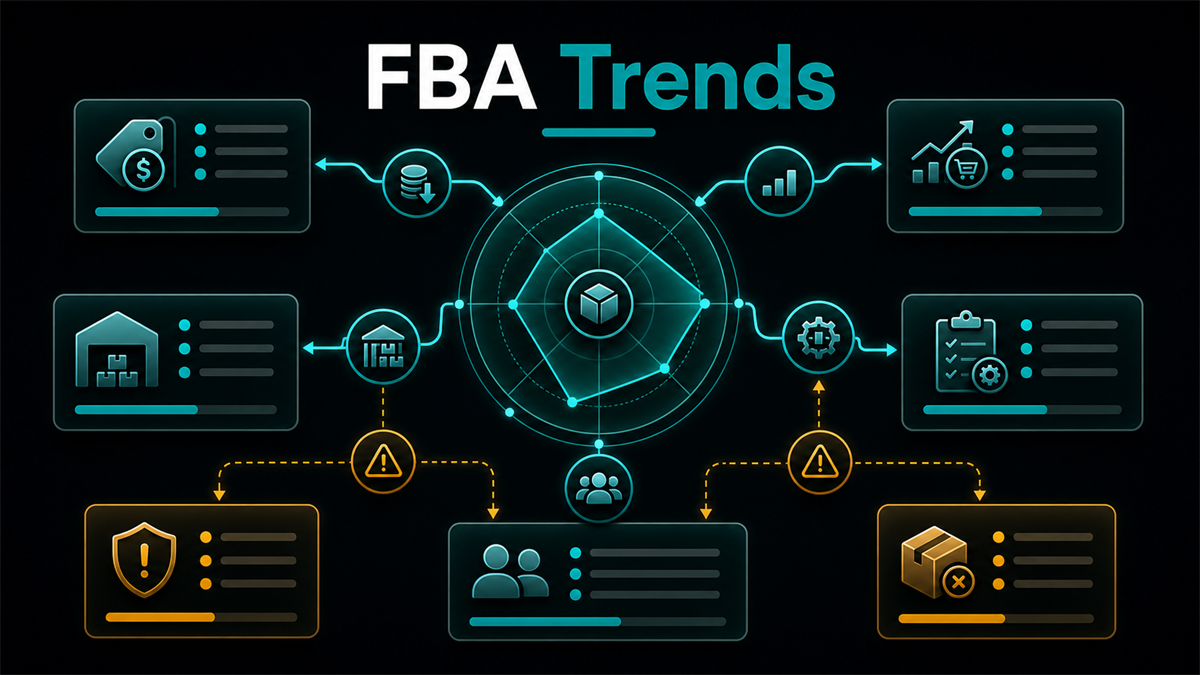
Amazon FBA trends in 2026 are less about hype and more about operational discipline. Fee modeling, advertising efficiency, inventory placement, catalog quality, supply chain flexibility, compliance, and multichannel fulfillment define the landscape. Sellers who monitor these trends and adjust their operations will protect margin. Sellers who do not will feel the squeeze.
Key Takeaways
- FBA cost modeling is more important in 2026 because fulfillment, storage, inbound placement, aged inventory, returns, and optional services can stack quickly.
- Advertising costs can pressure margins, forcing sellers to manage TACoS by SKU rather than by campaign.
- Inventory management is tighter operationally, with sellers needing to watch variation-level availability, aged inventory exposure, storage costs, and replenishment timing.
- AI-assisted tools are becoming standard for forecasting, ad management, and listing optimization, but they are operational aids, not guaranteed performance drivers.
- Multichannel fulfillment and broader supply-chain services are becoming more important as sellers diversify beyond one sales channel.
Trend 1: Fee Pressure Keeps Building
Amazon's fee structure is layered. The changes may look small at the SKU level, but they compound across a catalog.
Sellers need to model referral fees, FBA fulfillment fees, storage, inbound placement, returns processing, aged inventory exposure, removals, disposal, and optional services. A product can look profitable before these costs and become fragile after they are included.
The operational issue is not one single fee. It is the full cost stack. Sellers who only track product cost and selling price miss the charges that quietly drain contribution margin.
Amazon's public FBA guidance points sellers to cost categories such as storage, aged inventory, returns processing, removal, disposal, liquidation, and inbound placement services. Those are the categories sellers should review before sending inventory.
What sellers should do: Recalculate contribution margin for every active SKU using current Amazon fee data and the Revenue Calculator where useful. Review aged inventory exposure, model inbound placement options, and set removal or liquidation triggers before slow-moving inventory becomes expensive.
Trend 2: Advertising Efficiency Matters More Than Ad Spend
Advertising is still useful, but the margin for error in campaigns is smaller when products already have tight contribution margin.
The sellers winning on advertising are not necessarily the ones spending the most. They are the ones managing TACoS (Total Advertising Cost of Sales) at the SKU level, pruning keywords that do not convert, shifting budget to high-converting search terms, and monitoring the relationship between ad spend and organic ranking.
Sponsored Brands, Sponsored Display, and video ads provide more placement options, but each adds campaign complexity. Sellers who run campaigns without regular performance review waste ad dollars on clicks that do not convert.
What sellers should do: Track TACoS per SKU, not just ACoS per campaign. Set clear profitability thresholds for each product's advertising budget. Review search term reports weekly and remove low-converting, high-spend terms. Treat advertising as a cost center with measurable ROI, not a growth lever that "eventually pays for itself."
Trend 3: Inventory Placement and Storage Rules Are Tighter
Amazon's inventory management requirements continue to tighten, directly affecting both cost and operational flexibility.
Sellers need to monitor inventory at the sellable-unit and variation level, not only at the parent ASIN level. A parent product can look healthy while a key size, color, or pack count is running out.
Storage costs can change by season, size tier, inventory age, and service used. Slow-moving, bulky, or variation-heavy products need more careful forecasting than fast-turning simple SKUs.
Amazon Warehousing and Distribution (AWD) and other supply-chain options can help some sellers with bulk storage and replenishment, but they still need to be compared against 3PL alternatives and cash-flow constraints.
What sellers should do: Monitor inventory by SKU and variation, especially for products with multiple options. Set reorder points that reduce both stockout risk and overstock risk. Build seasonal storage pressure into Q4 margin calculations. Evaluate AWD as a bulk storage option, but compare it against 3PL alternatives before shifting inventory.
Trend 4: Catalog Quality Is an Ongoing Operational Requirement
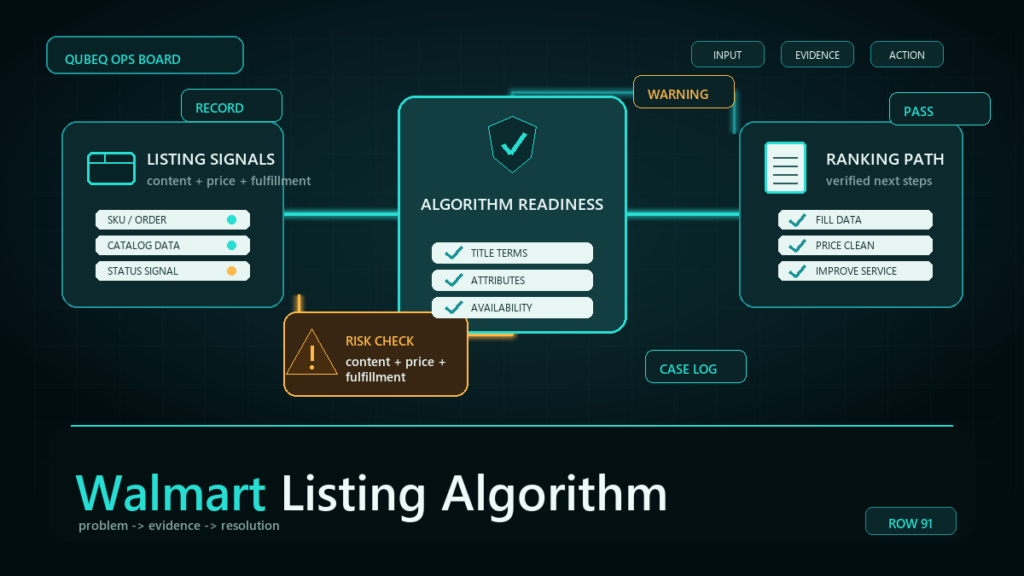
Catalog quality is not a one-time listing optimization task. Amazon's search algorithm, AI-powered shopping assistants like Rufus, and compliance systems all evaluate listing completeness and accuracy on an ongoing basis.
Listings with incomplete attributes, incorrect product types, broken variation structures, or missing backend keywords lose organic visibility. Suppressed listings lose sales entirely. Products that trigger compliance flags based on listing content can face removal.
AI-assisted shopping experiences and search summaries depend heavily on clear product data. Listings with clear noun phrases, complete attributes, and well-organized content are easier for search and shopping systems to interpret.
What sellers should do: Audit active listings for completeness: title, bullets, description, backend keywords, product type, variation structure, and images. Fix suppressed or stranded listings immediately. Write listings that answer buyer questions directly, not just stuff keywords. Treat catalog maintenance as a recurring operational task, not a launch-and-forget activity.
Trend 5: AI Tools Are Operational Aids, Not Magic
AI-assisted tools for Amazon sellers are more capable than they were a year ago. Tools now offer demand forecasting, dynamic pricing suggestions, automated bid adjustments, listing content generation, and competitor tracking.
However, AI tools are operational accelerators, not guaranteed performance drivers. A forecasting tool is only as good as the historical data it draws from. An AI-generated listing still needs human review for compliance, accuracy, and brand voice. An automated bid tool can optimize toward the wrong metric if the setup is incorrect.
The practical trend is that sellers who use AI tools to reduce manual work and improve decision speed have an advantage over sellers who do everything manually. But the advantage comes from using the tools correctly, not just from having them.
What sellers should do: Adopt AI tools for high-volume, repetitive tasks: keyword research, bid management, inventory forecasting, and listing drafts. Always review AI-generated content for compliance and accuracy before publishing. Do not treat AI output as a substitute for understanding your own unit economics.
Trend 6: Multichannel Fulfillment Is Now a Real Option
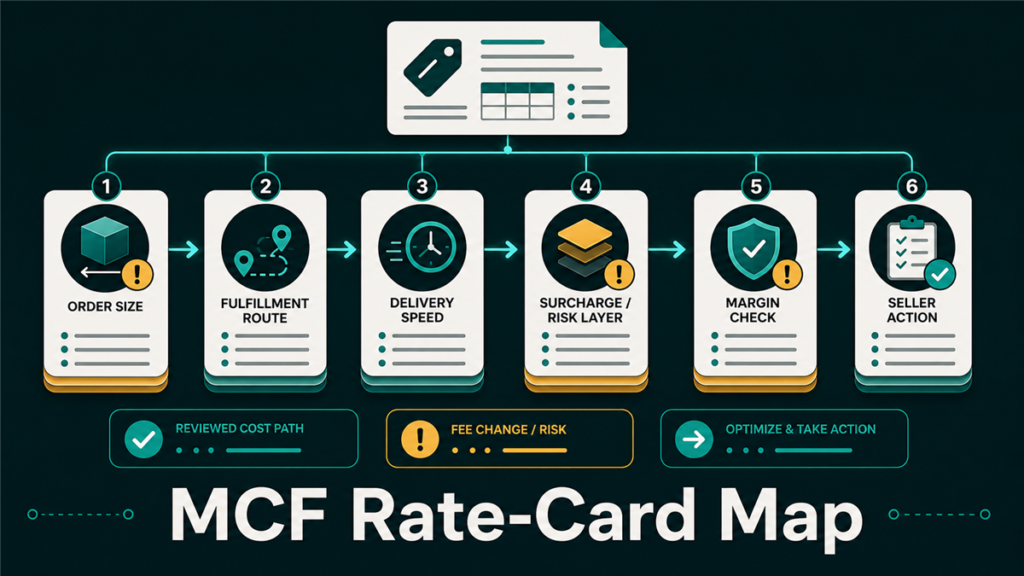
Amazon Multi-Channel Fulfillment (MCF), Supply Chain by Amazon, AWD, Buy with Prime, and related logistics services are part of a broader trend: sellers are comparing fulfillment networks across more than one sales channel.
For some sellers, consolidating inventory can reduce operational complexity. For others, the cost structure, packaging rules, marketplace policies, or channel restrictions may make a separate 3PL or FBM setup cleaner.
Amazon's broader supply-chain direction shows the company expanding logistics services across freight, distribution, fulfillment, and delivery. For sellers, the practical trend is that fulfillment decisions now sit inside a wider supply-chain strategy, not only inside Seller Central.
What sellers should do: If selling outside Amazon, evaluate MCF, FBM, 3PL, and direct-fulfillment options by channel. Confirm each marketplace's current fulfillment policy before routing orders through another network. Consider Supply Chain by Amazon for international shipping and bulk storage only after comparing total landed cost, service fit, and inventory control.
Trend 7: Compliance and Account Health Are Higher Stakes
Amazon's compliance requirements cover product safety, listing accuracy, intellectual property, and performance metrics. Enforcement is tighter, and the consequences of non-compliance are more immediate.
Sellers with poor account health scores face listing suppression, ASIN-level restrictions, and, in severe cases, account suspension. Products that fail safety or compliance checks can be removed without warning. Intellectual property complaints, even disputed ones, can affect account health.
What sellers should do: Check the Account Health Dashboard regularly. Respond to performance notifications promptly. Ensure product documentation (safety data sheets, compliance certificates, test reports) is current and accessible. Do not list products in restricted categories without proper approval.
Practical Monitoring Checklist for 2026
- Recalculate SKU-level contribution margin quarterly using current fee rates and actual ad spend.
- Monitor TACoS per SKU monthly and set kill thresholds for unprofitable products.
- Track inventory days of supply by SKU and variation, not just the parent ASIN level.
- Set aged inventory review triggers before slow-moving stock becomes expensive.
- Audit catalog quality quarterly: fix suppressed listings, update backend keywords, verify variation structures.
- Review Account Health Dashboard weekly.
- Evaluate fulfillment strategy annually: compare FBA, FBM, MCF, AWD, and 3PL costs for each SKU category.
- Test AI tools on a limited scope before rolling them into full operations.
FAQ
What is the biggest Amazon FBA trend in 2026?
The most impactful trend is the continued layering of fulfillment, storage, advertising, inventory, and optional-service costs. Sellers must model the full cost stack at the SKU level to protect margin.
Are Amazon advertising costs still going up?
Often, yes. Competitive categories can make clicks expensive enough to erase contribution margin. Sellers need tighter TACoS management and regular search term pruning to maintain advertising efficiency.
Should I use Amazon MCF for Walmart orders?
It depends on your volume, margins, and marketplace rules. MCF can simplify some multichannel operations, but sellers should confirm the current policy for each channel and model the total per-order cost against their current fulfillment method before switching.
Is AI going to replace Amazon seller tools?
AI is being built into existing seller tools for forecasting, bid management, and listing content. It improves speed and reduces manual work. But it does not replace the seller's responsibility to understand unit economics, review content for compliance, and make strategic product decisions.
How often should I recalculate my FBA margins?
At minimum, recalculate quarterly. Amazon updates fees at least annually, ad costs change continuously, and COGS or shipping costs can shift with supplier or logistics changes. Monthly recalculation is better for high-volume sellers.
Staying Ahead of FBA Trends
The trends in 2026 all point in one direction: FBA rewards operational discipline and penalizes neglect. Fee complexity, ad cost pressure, inventory rules, and compliance requirements are all higher than a year ago. The sellers who track these changes at the SKU level, adjust their operations, and maintain catalog quality will outperform those who do not.
If your Amazon operations need a systematic review, from catalog quality and variation structures to inventory strategy and margin analysis, Qubeq can audit the account and identify where margin is leaking before the next fee cycle makes it worse.