An Amazon Lightning Deal is a time-limited promotion, typically a few hours, that puts your product on Amazon's Deals page at a discounted price until the timer or the allocated inventory runs out. Run well, a Lightning Deal buys concentrated sales velocity, visibility to deal-hunting shoppers, and a way to move excess stock. Run carelessly, it buys a fee, a margin haircut, and a price-history problem. The difference is arithmetic done before submission.
- Lightning Deals run for a limited window on the Deals page and end when time or deal inventory runs out.
- Eligibility is determined per-ASIN in Seller Central; Amazon surfaces which of your products qualify, and requirements include Prime eligibility, review standards, and a meaningful discount against recent pricing.
- Deals carry fees, and Amazon has revised its deal fee structure in recent cycles; check the current fee shown in Seller Central at scheduling time rather than relying on published flat numbers.
- The deal discount interacts with your price history: deep deal prices can constrain future pricing and strike-through eligibility.
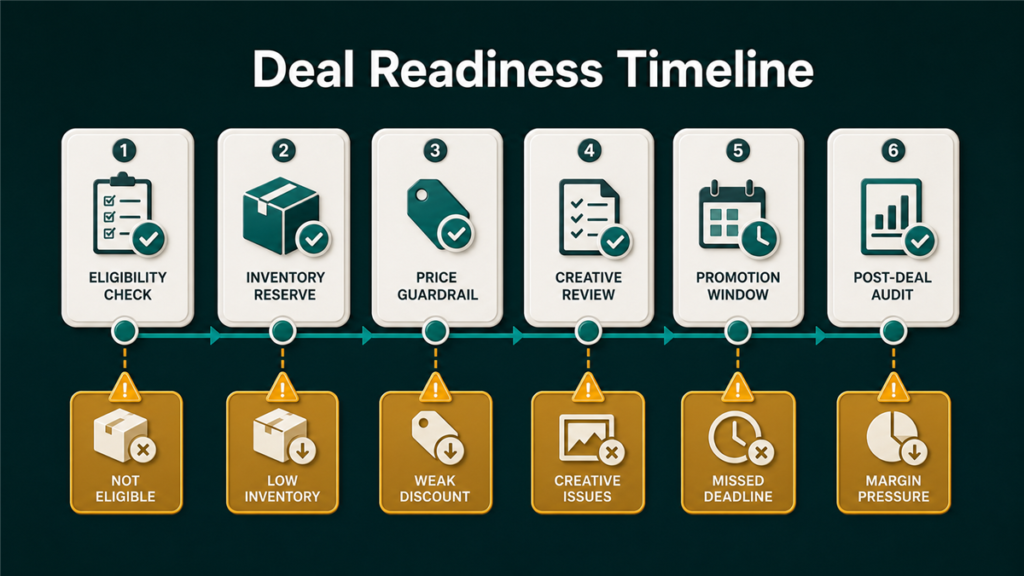
- A deal is worth running when the contribution margin at deal price, times realistic deal volume, beats the fee plus the rank and clearance value you assign. Do the math per ASIN.
What Lightning Deals Are and Where They Appear
Lightning Deals appear on Amazon's Deals page, one of the most trafficked destinations on the marketplace, especially around Prime Day, Black Friday, and Cyber Monday. Each deal shows the discount, a progress bar as deal stock claims, and a countdown. Scarcity and the timer do the conversion work: shoppers act because the deal visibly expires.
For sellers, the value is concentrated: hours of elevated traffic and velocity that can lift Best Seller Rank, generate reviews downstream, and clear inventory that would otherwise age into storage fees.
Eligibility: Let the Dashboard Tell You
Amazon decides deal eligibility per ASIN, and the practical source of truth is the Deals dashboard in Seller Central, which lists your eligible products. Common requirements include:
- A Professional selling account in good standing.
- Prime-eligible offers (FBA or Seller Fulfilled Prime).
- Products meeting Amazon's rating and review standards.
- A deal price meaningfully below recent pricing, validated by Amazon's pricing rules at submission.
- New-condition products that comply with category and deal policies; restricted categories are excluded.
Specific thresholds (star ratings, discount percentages, minimum quantities) have shifted over time and vary by marketplace and event, so treat the dashboard's eligibility list and validation checks as authoritative rather than any static rule list.
What Lightning Deals Cost
Deal fees are real and charged whether or not the deal performs. Amazon has revised its deal fee structure in recent cycles, including changes around how event and non-event deals are charged, so do not budget from older flat-fee figures. The fee for your specific deal is shown in Seller Central when you schedule it, and event-window deals (Prime Day, Black Friday, Cyber Monday) are priced differently from everyday deals.
Two cost layers matter beyond the fee:
- Margin cost: the discount times every unit sold at deal price.
- Price-history cost: deal pricing feeds your recent price history, which can affect future strike-through pricing and deal eligibility. A deal price you cannot afford to repeat still echoes after the deal ends.
How to Create a Lightning Deal
- In Seller Central, open the Deals dashboard under Advertising.
- Create a new deal and pick from the products Amazon lists as eligible.
- Set the deal price within Amazon's validation limits.
- Allocate deal quantity: enough to last the window, not your whole sellable pool.
- Choose the schedule options offered; during events, Amazon assigns windows.
- Review the fee shown, confirm, and submit for validation.
Keep regular inventory buffered separately from deal quantity. A deal that strips your sellable stock trades a visibility spike for a stockout, and the rank you bought decays while you are out of stock.
The Go/No-Go Math
Before submitting any deal, run this per ASIN:
- Contribution margin per unit at deal price (after referral, fulfillment, and product costs).
- Multiply by realistic deal-window volume (history from prior deals or comparable promotions, not hope).
- Subtract the deal fee.
- Add the value you honestly assign to secondary effects: rank lift, review velocity, clearance of stock that would otherwise accrue storage surcharges.
If the result is negative and the secondary effects are speculative, run a coupon or price promotion instead; they are cheaper ways to test demand at a lower price point.
Mini-Scenario
A seller with overstocked seasonal inventory faced rising aged-inventory surcharges going into spring. A Lightning Deal at a strong discount cleared most of the excess in one afternoon. The deal itself roughly broke even after the fee and discount, but the avoided storage surcharges and freed capacity made the whole move clearly positive. The same seller declined a deal on their hero ASIN the same month: the math showed the discount would cost more margin than the rank lift was plausibly worth, and a small coupon achieved the velocity bump instead.
FAQ
How long does a Lightning Deal run?
A limited window, typically a few hours, ending early if the allocated deal quantity sells out. Exact durations vary by marketplace and event.
How much does a Lightning Deal cost?
Amazon shows the fee at scheduling time in Seller Central, and fees differ between everyday deals and high-traffic events. Amazon has revised deal fee structures in recent cycles, so verify the current fee in the dashboard rather than relying on older published figures.
Why isn't my product eligible?
Eligibility is per-ASIN and reflects account standing, Prime eligibility, rating thresholds, pricing history, and category rules. The Deals dashboard lists what qualifies; improving reviews, pricing stability, and account health expands the list over time.
Do Lightning Deals improve organic ranking?
Concentrated sales velocity can lift rank, and the lift is most durable when the listing converts well at regular price afterward. A deal on a weak listing produces a spike, not a step change.
Are Lightning Deals worth it during Prime Day?
Event deals cost more and convert more. The same go/no-go math applies with bigger numbers on both sides. Inventory depth matters most during events: selling out mid-window wastes the placement you paid for.
Run Deals From a Position of Operational Strength
Lightning Deals reward sellers whose economics, inventory, and listings are already in order, and punish improvisation with fees and margin leaks. If you want your promotion calendar tied to actual SKU-level contribution margin and inventory position, Qubeq manages exactly that operational layer for established Amazon brands. Reach out and we will pressure-test your next deal before you pay for it.
Key Takeaways
- amazon lightning deals