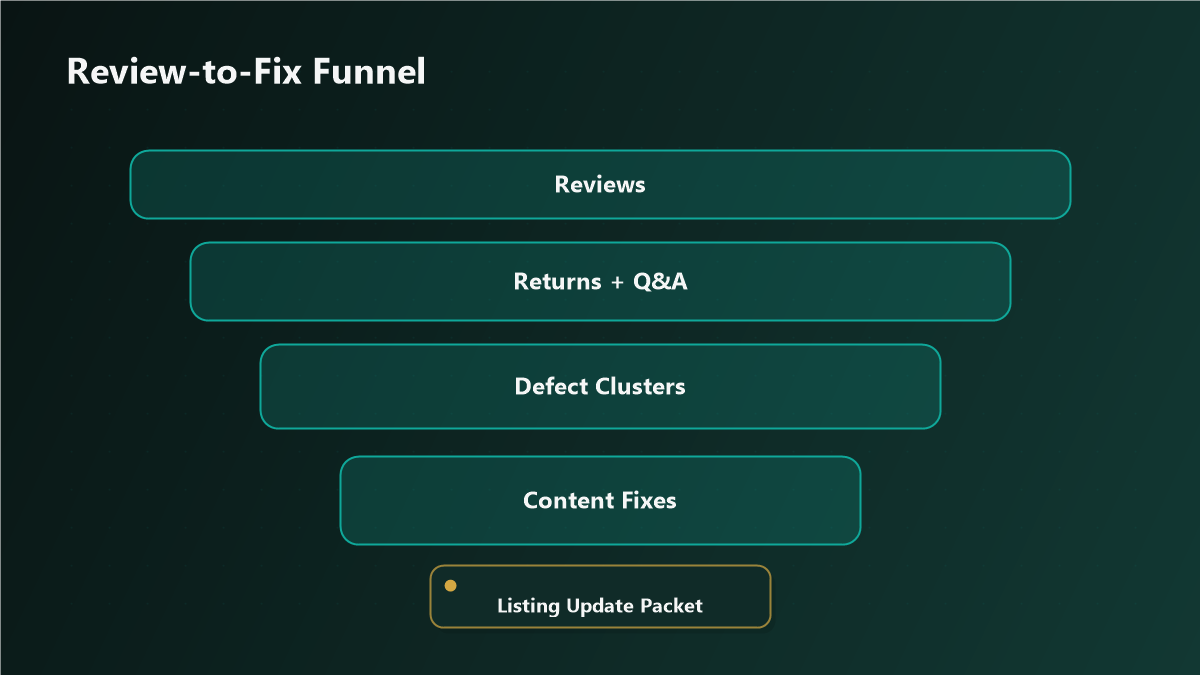
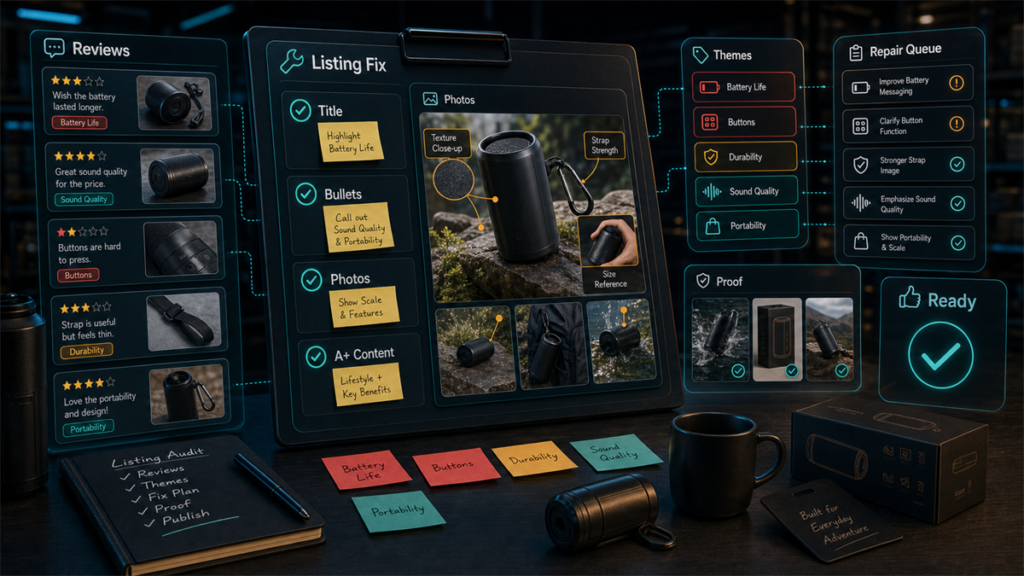
You already paid for the most honest listing audit you will ever get. It is sitting in your reviews, your return reasons, and your customer questions. Every recurring complaint is a content gap a buyer fell into. Every return reason is a detail your listing failed to set straight. Every repeated question is information a shopper needed and could not find. This is not about studying competitor reviews  that is a different exercise. This is about systematically reading your own customer voice and converting it into specific listing fixes that lift conversion and cut returns.
Key Takeaways
- Your reviews, returns, and questions are a free, brutally honest audit of where your listing fails.
- Three sources, three jobs: recurring complaints reveal content gaps, return reasons reveal missing details, repeated questions reveal missing information.
- Look for patterns, not one-offs  the same complaint three times is a fix; one outlier rarely is.
- Many "product problems" in reviews are actually expectation problems your listing created and can solve.
- A quarterly voice-of-customer pass turns scattered feedback into a prioritized list of content changes.
The Mindset Shift: Feedback Is a Fix List
Sellers tend to read reviews emotionally  proud of the good ones, stung by the bad ones. The productive read is clinical: each negative signal is a clue about a gap in the listing, not just a verdict on the product. Often the product is fine and the listing set the wrong expectation. A buyer who expected a larger item, a different material, or an included accessory is telling you exactly which detail your listing under-communicated. Reframe feedback as a backlog and the work becomes obvious.
Source 1: Recurring Complaints in Reviews
Read your reviews looking for the phrase that repeats. One person calling a product "flimsy" is noise; ten people using that word is a signal. Tally the recurring themes and sort them into two buckets: genuine product issues (route to the product team) and expectation or information gaps (route to the listing).
The listing-fixable ones are gold. "Smaller than I expected" means add a scale image and clearer dimensions. "Thought it came with the charger" means make the contents explicit. "Hard to set up" means add a how-it-works module or a clearer instruction note. Each recurring complaint maps to a specific content change.
Source 2: Return Reasons
Return reasons are the most direct map of detail gaps you have, because the customer is telling you precisely why the product did not match what they expected. Pull your return-reason data and look at the categories that recur. Reasons tied to expectation  wrong size, not as described, did not fit, missing parts  almost always trace to a listing that under-specified something. Reasons tied to defects or damage route to product or packaging, not content.
For each expectation-driven return reason, ask what the listing could have said or shown to prevent it, and add that to the fix list. Reducing even one recurring return reason protects margin and review score at once.
Source 3: Customer Questions
Repeated questions are missing information made visible. If shoppers keep asking the same thing, the answer belongs in the listing  in a bullet, the description, A+, or the Q&A itself. Compatibility, dimensions, materials, included items, and use cases dominate this list. Treat a frequently asked question as a defect in the listing: the buyer should not have had to ask.
From Signal to Fix: A Mapping
- "Smaller / bigger than expected" -> scale image, dimension callouts, clearer size in title or bullets.
- "Not as described" -> reconcile claims with reality; remove overstatement; add the missing caveat.
- "Missing parts / thought it included X" -> explicit contents image and bullet.
- "Hard to use / set up" -> how-it-works module, setup note, or instructional image.
- "Doesn't fit / not compatible" -> compatibility detail and a comparison or fitment module.
- "Cheap / flimsy feel" -> material and build detail, honest close-up imagery; or a genuine product fix if warranted.
A Quarterly Voice-of-Customer Pass
- Gather the period's reviews, return reasons, and customer questions for your key ASINs.
- Tag each negative signal by theme and by source.
- Separate genuine product issues from listing-fixable expectation and information gaps.
- Rank the listing-fixable themes by frequency and by likely conversion or return impact.
- Map the top themes to specific content changes using the table above.
- Implement, then watch the relevant return reason and review theme over the next period to confirm the fix landed.
A voice-of-customer dashboard that pulls reviews, returns, and questions into one view makes this a routine instead of a scavenger hunt.
What Good Looks Like
You can point to a content change and the customer signal that prompted it. Your top recurring complaint last quarter is shrinking this quarter. New reviews stop repeating an old complaint after you fixed the listing. Your fix list is ranked by frequency, not by which review stung the most.
Mini-Scenario: The Return Reason That Rewrote a Bullet
A pet-supplies brand had a steady trickle of returns on a popular item, reason coded as "not as described." Reading the attached reviews, the pattern was plain: customers expected the product to fit a size of pet it was never designed for, because the listing led with the feature and buried the size guidance. The product was fine; the listing had invited the wrong buyer. They moved fitment into the title and the first bullet, added a sizing image, and the "not as described" returns on that ASIN fell over the following months. The customers had written the fix; the brand just had to read it.
FAQ
How is this different from reading competitor reviews?
Competitor reviews tell you about a market and a rival's gaps. Your own reviews, returns, and questions tell you precisely where your listing is failing your buyers right now. This piece is about the latter  mining your own voice of customer.
How many complaints make a pattern?
There is no magic number, but treat a theme that appears repeatedly across independent customers as a signal and a one-off as noise. Frequency and consistency of wording matter more than raw count.
Can fixing the listing really reduce returns?
Many returns are expectation mismatches the listing created  wrong size, missing item, misread feature. Closing those information gaps addresses the cause. Defect and damage returns need a product or packaging fix instead.
Where should the answer to a common question go?
Wherever the buyer will see it before deciding  a bullet or the description for core facts, A+ for richer explanation, and the Q&A for the question itself. The goal is that the next shopper never has to ask.
How often should I run this?
Quarterly for most catalogs, and immediately after a spike in a particular return reason or a cluster of similar new reviews.
Let Your Customers Write Your Fix List
Your reviews, returns, and questions are the most honest audit you own, and they are free. A quarterly pass that turns recurring signals into ranked content fixes lifts conversion and cuts returns at the same time. If you want that pass run for you  pulled into a single voice-of-customer view and mapped to specific listing changes  Qubeq can audit your customer feedback and brief the fixes.