Seller Fulfilled Prime can give eligible self-fulfilled products Prime branding, but it also puts pressure on shipping speed, cancellation control, tracking accuracy, and weekly performance discipline. This Seller Fulfilled Prime readiness checklist helps sellers decide whether the operation is ready before they attempt the trial.
Key Takeaways
- Seller Fulfilled Prime is not just a badge decision. It is an operations commitment.
- Amazon describes prequalification, a 30-day trial, and ongoing performance requirements.
- Sellers should review warehouse cutoffs, carrier coverage, inventory accuracy, packaging, and account-health risk before enrolling.
- A small SKU pilot is safer than applying Prime promises to a large self-fulfilled catalog.
- If the team cannot monitor performance weekly, it is not ready for Seller Fulfilled Prime.
What Is Seller Fulfilled Prime?
Seller Fulfilled Prime lets eligible sellers display Prime branding on products they fulfill without Amazon. Amazon states that sellers can enroll after demonstrating the ability to provide the fast, reliable delivery experience Prime members expect.
The practical meaning is simple: Amazon customer expectations stay high, but the seller's own fulfillment operation carries the execution load.
Before you treat Seller Fulfilled Prime as a conversion lever, ask:
- Can we ship same-day or next-day when needed?
- Can our carrier network support the promised delivery speeds?
- Can we protect valid tracking, late shipment, and cancellation performance?
- Can our team handle pre-order buyer inquiries clearly?
- Can we monitor the program weekly without surprises?
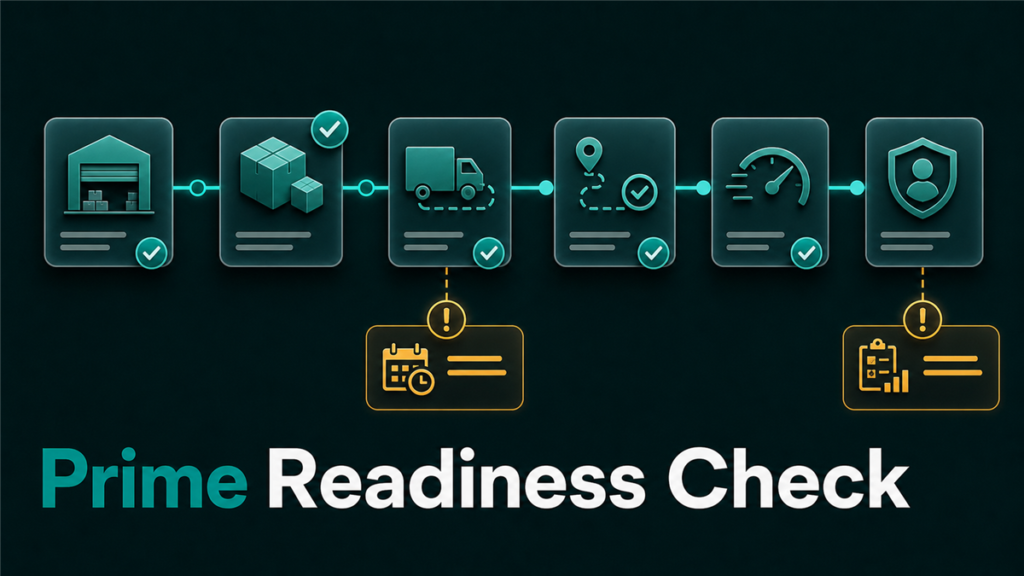
Seller Fulfilled Prime Readiness Checklist
Use this checklist before registering for the trial.
| Readiness Area | Pass Condition | Risk If Weak |
| Professional seller setup | Account type and program access are eligible | Trial access may be unavailable |
| Warehouse cutoffs | Same-day processing windows are realistic | Late shipment risk rises |
| Carrier coverage | Delivery speeds can be met by region and size tier | Prime promises become unreliable |
| Inventory accuracy | Sellable units are counted and reserved correctly | Cancellations increase |
| Packaging workflow | Orders can be packed consistently before cutoff | Handling time breaks |
| Tracking discipline | Valid tracking is applied on time | Account-health risk increases |
| Customer-service split | Team understands pre-order vs post-order responsibilities | Confused support handoffs |
| Weekly review owner | One person owns performance monitoring | Small issues become program risk |
If more than two areas are weak, fix the operation before starting the trial.
Which Products Should You Pilot First?
Start with products that are easy to fulfill correctly. Do not begin with the hardest SKUs in the catalog.
Good pilot candidates:
- Stable demand.
- Clean listing status.
- Accurate inventory counts.
- Predictable packaging.
- Low damage risk.
- Good margin after shipping cost.
- Warehouse location close to major customer regions.
Risky pilot candidates:
- Oversize or extra-large items.
- Fragile products.
- Products with frequent stockouts.
- Products that need custom handling.
- SKUs with thin margin after expedited shipping.
- Products with unresolved listing or compliance issues.
The first pilot should prove the process, not stress-test every weakness at once.
Build The Weekly SFP Review
Amazon notes that performance requirements are reviewed weekly. Sellers should mirror that rhythm internally.
Each week, review:
- Late shipment signals.
- Valid tracking issues.
- Cancellation causes.
- Carrier performance by lane.
- Cutoff misses.
- Inventory adjustments.
- Customer contact patterns.
- Any account-health alerts.
This review should not be a blame meeting. It is an exception-control system. The goal is to catch the pattern while it is still small.
Mini-Scenario
A seller wants to enroll 150 self-fulfilled SKUs because the Prime badge may help conversion. The warehouse ships most orders on time, but inventory counts are updated only once per day and some SKUs require custom packaging.
A safer plan is to pilot 15 stable SKUs with reliable packaging, confirm carrier coverage, and review weekly performance before expansion. If the pilot exposes cutoff or inventory problems, the seller fixes those first instead of risking Prime offers across the full catalog.
FAQ
Is Seller Fulfilled Prime the same as FBA?
No. FBA uses Amazon fulfillment centers for storage, packing, shipping, customer service, and returns. Seller Fulfilled Prime lets eligible sellers fulfill Prime orders themselves while meeting program requirements.
Does Seller Fulfilled Prime require a trial?
Amazon describes a required trial before enrollment. Sellers must prequalify, register for the trial, and meet performance requirements during the trial.
Should every seller use Seller Fulfilled Prime?
No. It works best when the seller has reliable shipping operations, accurate inventory, strong carrier coverage, and the ability to monitor performance closely.
What can cause Seller Fulfilled Prime risk?
Late shipments, invalid tracking, cancellations, poor carrier coverage, weak inventory accuracy, and missed cutoffs can all create risk.
Can a 3PL support Seller Fulfilled Prime?
Potentially, but the 3PL must be able to meet the required shipping speed, tracking, packing, and cutoff discipline. The seller still owns the account outcome.
Use Seller Fulfilled Prime Only When Operations Are Ready
Seller Fulfilled Prime can be useful, but it should not be used to cover weak fulfillment. Start with the operation, then decide whether the badge makes sense.
Qubeq helps Amazon sellers map fulfillment workflows, account-health risks, catalog readiness, and Seller Central execution. If your team is considering Seller Fulfilled Prime, the first step is a readiness review before the trial begins.