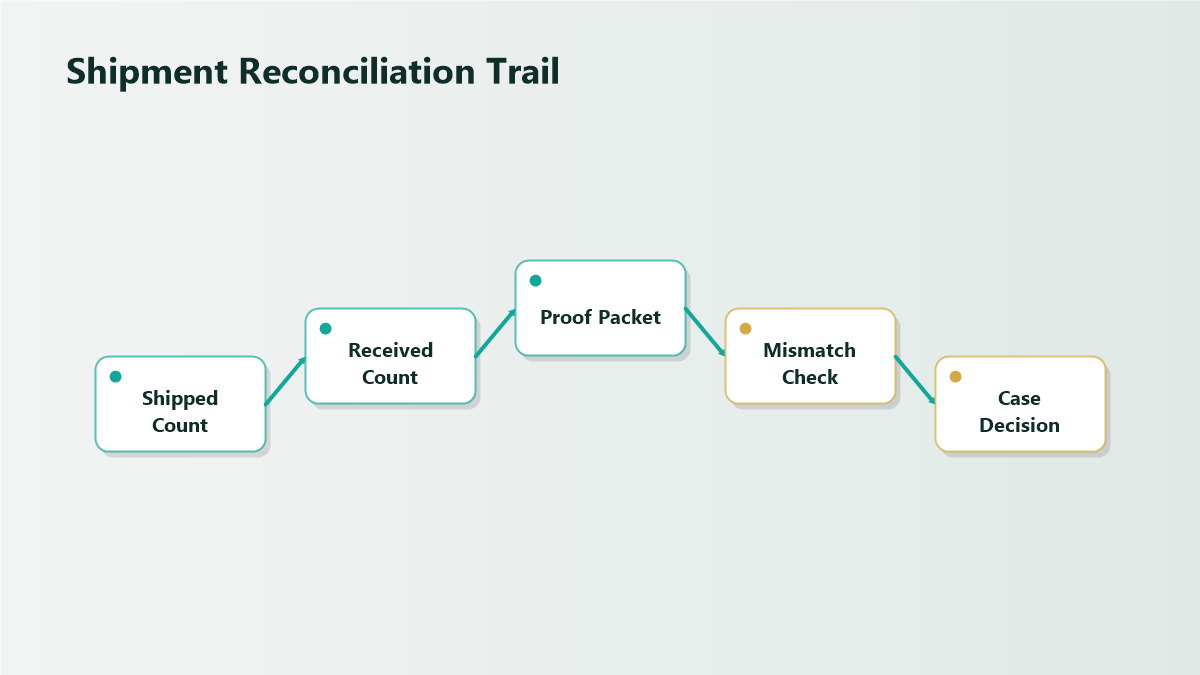

You sent a known quantity into FBA and the received count came back short. Before you open a case or assume the units are gone, you need to confirm the gap is real, understand the window you are working inside, gather evidence that will actually support a claim, and know the conditions under which a reimbursement applies. This is the decision path for one specific symptom, not a general FBA primer.
Key Takeaways
- A short received count is not automatically a loss; units are often still being received, in transfer, or were counted against a different shipment.
- Confirm the discrepancy is real and stable before acting; receiving can lag, and counts can update.
- There is a reconciliation window in which discrepancies should be investigated; work inside it and do not let cases age out, while verifying the current timing against official guidance.
- Evidence is everything: your shipping plan, carrier proof of what shipped and was delivered, box content details, and supplier documentation.
- Reimbursement applies under specific conditions when units are confirmed received-short or lost in Amazon's control and the discrepancy is not otherwise resolved; it is conditional, not guaranteed.
Step 1: Confirm the Discrepancy Is Real
A short count at first glance is frequently not a true loss. Before anything else:
Only once the received count has stabilized and still falls short do you have a real discrepancy to work.
Step 2: Understand the Window You Are In
Inbound discrepancies are investigated within a defined reconciliation window rather than open-endedly. Treat time as a resource: the longer a real gap sits, the harder it is to evidence and the closer it drifts to aging out. Do not assume a specific number of days from memory; confirm the current window and eligibility timing against official guidance, then work well inside it. The practical rule is simple: once you have confirmed a real gap, start the evidence and case process promptly rather than letting it sit.
Step 3: Gather Evidence Before You File
A claim succeeds or fails on documentation. Assemble:
Capture this while it is fresh. Reconstructing carrier proof weeks later is the most common reason a legitimate discrepancy cannot be resolved.
Step 4: Decide Whether to Investigate or File
With a confirmed gap, an understood window, and evidence in hand:
- If the discrepancy may still be a receiving lag or a split shipment, give receiving time to settle and re-check.
- If the gap is stable and units are genuinely unaccounted for, open the reconciliation or investigation path for that shipment.
- Provide the evidence requested; respond to follow-ups promptly with the documents already assembled.
- Track the case ID and dates; do not open duplicate parallel cases for the same shipment, which can confuse the trail.
Step 5: When Reimbursement Applies
Reimbursement is conditional, not automatic. In general terms, it applies when units are confirmed to have been received short or lost while in Amazon's control and the discrepancy is not otherwise reconciled, and when the claim is supported by the evidence and raised within the applicable window. Several things can change the outcome: units later found and received, ownership or supplier documentation that cannot be produced, or a window that has closed. Keep your expectations conditional and your language non-promissory; you are pursuing a legitimate, evidenced claim, not collecting a guaranteed payout.
Mini-Scenario: The Missing Units That Were Never Missing
A seller shipped a multi-box plan and saw the received count land roughly twenty percent short the morning after delivery. Their first instinct was to file a loss claim. Instead they checked the shipment state and found it still receiving, and noticed the plan had been split across two destinations. Over the next two days the count climbed as the second portion was received, and the gap closed to a small remainder. For that genuine remainder, they already had the shipping plan, box contents, and carrier proof of delivery saved from day one, so the reconciliation was quick. Filing on day one would have meant chasing a discrepancy that was mostly just receiving lag.
FAQ
Why did FBA receive fewer units than I shipped?
Often the shipment is still being received, was split across destinations, or the counts are being compared across different shipments. Confirm the received status has settled before treating it as a real loss.
How long do I have to report an FBA received-quantity discrepancy?
There is a reconciliation window, but the exact timing changes and should be verified against current official guidance rather than assumed. The safe practice is to confirm a real gap and start the process promptly.
What evidence do I need for an FBA shipment discrepancy?
Your shipping plan and declared box contents, carrier proof of shipment and delivery, supplier invoices or proof of ownership, and a clear record of shipment ID, dates, and the shipped-versus-received numbers.
Will I automatically get reimbursed for missing FBA units?
No. Reimbursement is conditional on the units being confirmed received-short or lost in Amazon's control, supported by evidence, and raised within the applicable window. Units later found, missing documentation, or a closed window can change the outcome.
Should I wait or file right away?
Wait only until the received status settles and you have confirmed a stable gap and split-shipment status. Once the gap is real, move promptly with your evidence rather than letting the window erode.
Resolve the Gap Before the Window Closes
A short received count is sometimes a lag and sometimes a real loss, and the difference is worth confirming before you act. Once the gap is real, evidence and timing decide everything. If you have a confirmed discrepancy and want the reconciliation handled correctly and on time, Qubeq can verify the gap, assemble the evidence, and pursue the claim within the applicable window.