
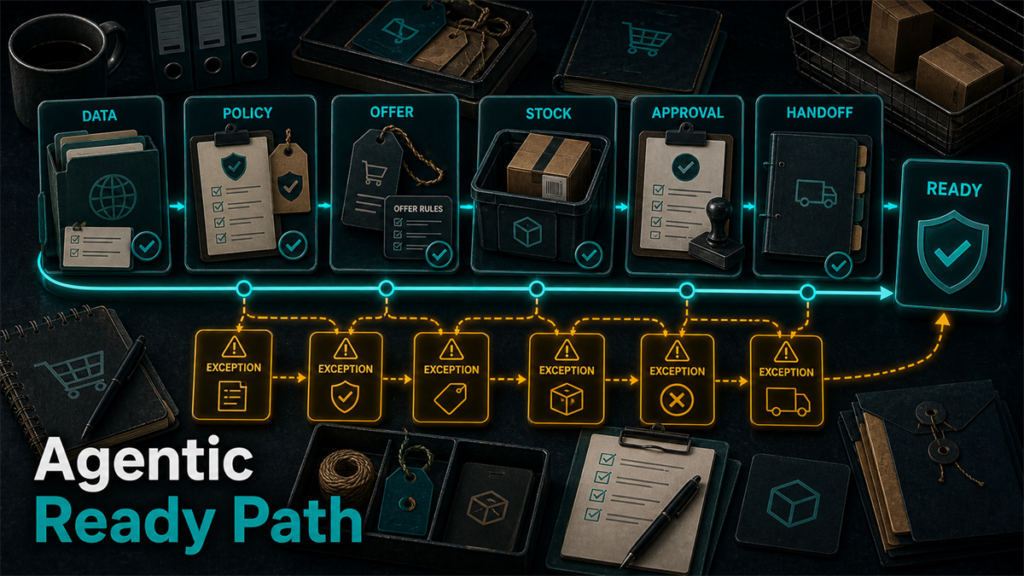
AI shopping agents are beginning to browse product catalogs, compare options across platforms, and complete purchases on shoppers' behalf  and they filter out listings that don't give them the data they need. This guide explains what agentic commerce is, what AI agents look for when evaluating a product, and the practical steps marketplace brands can take to stay in the running.
Key Takeaways
- Agentic commerce means AI agents  not human shoppers  doing the browsing, comparing, and buying. Your listings need to be readable by machines, not just appealing to humans.
- Incomplete product attributes, inconsistent pricing across channels, and vague return policies are the fastest ways to get excluded from an agent's shortlist.
- This readiness work is mostly good catalog hygiene that helps everywhere: search, AI overviews, voice, and human shoppers.
- The Shopify/Google Universal Commerce Protocol (UCP) and OpenAI/Stripe Agentic Commerce Protocol (ACP) are emerging standards worth monitoring. Adoption scope is still developing  verify current status before citing either. [VERIFY BEFORE PUBLISH]
- Getting ready now means auditing your structured data, feed consistency, inventory accuracy, and policy pages.
What Is Agentic Commerce, and Why Should Marketplace Brands Pay Attention?
Agentic commerce is a model of online shopping where AI agents make decisions across the full buying journey  from product discovery and comparison through checkout and post-purchase support  with minimal human intervention at each step.
That's different from a chatbot that helps a shopper find a product on your site. In conversational commerce, a shopper types a question and gets a recommendation. The shopper still clicks, compares, and buys. In agentic commerce, the AI agent does the clicking, comparing, and buying. The shopper sets a goal or a preference  "find me a 40L waterproof hiking backpack under $120 with free returns"  and the agent goes off and executes.
The agent doesn't browse the way a human does. It reads structured data fields, checks policies, confirms inventory, validates pricing, and either selects a product or moves to the next option. A product that doesn't give the agent what it needs gets skipped.
Platforms already building agentic commerce infrastructure include ChatGPT (with OpenAI's Agentic Commerce Protocol developed with Stripe), Microsoft Copilot (Copilot Checkout), Google AI Mode (with its partnership on the Universal Commerce Protocol), and Shopify's Agentic Storefronts (which syndicate merchant catalogs across AI channels). [VERIFY: confirm current availability and scope of each at publish time.] According to Shopify, AI-driven orders increased 15-fold in 2025. [VERIFY: locate original source in Shopify enterprise blog before publishing.]
McKinsey estimates the global agentic commerce opportunity could reach $3 to $5 trillion by 2030. [Source: McKinsey, "The Agentic Commerce Opportunity," October 2025.] That number is a long-range projection, not a current state. The current state is: early deployments, limited channel coverage, and infrastructure that's still being built. But the data-layer decisions brands make today  clean attributes, accurate feeds, clear policies  will either include or exclude them from the AI agent's consideration set as that infrastructure matures.
How Agentic Commerce Differs From Voice Commerce and AI Recommendations
It's worth being precise here because these terms get conflated.
Voice commerce (like Alexa for Shopping on Amazon) is channel-specific and uses voice as the input interface. The buying experience is still triggered and confirmed by the human.
AI product recommendations surface products within a shopping session but don't complete transactions on the shopper's behalf.
Agentic commerce goes further: the AI agent acts autonomously, often operating outside a single platform or storefront, and can execute the purchase when the shopper's preset criteria are met.
The readiness requirements overlap, but the stakes on data completeness and policy clarity are higher for agentic commerce because the agent has no patience for missing information.
What Do AI Shopping Agents Actually Check?
AI agents don't respond to marketing copy. They read structured data. Here's what the agent is looking for when it evaluates your listing:
Structured Product Attributes
The agent needs machine-readable fields  title, description, price, material, dimensions, weight, color, size, compatibility, and product category  in standardized formats. Information buried in marketing copy, in A+ Content modules, or in JavaScript-rendered page elements is often invisible to the agent.
A hiking backpack titled "Adventure Day Pack  Green" with no volume, dimensions, or material listed won't match a query for "40L waterproof hiking backpack." A listing titled "40L Waterproof Hiking Backpack, Green, Nylon, 21 x 13 x 8 inches" will.
On Amazon, this means completing all relevant backend attributes in the flat file or the Add a Product workflow: item type keywords, material type, capacity, product dimensions, item weight, and any category-specific required or recommended fields. On Walmart Seller Center, it means completing all item setup attributes, including attributes marked optional that agents may use for filtering. On a DTC storefront, it means submitting to Google Merchant Center with a complete product feed and adding ecommerce schema markup to product pages.
Variant Structure
AI agents can confuse separate SKUs with separate products when variants are listed independently rather than in a proper parent-child structure. If a brand sells a jacket in five colors and each color is a standalone listing without a variation relationship, the agent may treat them as five unrelated products, fail to find the shopper's preferred color, and move on.
Correct variation architecture  a single parent with child ASINs or items linked by color, size, or other variant attributes  lets the agent understand what options are available and whether any match the shopper's criteria.
Real-Time Inventory Accuracy
An agent that selects a product and attempts checkout, only to find the item is out of stock or has a four-week lead time, will fail the shopper's task. Inventory accuracy across all active channels is a prerequisite for agentic commerce participation. On Amazon, this means FBA stock levels and FBM quantity fields match reality. On Walmart, the item quantity feed must be current. On a DTC storefront, the inventory sync with whatever fulfillment system the brand uses must be reliable.
Pricing Consistency Across Channels
AI agents may compare your product price across Amazon, Walmart, and your DTC site in a single session. Price discrepancies between channels can trigger Amazon's pricing policies (which may suppress a listing) or simply cause the agent to select a cleaner-priced competitor. Marketplace price parity matters operationally as well as for agent trust signals.
Return Policy Clarity
Shoppers increasingly instruct AI agents to filter for specific return conditions. An agent asked to "only consider brands with free returns" will exclude a product whose return policy is buried in a footer link, described only in vague terms, or absent from the structured policy fields the agent reads. Return policy information needs to be explicit, findable, and written in plain language on a dedicated, crawlable page.
The same applies to shipping timelines, warranty terms, and any exclusion conditions. If the policy requires a human to read four paragraphs to find the answer, the agent will likely skip the listing.
Fulfillment and Checkout Readiness
The agent needs a path to complete the transaction. On Amazon, fulfillment through FBA or a reliable FBM setup handles this. On Walmart, WFS or a compatible carrier integration is needed. On DTC storefronts, checkout needs to be accessible to agent protocols  specifically, it needs to support the payment and checkout flows the agent is using, whether that's Google Pay, Shop Pay, or a protocol like UCP or ACP. [VERIFY: confirm which checkout protocols are required for which channels before publishing.]
If the checkout flow requires account creation, CAPTCHA resolution, or multi-step human confirmation, agentic checkout may fail or be deprioritized.
The Agentic Commerce Readiness Checklist for Marketplace Brands
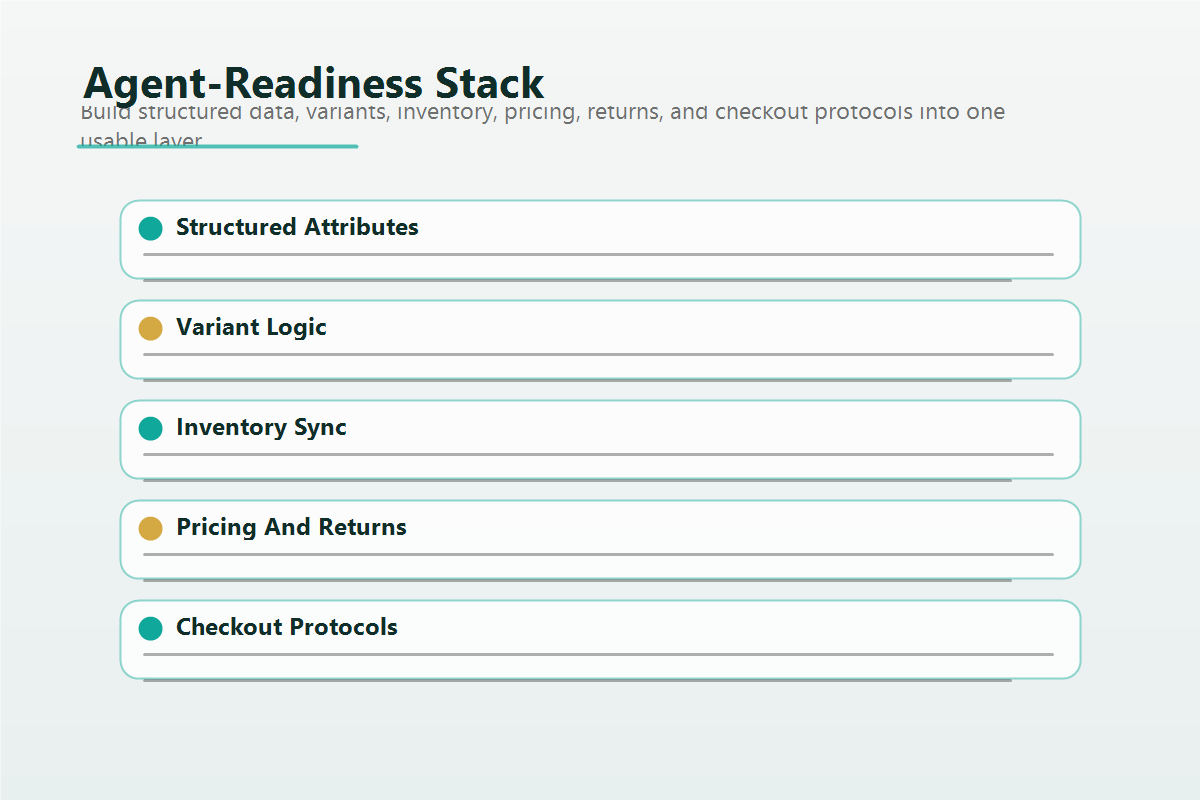
Work through each layer before your next catalog audit or marketplace expansion.
Structured Data and Attributes
- Audit every active SKU for complete attribute coverage in each marketplace's required and recommended fields. Flag any SKU where optional fields that describe material, dimensions, compatibility, or use case are empty.
- Rewrite product titles to include specific, factual descriptors: capacity, material, dimensions, intended use. Remove vague marketing phrases.
- Submit a complete, current product feed to Google Merchant Center for any products sold on a DTC storefront or Shopify channel. Add ecommerce schema markup to product pages.
- Check whether JavaScript rendering is blocking AI crawlers from reading product data on DTC pages. Use Google's Rich Results Test or a similar tool to confirm.
Variation Structure
- Audit all variation families across Amazon and Walmart. Confirm each variant relationship is correctly built (parent-child on Amazon, grouped item setup on Walmart). Any variants listed as standalone products that should be linked need to be merged or restructured.
- Confirm that all child ASINs or variation items have consistent, complete attributes. A parent-child structure where only the parent has complete attributes and the children are sparse doesn't give the agent what it needs.
Inventory and Feed Accuracy
- Cross-check live inventory quantities between your WMS or 3PL records and each marketplace's active feed. Any channel where the system of record and the marketplace feed diverge by more than a small buffer is a risk.
- Set up inventory update frequency that matches your actual sell-through rate. High-velocity SKUs fed by a 24-hour update interval may show phantom stock.
Pricing Consistency
- Audit your prices across Amazon, Walmart, your DTC storefront, and any other active channels. Document any intentional price differences and confirm they're within each marketplace's price parity requirements.
- Review Amazon's automated pricing rules or repricing tool settings to confirm they won't push a price above your DTC price unexpectedly.
Policy and Trust Signal Pages
- Publish a standalone, crawlable return policy page for your DTC storefront. Write it in plain language with a clear headline, a specific return window, and clear conditions. Avoid accordion menus or JavaScript-loaded policy text.
- Confirm your shipping timeline, warranty, and FAQ content is accessible to crawlers, not buried in site elements that block indexing.
- On Amazon, verify that your brand's storefront or A+ content includes consistent, accurate policy signals  return windows, fulfillment type, warranty claims  that match your current setup.
Checkout and Fulfillment Readiness
- On DTC storefronts, confirm your checkout supports the payment methods most AI agent protocols use (Google Pay, Shop Pay, major credit cards). Remove unnecessary friction like mandatory account creation before purchase.
- Monitor your fulfillment SLA across channels. A published two-day ship time that frequently becomes five days in practice will generate negative signals in agent feedback loops over time.
What This Looks Like in Practice
A mid-sized outdoor gear brand sells on Amazon, Walmart, and its own Shopify storefront. On Amazon, the brand has solid FBA operations and complete parent-child variation families. On Walmart, item setup was completed two years ago and hasn't been touched since  several attributes that Walmart now treats as recommended (compatible with, use case, waterproof rating) are empty. The DTC storefront has a product feed submitted to Google Merchant Center, but the feed hasn't been updated since a site redesign, and several product pages now load key specs in a JavaScript module that Google's crawler can't read.
An AI agent searching for waterproof outdoor gear for a shopper compares Amazon, Walmart, and the brand's DTC site. The Amazon listing matches the query and shows in-stock. The Walmart listing returns incomplete attribute data and gets ranked lower in the agent's comparison. The DTC listing doesn't surface the waterproof rating in a machine-readable field, so the agent can't confirm the product matches the spec the shopper asked for.
The brand doesn't know any of this is happening. From a Seller Central view, everything looks fine. The problem lives in the data and feed layer, not in the listing's visual presentation.
The fix isn't complicated. It's a feed audit on Walmart, a schema audit on the DTC site, and a structured data pass across all active channels. That work takes hours, not weeks. The brand that does it will be in the agent's comparison set. The brand that doesn't won't be.
FAQ
What is agentic commerce?
Agentic commerce is an online shopping model where AI agents  software that can autonomously research, compare, and act  handle the buying journey on behalf of a human shopper, from product discovery through checkout. Unlike conversational commerce (where the human is still clicking and confirming), agentic commerce lets the agent execute purchases when the shopper's preset criteria are met.
Does agentic commerce apply to my Amazon listings right now?
Amazon's own agentic commerce infrastructure is developing. The data readiness work  complete structured attributes, accurate inventory, correct variation structure  benefits Amazon search, Amazon's AI-powered discovery features, and any external AI agent that can read Amazon product data. The same catalog hygiene applies. [VERIFY: Check whether Amazon has published any agentic commerce or AI agent readiness documentation for sellers before publishing.]
Do I need to be on Shopify to participate in agentic commerce?
No. Shopify has built specific agentic infrastructure (Agentic Storefronts, catalog syndication to ChatGPT and Copilot). Brands not on Shopify can still reach AI agents by submitting structured product data to Google Merchant Center, adding ecommerce schema markup to product pages, and keeping their data clean and consistent across all active channels. The Shopify tools provide one path; the underlying structured data requirements are the same regardless of platform.
What product data fields matter most for AI agents?
The fields that describe what a product actually is and does matter most: title with factual specifics, material or composition, dimensions, weight, capacity or volume (where relevant), compatibility or fit, intended use, and price. Fields that describe how the product is sold also matter: return window, shipping speed, fulfillment type, and availability. Marketing-language fields (A+ Content, enhanced descriptions, lifestyle copy) are useful for human shoppers but are generally not what agents use to match products to search criteria.
When will AI agents actually be completing purchases at scale?
Early deployments are live as of mid-2026 on platforms including Microsoft Copilot Checkout and through Shopify's Agentic Storefronts on ChatGPT and Google AI Mode. [VERIFY current status before publishing.] Full-scale adoption across all major channels is still developing. The practical answer is: some agents are buying now, more will be buying within 12–18 months, and the data layer work that makes a listing agent-ready takes time to get right. Starting the audit now is the correct move.
Is this different from optimizing for voice search?
Yes, though there's overlap. Voice search optimization (for Alexa, Google Assistant) focuses on how a product appears in spoken query results and often involves specific keyword strategies for voice-formatted queries. Agentic commerce readiness is broader: it's about the entire data, feed, inventory, pricing, and policy layer that an AI agent reads when deciding whether to recommend and purchase a product. Voice readiness is one input into that; the full data infrastructure is the full answer.
Your Catalog Is the Foundation Agents Build On
Agentic commerce readiness isn't a separate project. It's the same catalog and operations discipline that makes listings perform better in search, rank better on marketplace algorithms, and convert better with human shoppers. Clean attributes, accurate variation structures, consistent pricing, real-time inventory, and clear policy pages are what good catalog management produces.
If your listings have gaps in any of these areas, the agentic commerce shift is a useful forcing function to address them. But the work itself is standard catalog hygiene  the kind that affects your performance today, not just in a hypothetical AI-agent future.
If your team is carrying a backlog of incomplete product data, misbuilt variation families, or feed discrepancies across channels, Qubeq's catalog and listing management service covers the full audit and remediation workflow. We also work across other marketplaces beyond Amazon. If you want to understand where your catalog stands before the next wave of AI agent deployments, start with a conversation.