Cross marketplace taxonomy mapping matters because each platform describes products differently. If merchants assume one internal category can simply be copied everywhere, the result is usually attribute gaps, weak filters, and product records that become harder to trust from system to system.
Freshness note: Category mapping should be checked against each target channel taxonomy before upload, and Shopify category metafields and standard product categories should be aligned with marketplace and search discoverability.
Key Takeaways
- Product taxonomy mapping is about category and attribute alignment, not SKU identity.
- Different platforms structure categories and attributes in different ways.
- A product should be mapped by its main function, not only by internal naming habits.
- Weak category mapping often creates weak attribute coverage later.
- The safest approach is to build one clear mapping discipline before bulk catalog expansion.
What Taxonomy Mapping Actually Means
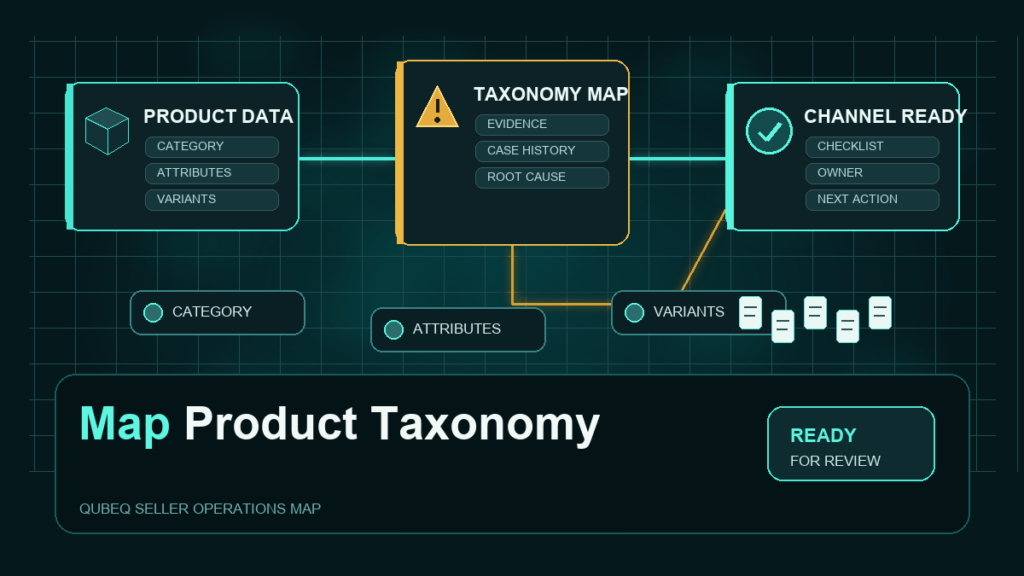
Taxonomy mapping is the process of translating one product structure into another without losing meaning. A product may have one category inside Shopify, a different standardized category expectation in Google, and other channel-specific product-type or attribute expectations elsewhere.
That means mapping is not just a copy job. It is a judgment process:
- What is the product's main function?
- Which attributes become available or required once that category is chosen?
- Does the mapping preserve the same meaning across systems?
If that logic is weak, the catalog starts drifting.
Why Category Mistakes Cause Bigger Data Problems

Attributes depend on categories
Category structure often controls which product details can or should be attached to the record.
Internal naming is not enough
A merchant's in-house category names may make sense internally but still map poorly to channel requirements.
One mismatch scales badly
If a weak category choice is repeated across a large catalog, the cleanup becomes much more expensive.
A Better Mapping Approach
Start with the product's real role
Choose the category based on what the product actually is for, not on whichever internal label is most convenient.
Review the attribute consequences
If a category unlocks the wrong or incomplete attribute set, the mapping may need to be revised.
Build a repeatable translation layer
The strongest teams document how internal categories map outward instead of deciding from scratch every time.
A Practical Mapping Checklist
- List your internal product groups and the main function of each.
- Map them to the most accurate standardized or channel-specific category.
- Review which attributes the mapped category enables or expects.
- Test the mapping on a smaller product set before scaling it across the catalog.
- Document the mapping rules so the team does not reinvent them later.
Scenario: The Category Labels Looked Fine Until The Attributes Fell Apart
A merchant had a stable internal category structure and assumed it could be reused everywhere. The problem appeared when channel-specific data needs started surfacing. Some categories did not unlock the right details, others grouped products too broadly, and several items were technically "mapped" but not in a way that preserved their real function.
The issue was not a lack of categories. It was weak translation between systems. Once the merchant treated taxonomy mapping as a governed process instead of an export step, the product data improved.
FAQ
Is taxonomy mapping the same as SKU mapping?
No. SKU mapping is identity tracking. Taxonomy mapping is category and attribute alignment.
Why does category choice matter so much?
Because category choice often affects which attributes become available or required.
Can one internal taxonomy work everywhere?
It can help internally, but it usually needs translation before it fits every platform well.
Should merchants map by product name alone?
No. The mapping should reflect the product's real function and attribute needs.
What is the biggest readiness mistake?
Assuming that a close-enough category is good enough across every selling system.
Better Multi-Channel Catalogs Start With Better Translation Between Systems
Cross marketplace taxonomy mapping helps merchants preserve product meaning as the catalog moves between systems. If your team is trying to tighten multi-channel product data before it scales further, Qubeq can help you think through those other marketplace operations. If you want help pressure-testing the mapping model, contact us here.