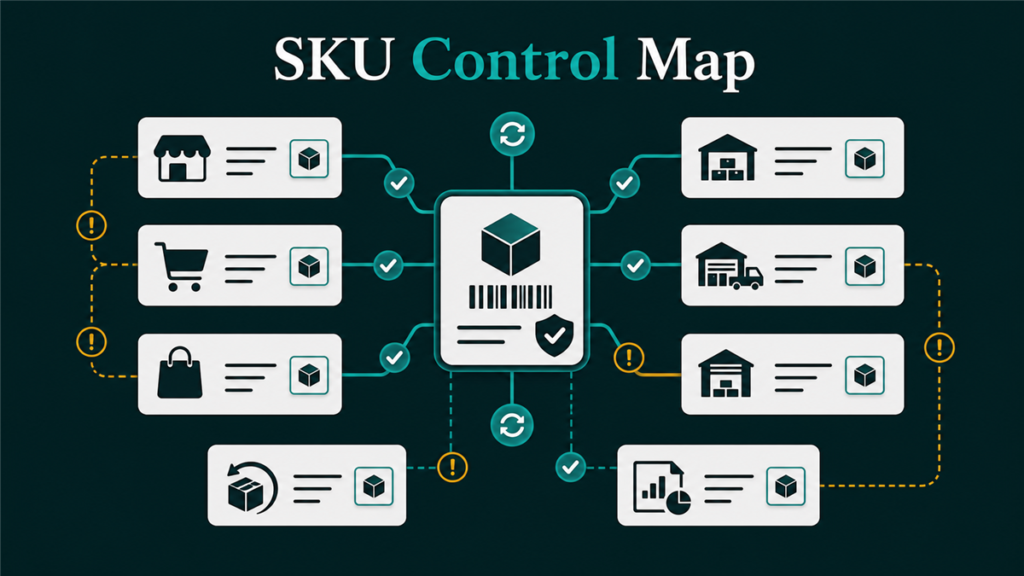
Cross marketplace SKU mapping connects the seller's internal SKU logic to marketplace listings, fulfillment systems, inventory quantities, returns, reports, and reconciliation. Without a clean mapping table, one product can become several disconnected records across Amazon, Walmart, Shopify, FBA, WFS, and 3PL systems.
Key Takeaways
- A SKU is the seller's internal identifier, but marketplaces and fulfillment systems may use their own product, offer, and inventory identifiers.
- SKU mapping should connect item identity, offer identity, fulfillment location, inventory quantity, and reporting logic.
- Bad mapping can break inventory, fulfillment, returns, catalog content, reimbursements, and finance reporting.
- Sellers should not rename or merge live SKUs without a migration plan.
- Qubeq treats SKU mapping as a backend operations control, not a spreadsheet housekeeping task.
What is cross-marketplace SKU mapping?
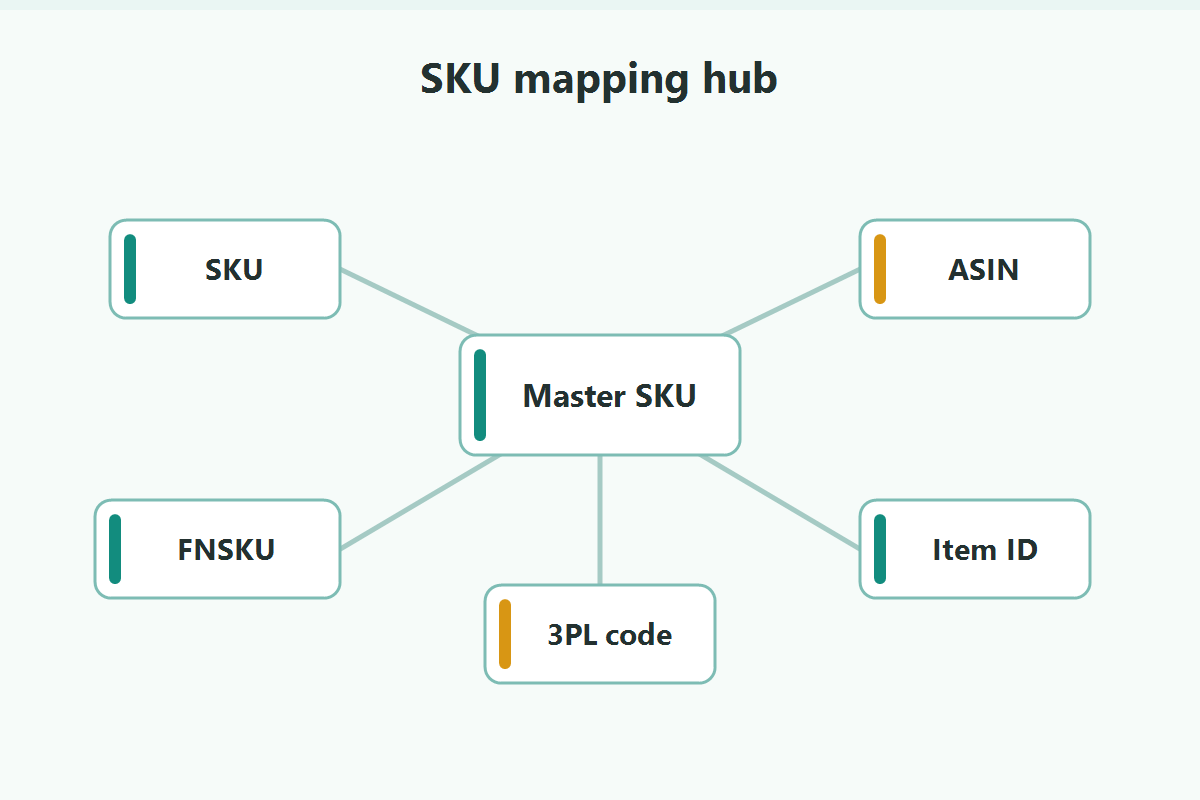
Cross-marketplace SKU mapping is the process of connecting one sellable item to the correct identifiers across each marketplace, fulfillment channel, warehouse, and reporting system. The goal is to make sure every system is talking about the same item.
A mapping table may connect:
- Internal SKU.
- Amazon seller SKU.
- ASIN.
- FNSKU.
- Walmart SKU.
- Walmart item ID or relevant item record.
- Shopify product or variant SKU.
- 3PL item code.
- UPC or GTIN.
- Bundle or kit identifier.
- Fulfillment node or warehouse location.
Exact field names vary by platform and should be verified before technical implementation.
Why SKU mapping breaks marketplace operations
SKU mapping breaks marketplace operations when item identity, offer identity, and fulfillment identity drift apart. The result is usually not one obvious error. It is a trail of inventory, order, return, and reporting mismatches.
| Broken area | What can go wrong |
| Inventory | Wrong quantity pushed to Amazon, Walmart, Shopify, or 3PL |
| Fulfillment | Orders route to the wrong warehouse or fulfillment method |
| Catalog | Content updates are applied to the wrong offer or item |
| Returns | Returned units cannot be matched to the correct SKU |
| Reimbursements | FBA or WFS events cannot be reconciled cleanly |
| Finance | Sales, fees, refunds, and COGS reports do not align |
| Bundles | Kit components and parent SKUs are counted incorrectly |
SKU mapping is one of those backend problems that looks boring until it becomes expensive.
SKU, ASIN, FNSKU, item ID, and 3PL code are not the same thing
SKU, ASIN, FNSKU, Walmart item identifiers, Shopify variants, UPC/GTIN, and 3PL item codes serve different jobs. Sellers should not collapse them into one label without understanding the purpose of each identifier.
Useful distinctions:
- SKU: the seller's internal offer or item identifier.
- ASIN: Amazon's catalog identifier for a product detail page.
- FNSKU: an Amazon fulfillment identifier used for FBA inventory.
- UPC/GTIN: product identity identifier used across retail systems.
- Walmart SKU: seller-controlled item identifier inside Walmart workflows.
- Shopify variant SKU: variant-level commerce identifier.
- 3PL item code: warehouse or fulfillment-system identifier.
- Bundle or kit code: operational identifier for a sellable combination.
The exact platform field names should be verified near implementation. The strategic point is stable: identifier confusion creates operational confusion.
Cross-marketplace SKU mapping framework
A cross-marketplace SKU mapping framework should show how each system identifies the item, sells the item, fulfills the item, returns the item, and reports the item. Use one master mapping table as the source of truth.
1. Start with internal item identity
Define the item, variation, bundle, or kit inside the seller's own system first. Include brand, product name, size, color, pack count, condition, and unit of measure.
2. Map marketplace identifiers
Connect the internal item to Amazon, Walmart, Shopify, or other marketplace identifiers. Include offer-level identifiers and catalog-level identifiers separately.
3. Map fulfillment identifiers
Connect the item to FBA, WFS, 3PL, warehouse, or merchant-fulfilled records. Include ship nodes, fulfillment locations, or warehouse item codes where relevant.
4. Map reporting fields
Connect the item to finance, inventory, returns, reimbursement, and advertising reports. This is where many teams discover that the same product has several names.
5. Add ownership and change control
Assign one owner for SKU mapping changes. Do not let catalog, warehouse, finance, and marketplace teams change identifiers independently.
SKU mapping audit checklist
A SKU mapping audit should test whether the same product is traceable from listing to order, fulfillment, return, and report. Use this checklist before expanding to a new marketplace.
- List all active internal SKUs.
- Match each internal SKU to marketplace SKUs and catalog identifiers.
- Separate parent, child, variation, bundle, and kit records.
- Match each SKU to fulfillment methods: FBA, WFS, 3PL, merchant fulfilled.
- Confirm warehouse item codes and pack quantities.
- Review inventory feed destinations.
- Check return and refund reports by SKU.
- Check finance reports for matching sales and COGS logic.
- Identify duplicate, retired, or orphaned SKUs.
- Document migration rules before changing live SKUs.
If the team cannot trace one order from marketplace to warehouse to return and finance, the mapping needs cleanup.
Mini-scenario: one product, four different records
A seller sells the same insulated bottle on Amazon, Walmart, Shopify, and through a 3PL. Amazon uses one seller SKU, Walmart uses a shortened SKU, Shopify uses a variant SKU, and the 3PL uses a warehouse item code from an old naming system.
Inventory looks fine until a Walmart promotion increases orders. The warehouse ships the wrong pack count because the 3PL item code maps to a single unit, while Walmart's offer was a two-pack. The fix is a master SKU map that separates product identity, offer pack count, fulfillment code, and marketplace listing.
FAQ
What is cross-marketplace SKU mapping?
Cross-marketplace SKU mapping connects a seller's internal SKU to marketplace, fulfillment, warehouse, return, and reporting identifiers across platforms like Amazon, Walmart, Shopify, FBA, WFS, and 3PL systems.
Why does SKU mapping matter?
SKU mapping matters because inventory, fulfillment, returns, reimbursements, and finance reports depend on matching the right item across systems.
Is an Amazon SKU the same as an ASIN?
No. A seller SKU identifies the seller's offer or inventory record, while an ASIN identifies an Amazon product detail page.
Should sellers rename old SKUs?
Not without a migration plan. Changing live SKUs can affect listings, inventory feeds, fulfillment, reporting, and historical data.
Can Qubeq help with SKU mapping?
Yes. Qubeq can audit marketplace SKU structures, identify mapping gaps, and help build a cleaner backend operations workflow across Amazon, Walmart, Shopify, and fulfillment systems.
Make the SKU map the operating source of truth
Cross-marketplace SKU mapping is not glamorous, but it holds the backend together. If your team is expanding across Amazon, Walmart, Shopify, FBA, WFS, and 3PL systems, Qubeq can help clean the SKU map before small naming differences become fulfillment, return, and reporting problems.