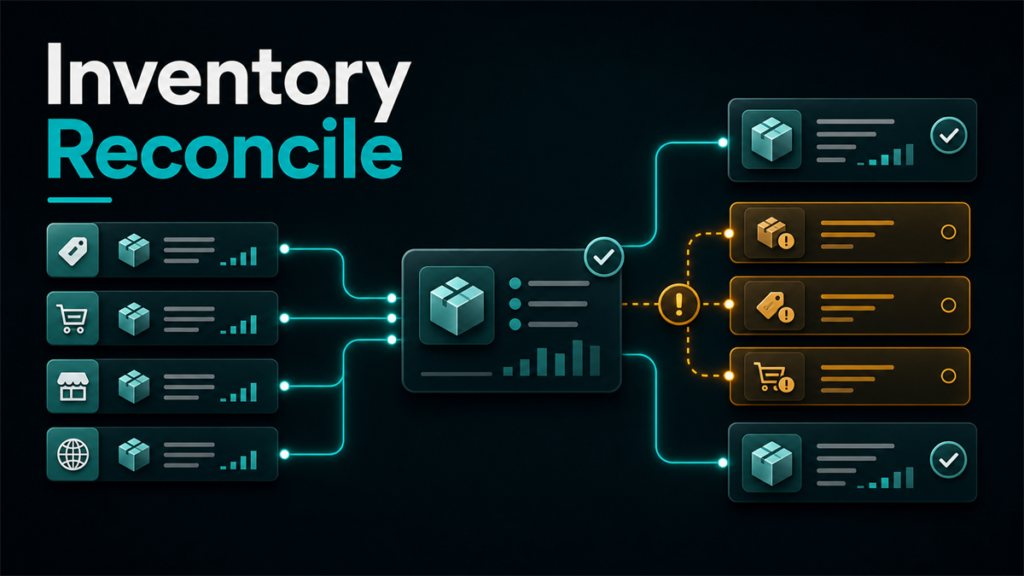
The moment a brand sells on more than one marketplace, inventory truth becomes harder to keep. Not because the team is careless, but because each channel exposes stock differently, each system updates on its own rhythm, and every extra warehouse, app, or listing rule adds another place for quantity to drift.
Key Takeaways
- Inventory reconciliation is not the same job as SKU mapping. One is naming and structure. The other is quantity truth.
- Multi-channel stock problems usually begin with timing gaps, unclear source-of-truth logic, or inconsistent location handling.
- Shopify, Walmart, Etsy, and Faire each expose inventory in different ways, which means one central habit of review matters more than ever.
- Sellers do not need perfect software to improve. They need a repeatable stock-review routine and a clear escalation path when numbers drift.
- Oversell prevention is less about one magic tool and more about disciplined reconciliation.
Why Inventory Truth Breaks So Easily
Single-channel teams can often get away with looser review because the same platform both receives the order and defines the visible quantity. Multi-marketplace teams lose that simplicity.
Drift usually starts when:
The problem is rarely one giant error. It is usually a stack of small mismatches.
The Three Questions Every Team Needs to Answer
Before building any process, answer these clearly:
1. What is the source of truth?
If the answer changes depending on who you ask, the process is already weak.
2. How do locations affect available inventory?
Shopify, for example, explicitly separates inventory by location. That matters if your fulfillment logic or channel feeds are acting as if stock is pooled more loosely than it really is.
3. What counts as trusted stock?
Not every quantity should be treated as equally sellable. Inbound, transfer, reserved, damaged, or return-pending inventory may need different handling.
Channel-Specific Friction Points
Shopify
Shopify's official help materials make multi-location inventory logic very clear: stock is tracked by location, and transfers move inventory between those locations. That is powerful, but it also means sellers need to understand how those locations map to actual fulfillment behavior.
Walmart
Walmart's multichannel messaging emphasizes inventory visibility and restock coordination. That is helpful, but it does not change the fact that your team still needs to review what is available, what is inbound, and what is committed elsewhere.
Etsy
Etsy quantity logic can feel simpler than Amazon or Walmart, but that simplicity is deceptive. Listing quantities, renewals, and made-to-order assumptions still affect visible availability.
Faire
Faire adds another layer because availability and lead times shape retailer expectations. A number may exist in theory while still being operationally risky to promise quickly.
A Practical Weekly Reconciliation Workflow
Use one repeatable process each week:
- Pull current stock by SKU from the source-of-truth system.
- Pull visible or channel-committed quantities from each active marketplace.
- Review location-based differences and transfer status.
- Flag any SKU where channel availability is relying on inventory not yet fully trusted.
- Identify oversell-risk SKUs, slow-moving trapped SKUs, and items with repeated drift.
- Correct channel quantities or internal records before the next demand spike.
- Record the reason for the mismatch so the same class of problem is easier to catch next time.
The last step is what turns reconciliation from busywork into process improvement.
What Sellers Commonly Get Wrong
They confuse inventory mapping with inventory reconciliation
Having a consistent SKU name across channels is helpful, but it does not prove the quantities are right.
They assume software synchronization means operational truth
Apps can reduce manual work. They cannot replace judgment about timing, locations, returns, and stock trust.
They reconcile only after an oversell
That is too late. The goal is to catch the drift before the order exposes it.
They treat all channels as if they consume stock at the same rhythm
Different marketplaces can create very different demand patterns and stock pressure.
A Simple Escalation System
Not every mismatch needs the same response. Classify inventory issues into three buckets:
- watch: small drift that should be corrected but is not urgent
- act now: visible mismatch that could create oversell or under-availability soon
- stop and investigate: repeated or unexplained drift where the source-of-truth logic may be failing
This keeps teams from treating every discrepancy like a fire while still catching the real fires.
Scenario: The Team With Good Software and Weak Discipline
A brand sold through Shopify, Amazon, Walmart, Etsy, and wholesale. The team had software connections in place and assumed that meant inventory accuracy was largely solved.
But the same few problems kept showing up: one warehouse transfer was counted too early, one marketplace lagged on updates, and one group of products kept using quantities that were technically present but not safely sellable yet. No single mistake looked dramatic. The pattern did.
Once the team started running one weekly reconciliation process with clear source-of-truth rules and mismatch notes, the oversell risk dropped. The tools did not change much. The discipline did.
FAQ
Is inventory reconciliation the same as SKU mapping?
No. SKU mapping is structure. Inventory reconciliation is quantity truth.
Do I need expensive software to improve reconciliation?
Not necessarily. Better process often creates the first major improvement.
What is the most important first step?
Define one trusted source of truth and make sure the team agrees on it.
How often should multi-channel inventory be reconciled?
Weekly at minimum, with closer review on fast-moving or high-risk SKUs.
Why do location settings matter so much?
Because inventory that exists in one place may not actually be usable for every order path at that moment.
Better Inventory Control Starts With Clear Truth, Not More Noise
Multi-marketplace inventory reconciliation is not glamorous, but it is one of the cleanest ways to reduce avoidable channel damage. A seller does not need perfect systems to get better. It needs clear truth, a repeatable review habit, and a team that knows how to respond when the numbers do not agree.
If your business is expanding across marketplaces and the inventory picture is getting harder to trust, Qubeq can help think through those other marketplace operations with more structure. If you want help pressure-testing where stock drift is actually starting, contact us here.