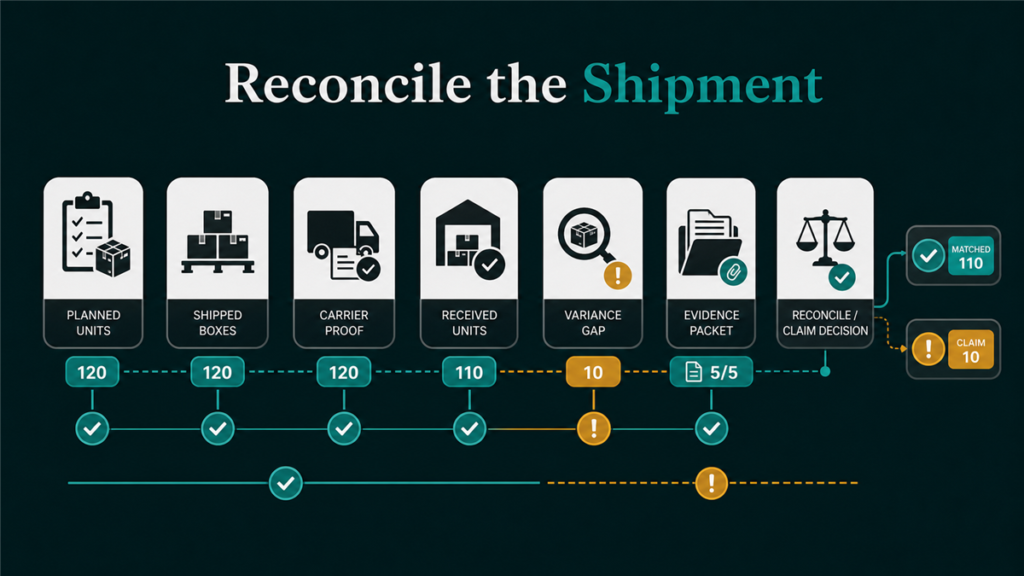
To reconcile FBA shipments, compare what the seller shipped against what Amazon received, adjusted, investigated, or marked eligible for review. The purpose is to identify real discrepancies before opening reimbursement cases or support tickets.
Key Takeaways
- FBA shipment reconciliation is the process of matching shipped units, received units, shipment status, and evidence.
- Sellers should wait until the shipment is ready for reconciliation before treating missing units as claim-ready.
- Box content data, carrier proof, shipment IDs, and SKU/FNSKU counts are core evidence.
- Reconciliation and reimbursement are connected, but they are not the same step.
- A clean reconciliation log helps prevent vague cases and duplicate claims.
What does it mean to reconcile FBA shipments?
To reconcile FBA shipments means to review an inbound shipment after Amazon receives it and compare expected units with Amazon's received records. A seller is looking for shortages, overages, receiving delays, damaged units, FNSKU mismatches, and investigation outcomes.
The workflow is simple in concept:
- What did the seller plan to send?
- What did the warehouse or prep center pack?
- What did the carrier deliver?
- What did Amazon receive?
- What did Amazon adjust or investigate?
- What still needs review?
The final answer may be "no claim needed." Some shipments finish receiving later than expected. Some discrepancies are corrected during investigation. Some missing units become claim-ready only after the shipment reaches the correct status.
Why reconciliation should happen before reimbursement claims
Reconciliation should happen before reimbursement claims because Amazon needs shipment-level evidence, not a general statement that inventory is missing. A reimbursement case is stronger when the seller can show the exact shipment, SKU, quantity gap, and supporting documents.
Without reconciliation, sellers often make three mistakes:
- Filing before the shipment has finished receiving.
- Filing a missing inventory case without a shipment ID or quantity trail.
- Filing duplicate cases after Amazon already corrected the shipment.
A good reconciliation process reduces case volume while improving case quality. It also gives the operations team a feedback loop for prep errors, box-content mistakes, and carrier documentation gaps.
FBA shipment reconciliation workflow
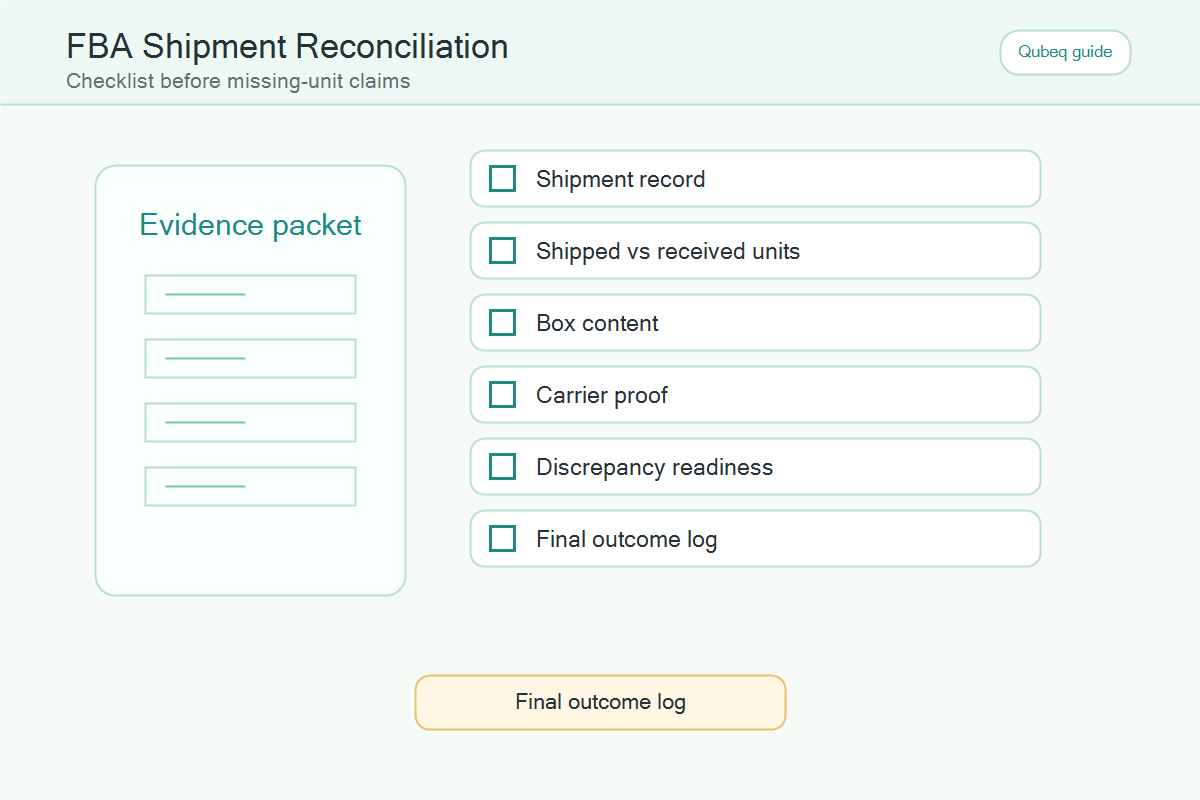
An FBA shipment reconciliation workflow should move from shipment setup to evidence review before any claim decision. Use this as an operating checklist.
1. Confirm the shipment record
Start with the shipment ID, shipment name, shipping plan, destination, SKU list, and expected units. The reconciliation log should include the basic shipment record before any issue is investigated.
Track:
- Shipment ID.
- Shipment creation date.
- SKUs and FNSKUs.
- Expected quantity by SKU.
- Packing method and box content approach.
- Carrier and tracking information.
2. Compare shipped units and received units
The core reconciliation step is comparing shipped units with Amazon's received units. If the shipment is still receiving, mark the discrepancy as pending rather than claim-ready.
Track:
- Quantity expected.
- Quantity received.
- Quantity missing.
- Quantity over-received.
- Quantity adjusted.
- Current shipment status.
The current Seller Central labels and eligible review timing should be verified before filing.
3. Review box content and warehouse records
Box content records can show which units were packed in which boxes. Warehouse pick sheets, prep center records, weight records, pallet records, and carton labels can support the seller's expected quantity.
For high-value or high-volume shipments, keep these records organized before the shipment leaves the warehouse. Trying to reconstruct box contents after a discrepancy is much harder.
4. Match carrier proof to shipment evidence
Carrier proof does not prove every unit was inside the box, but it can support delivery and shipment movement. Match carrier tracking, proof of delivery, shipment weight, pallet records, or bill of lading data to the shipment.
Carrier evidence is especially useful when Amazon received fewer units than expected or when the shipment appears delayed, split, or partially received.
5. Decide whether the discrepancy is ready for review
Not every quantity gap is ready for a case. Some differences resolve during receiving. Some need more time. Some are seller-side errors in labeling, box content, or shipment setup.
Before opening a case, ask:
- Is the shipment eligible for reconciliation under the current workflow?
- Is the missing quantity still missing after receiving or investigation?
- Is there enough evidence to support the expected quantity?
- Did Amazon already adjust or reimburse the discrepancy?
- Is this one clear issue or several issues mixed together?
6. Log the final outcome
Every reconciliation should end with a status. The status can be resolved, still receiving, seller-side error, case-ready, reimbursed, denied, or no action.
This log prevents the team from filing the same claim twice or forgetting to follow up after Amazon asks for documents.
Evidence checklist for FBA shipment reconciliation
The evidence checklist for FBA shipment reconciliation should connect seller records, carrier records, and Amazon records. A claim-ready discrepancy needs more than a spreadsheet estimate.
| Evidence | Why it matters |
| Shipment ID | Connects the discrepancy to the Amazon shipment record |
| SKU/FNSKU list | Shows exactly which units are affected |
| Expected quantity | Establishes what the seller sent |
| Received quantity | Shows Amazon's recorded receipt |
| Box content data | Supports carton-level unit placement |
| Carrier tracking | Supports shipment movement and delivery |
| Warehouse or prep records | Supports packed quantity |
| Reimbursement check | Prevents duplicate claims |
| Case history | Shows whether the issue was already reviewed |
Keep the evidence simple. A support associate should be able to understand the discrepancy without reading a long narrative.
Common reconciliation problems
Common reconciliation problems include missing units, overages, FNSKU mismatches, box-content mismatches, carrier delivery issues, and premature case filing. Each problem needs a different response.
- Missing units: Compare expected, received, and adjusted units after the shipment is ready for review.
- Overages: Check whether extra received units came from mispacked boxes or SKU confusion.
- FNSKU mismatch: Review labels, product prep, and warehouse scan records.
- Box-content mismatch: Compare carton records with the shipment plan.
- Carrier issue: Match proof of delivery, tracking events, and weight records.
- Premature case filing: Wait until the current workflow allows investigation or reconciliation.
Mini-scenario: 60 units missing after receiving
A seller ships 1,200 units across 40 cartons. Amazon receives 1,140 units and the team wants to open a claim immediately. The reconciliation log shows that four cartons had unclear box content records, and the carrier proof only confirms delivery by tracking number, not carton-level contents.
The team pauses the claim. They compare box labels, warehouse packing records, SKU/FNSKU counts, and receiving status. After receiving closes, 30 units are adjusted in the account and 30 remain missing with stronger shipment evidence. The final case is smaller, but it is easier to review.
FAQ
When should sellers reconcile FBA shipments?
Sellers should reconcile FBA shipments after Amazon has received or investigated the shipment enough for the discrepancy to be reviewed. Current timing should be verified in Seller Central.
Is shipment reconciliation the same as filing a reimbursement claim?
No. Shipment reconciliation is the evidence review. A reimbursement claim may follow if the discrepancy appears eligible, unreimbursed, and supported.
What documents help with FBA shipment reconciliation?
Shipment IDs, SKU/FNSKU lists, box content records, carrier tracking, proof of delivery, warehouse pick records, and reimbursement checks can all help.
Should sellers open a case for every missing unit?
No. Sellers should first confirm shipment status, receiving progress, evidence, and automatic adjustments before opening a case.
Can Qubeq help reconcile FBA shipments?
Yes. Qubeq can review inbound shipments, organize evidence, identify claim-ready discrepancies, and build a cleaner FBA reimbursement workflow.
Reconcile first, claim second
The best FBA reimbursement work starts before the case. If your team is seeing repeated inbound discrepancies, Qubeq can audit shipment records, organize evidence, and separate real claim opportunities from receiving noise.