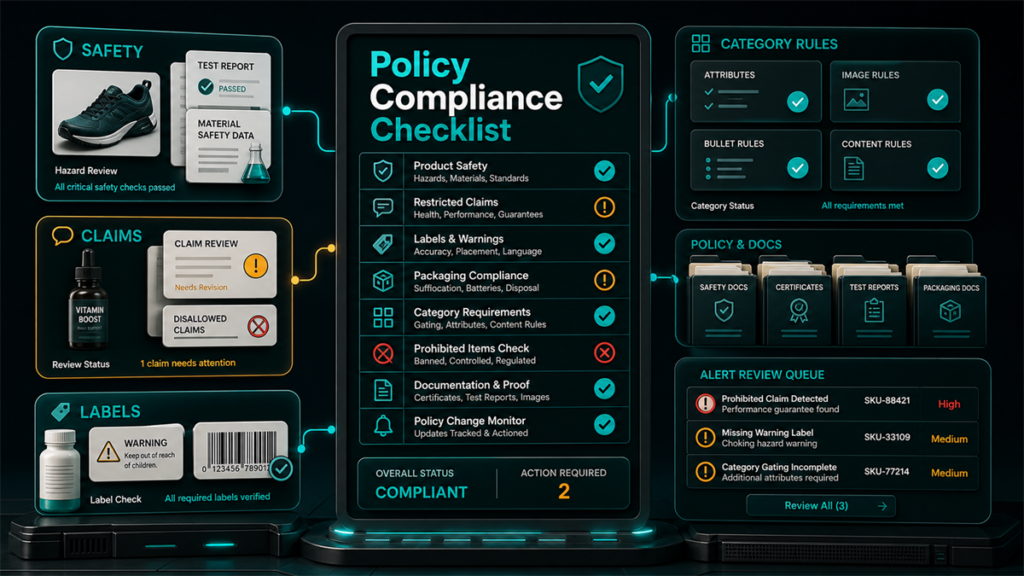
An Amazon product policy compliance checklist is a fixed set of checks you run before a listing goes live and again on a schedule, covering eligibility, claims wording, intellectual property, identifiers, condition rules, and regulated-product documentation. Every violation caught at this stage is one that never touches the Account Health Rating, and that is the entire point: prevention is cheap, appeals are not.
Key Takeaways
- Run the checklist at two moments: before any listing goes live, and again whenever a policy update notice arrives.
- The seven blocks cover eligibility, claims wording, intellectual property, identifiers and authenticity, condition and packaging, regulated documentation, and re-check cadence.
- Claims wording is the most common self-inflicted violation: medical, safety, and superlative phrasing slips into bullets through copy templates.
- Keep authenticity and sourcing documentation organized before Amazon asks; gathering invoices under a deadline is where appeals fail.
- A checklist without a re-check trigger decays. Policy update notices are the trigger.
Why a Pre-Listing Checklist Protects the Account Health Rating
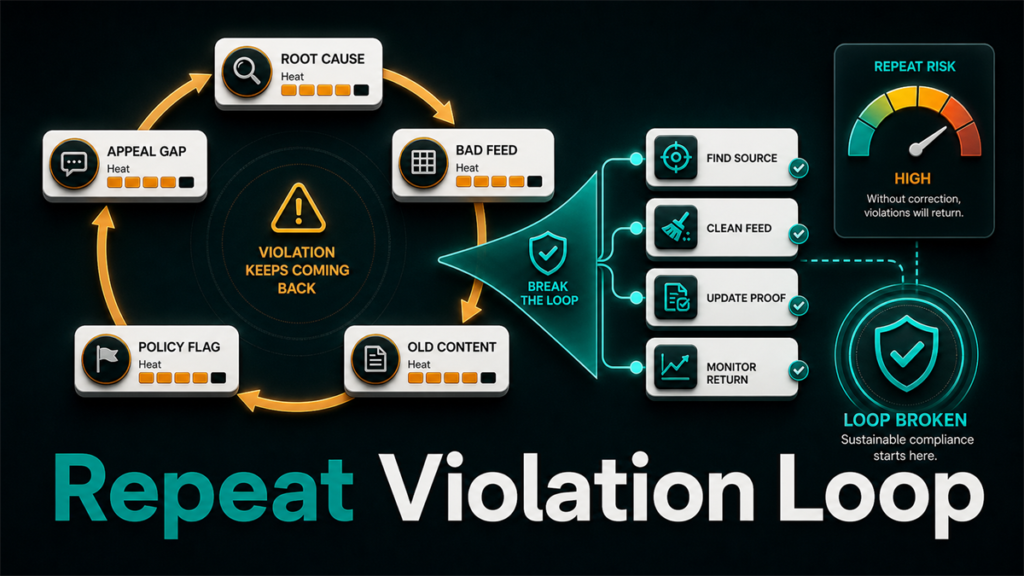
A documented compliance check before publishing keeps violations off the account record entirely, which matters because the Account Health Rating appears to reflect violation history, not just current state. Amazon does not publish the full scoring inputs, so treat any precise scoring description with caution, but the operational logic holds either way: a violation you prevent never needs an appeal, never sits on the record, and never becomes part of a repeat pattern.
Most sellers run these checks informally and inconsistently. The catalog person checks identifiers, someone else wrote the bullets, and nobody owns the regulated-documentation question. The checklist below turns that scatter into one pass with one owner.
The Seven-Block Compliance Checklist
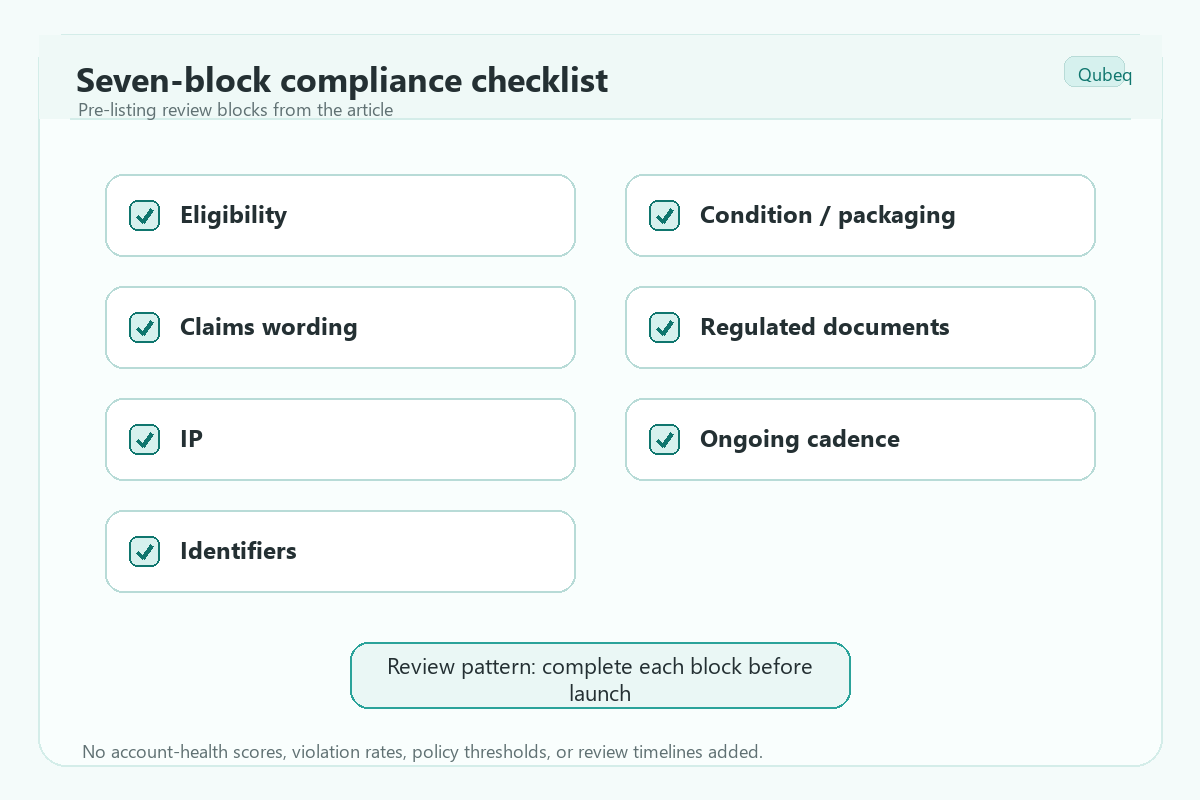
Work through the blocks in order for every new listing. Blocks 1 through 6 are pre-listing checks; block 7 keeps the first six honest over time.
Block 1: Product eligibility and restricted categories
Confirm the product can be sold at all before investing in listing work.
- Check the product against Amazon's current restricted products pages for the target marketplace. Category rules vary by marketplace and change over time.
- Confirm whether the category or product type requires approval, and whether your account already holds it.
- Verify any condition restrictions on the category (some categories limit used or refurbished sales).
- If the product sits near a restricted line (supplements, children's products, batteries, anything with a plug or a chemical), document why you believe it is eligible, with the help page you relied on.
Block 2: Claims and wording on the listing
Read every bullet, title, and description line as a policy reviewer would, not as a marketer.
- Remove or rewrite medical and health claims: anything implying the product treats, cures, prevents, or diagnoses a condition.
- Remove unverifiable safety claims ("non-toxic," "chemical-free," "hypoallergenic") unless you hold documentation that supports them.
- Strip superlatives and ranking claims ("best," "#1," "top-rated") and time-sensitive promotional wording from the detail page.
- Check images for embedded text making the same banned claims; the image is part of the listing.
- Confirm the listing describes the product actually shipped, with no accessory or quantity ambiguity.
Block 3: Intellectual property
Every brand name, logo, and image on the listing needs a right behind it.
- Confirm you have the right to use the brand name, and that the brand value on the listing matches your authorization or registration.
- Verify product images are owned or licensed by you, not pulled from a manufacturer site or competitor listing without rights.
- Check that compatibility wording ("fits," "compatible with") names other brands only in the way Amazon's intellectual property policy permits, and never implies endorsement.
- Search the key listing phrases for trademarks you might be using generically.
Block 4: Product identifiers and authenticity documentation
The GTIN on the listing must trace to the product and to your sourcing paperwork.
- Confirm the UPC/EAN/GTIN is genuine, matches the physical product packaging, and traces to the brand through GS1 records where applicable.
- If the product has no standard identifier, complete the exemption process before listing rather than reusing a code.
- File supplier invoices, authorization letters, and chain-of-custody documents where the team can retrieve them in hours, not days. Amazon may request them with a short window.
- Confirm invoice details (supplier name, quantities, product identifiers) actually match what you sell, since mismatched paperwork can be worse than missing paperwork.
Block 5: Condition and packaging policies
The stated condition must match what the buyer opens.
- Apply Amazon's condition guidelines honestly: "New" means new in original packaging, with no exceptions for "basically new."
- Confirm expiration-dated products meet remaining-shelf-life expectations for the fulfillment channel.
- Verify packaging and prep meet current FBA requirements for the product type (poly bags, suffocation warnings, sold-as-set labeling, battery handling).
- Check that bundles and multipacks are listed under bundle rules, not as the single-unit ASIN.
Block 6: Regulated and restricted product documentation
If the product touches a regulated space, the documentation comes before the listing, not after the request.
- Identify whether the product type requires compliance documents (safety testing certificates, lab reports, regulatory registrations). Requirements depend on the product type and marketplace, so verify against current help pages.
- Obtain and file the documents in the listing's compliance folder before publishing.
- Record the document expiry dates; a lapsed certificate is a future violation with a known date.
Block 7: Ongoing cadence
A compliance check is only current until the next policy update notice.
- Re-run the relevant blocks for affected ASINs whenever a policy update notice arrives, and treat the notice's effective date as the deadline.
- Sweep the full catalog against blocks 2 and 3 quarterly, since copy edits and image swaps reintroduce risk between launches.
- Re-verify regulated documentation against expiry dates monthly.
- Assign one owner for the checklist and one place where completed checks are logged per ASIN.
Mini-Scenario: The Bullet That Almost Shipped
A skincare brand prepared a launch with bullets written from the supplier's marketing sheet, including "clinically proven to reduce inflammation." The phrase reads as a medical claim. The catalog lead running block 2 flagged the line two days before launch, and the team rewrote the bullet around the ingredient and texture instead.
The same sweep then found the identical phrase on two live ASINs that had used the same copy template for over a year. Both were rewritten the same week. Nothing dramatic happened, which is what prevention looks like: the violation that never arrives doesn't make a story, it just leaves the Account Health page quiet.
FAQ
What does an Amazon product policy compliance check cover?
Seven areas: category eligibility, claims wording, intellectual property, product identifiers and authenticity documents, condition and packaging, regulated-product documentation, and a re-check cadence tied to policy update notices.
When should I run the compliance checklist?
Before every new listing goes live, again for affected ASINs whenever a policy update notice arrives, and as a quarterly sweep across the catalog for claims and intellectual property drift.
Which checklist block catches the most violations?
In our experience, claims wording. Medical, safety, and superlative phrasing enters listings through supplier copy and shared templates, then spreads across ASINs before anyone reads it as a reviewer would.
Do I need documentation before Amazon asks for it?
Yes. Amazon may request invoices or compliance certificates with a short response window, and gathering supplier paperwork under that deadline is where many sellers fail. File documents at listing time.
Does passing the checklist guarantee no violations?
No. Policies change, and enforcement involves judgment you cannot fully predict. The checklist removes the preventable violations, which in most catalogs is the large majority.
Make Prevention Somebody's Job
A compliance checklist works when it has an owner, a log, and a trigger, and decays when it is everyone's intention and no one's task. If your catalog has grown faster than your policy checks, or a recent violation showed you the gaps, Qubeq can run the compliance sweep across the catalog, set up the per-ASIN documentation system, and own the re-check cadence as part of managing the account.