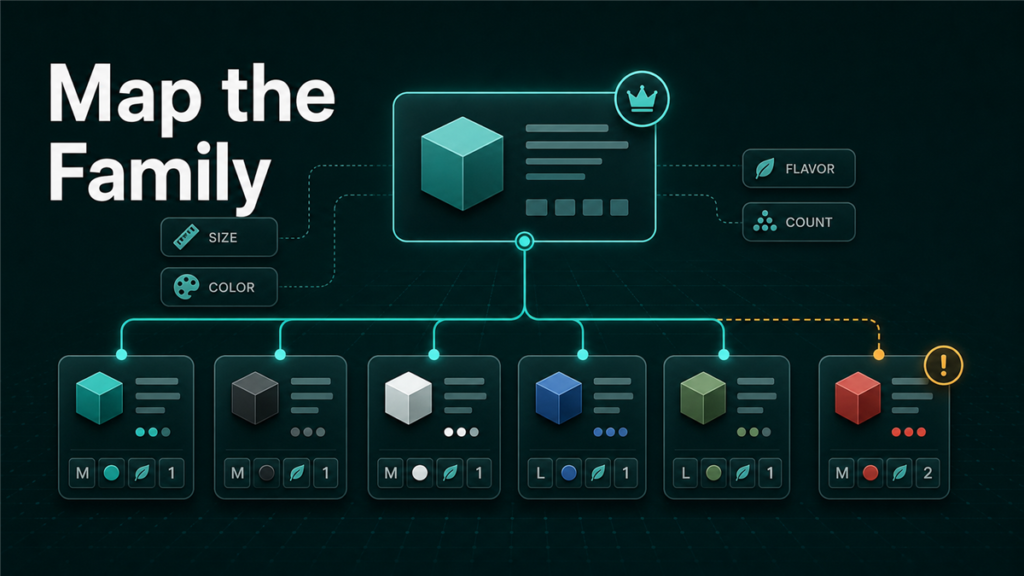
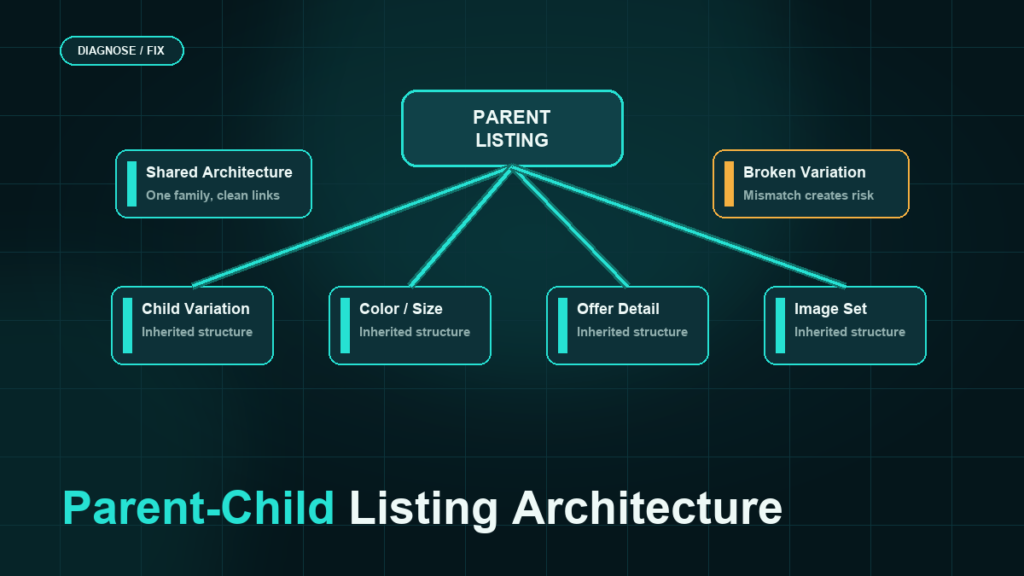
Amazon parent-child listing architecture is the planning layer behind a clean variation family. Before uploading a parent or repairing child ASINs, sellers need to confirm the product type, variation theme, child attributes, and customer-facing logic. This guide is for designing the structure before the catalog is changed.
If you need tactical setup or repair steps for an existing family, use the parent-child setup and repair basics setup guide. This page is for planning the variation architecture so the upload is valid before the first file is submitted.
Key Takeaways
- The parent listing is not the sellable product. It exists to connect child ASINs.
- Each child ASIN should represent a real buyable variation with its own SKU, offer, and accurate attributes.
- Amazon allows parent-child relationships only when the product type supports the selected variation theme.
- Broken variation families usually come from wrong product type selection, invalid variation themes, mismatched child attributes, or mixed products that should not share a parent.
- Sellers should document the current variation structure before making flat file changes.
This Guide vs the Setup and Repair Guide
This architecture guide is about deciding what the variation family should be. The setup and repair guide is about making or fixing the fields after that decision is clear.
| Question | Architecture guide | Setup/repair guide |
| Should these products share one parent? | Yes | No |
| Which product type supports the family? | Yes | Reference only |
| Which variation theme should define the family? | Yes | Reference only |
| How do I fix a detached child? | No | Yes |
| Which flat file fields connect the rows? | Reference only | Yes |
Architecture Decisions Before Upload
- Core product sameness: the children should represent the same core product, not a collection of loosely related items.
- Product type: the product type controls which variation themes and attributes are valid.
- Variation theme: the theme should match how customers compare the products, such as size, color, flavor, count, or style.
- Child attribute completeness: every child needs the attribute values required by the theme.
- Offer and SKU logic: each child should have its own SKU, offer, price, inventory, and buyable identity.
- Customer clarity: a variation family should make the buying decision easier, not hide different products under one page.
When the family depends on supported values, use variation theme troubleshooting before uploading.
When Not to Create a Parent-Child Family
Do not create a variation family only to combine reviews, rescue a weak ASIN, or make unrelated products look connected.
- Products have different brands.
- Products have different core functions.
- Products belong to different product types.
- One child is an accessory and another is the main product.
- The variation attribute is not supported for the product type.
- The family would confuse customers about what they are buying.
If the relationship is not valid, the safer route is separate listings with strong internal catalog organization, not a forced parent-child family. If the root issue is catalog classification, compare product type vs browse node before deciding the architecture.
Parent-Child Architecture Map
- Product type
- Approved variation theme
- Parent SKU naming convention
- Child SKU list
- Child attribute values
- Offer data
- Image and content consistency
- Flat file QA
- Processing report review
- Live detail page QA
What Is an Amazon Parent-Child Listing?
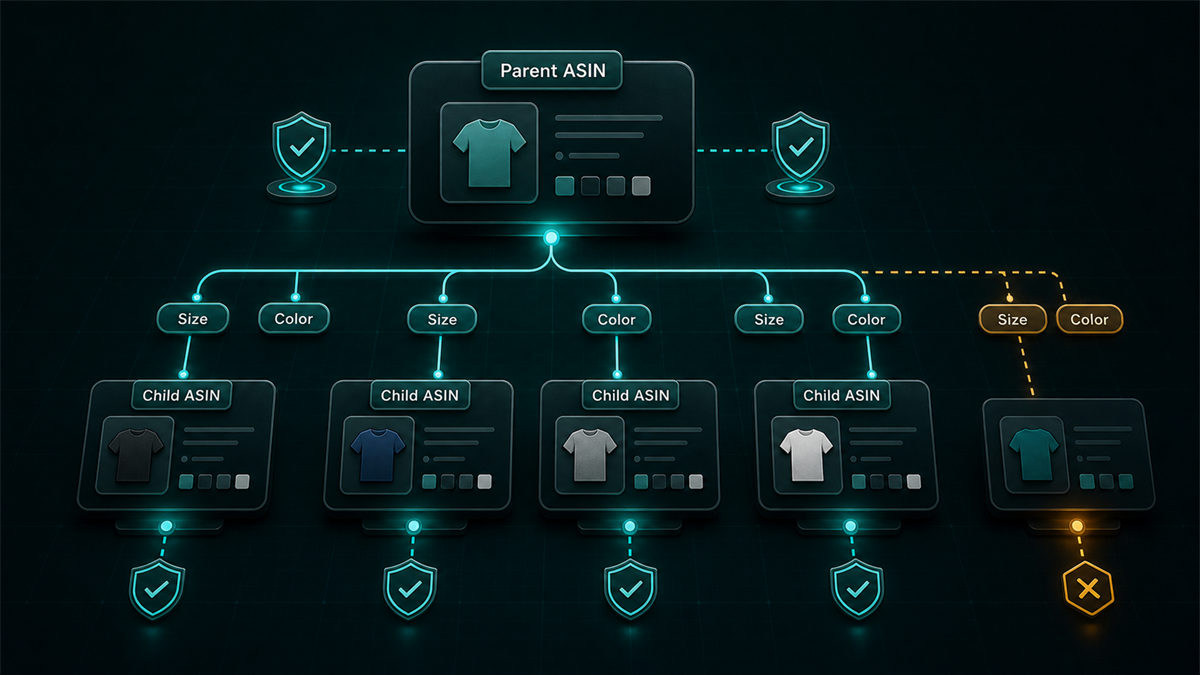
An Amazon parent-child listing is a variation relationship where one parent record groups multiple related child products on a shared product detail experience.
The parent is a non-buyable catalog record. The child ASINs are the actual sellable products. A customer does not buy the parent. A customer buys one child variation, such as a blue medium shirt, a 12-pack size, or a vanilla flavor.
The parent-child structure helps customers compare related options without leaving the product detail page. It also helps the seller manage related items in a cleaner architecture when the variation relationship is valid.
The structure usually contains:
| Element | What it does | Seller risk if wrong |
| Parent SKU | Groups related child listings | Broken family or duplicate parent |
| Child SKU | Represents the sellable variation | Missing or incorrect offer |
| Parentage | Tells Amazon whether the row is parent or child | Flat file rejection |
| Relationship type | Identifies the child as part of a variation | Child does not attach |
| Variation theme | Defines the attribute used for the relationship | Invalid variation error |
| Child attributes | Size, color, flavor, count, or other theme values | Confusing customer experience |
When Should Sellers Use an Amazon Parent-Child Listing?
Sellers should use an Amazon parent-child listing only when the products are the same core product and differ by an approved variation attribute.
A valid variation relationship should make the buying decision easier. If the child ASINs are materially different products, the variation family can create customer confusion and may violate Amazon catalog rules.
Good parent-child candidates include:
- Same shirt in different sizes or colors
- Same supplement in different count sizes, if allowed for that product type
- Same cable in different lengths, if the product type supports length as a variation theme
- Same home product in different patterns, if the product type allows pattern variations
Bad parent-child candidates include:
- Different products bundled under one parent only to share reviews
- Products with different brands
- Products with different core functions
- Products from different product types forced into the same family
- Accessories grouped with the main product when they are not true variations
Amazon variation work should be treated as catalog architecture, not a quick merchandising trick. A variation family that looks convenient to the seller may still be invalid if it does not match Amazon's product type and variation theme rules.
How Does the Parent-Child Structure Affect Amazon Catalog Operations?
The parent-child structure affects listing edits, flat file uploads, search display, catalog cleanup, and Seller Central case resolution.
When the variation architecture is clean, the seller can update related child listings in a controlled way. When the architecture is messy, normal listing edits may fail or create new problems. One wrong parent-child field can affect every child ASIN attached to the parent.
Common operational effects include:
- A child ASIN may detach from the parent after an incorrect update.
- A child ASIN may show the wrong color, size, or style label.
- A flat file upload may fail because the selected variation theme is invalid for the product type.
- A parent may remain in the catalog after the seller thinks the relationship has been deleted.
- Seller Support may ask for evidence before correcting a locked or conflicted variation family.
For sellers with large catalogs, parent-child errors are rarely isolated. A small mistake in the template can repeat across dozens or hundreds of SKUs.
How to Plan an Amazon Parent-Child Listing Before Uploading
A parent-child listing should be planned before the seller touches the flat file or listing editor.
Use this workflow before creating or repairing a variation family:
- Confirm the product type for the ASINs.
- Download the correct category-specific listing template or use the correct listing workflow.
- Check which variation themes are allowed for that product type.
- Confirm that every child ASIN belongs in the same family.
- Build a clean parent SKU naming convention.
- Fill the parent row and child rows consistently.
- Validate child attribute values before upload.
- Upload a controlled file and review the processing report.
- Verify the live detail page after the catalog update applies.
The product type comes first because product type controls the required attributes, valid values, and allowed variation themes. If the product type is wrong, the seller may waste time fixing symptoms while the underlying catalog foundation remains broken.
What Fields Matter Most in a Parent-Child Flat File?
The most important flat file fields are the fields that define the relationship, not only the visible listing copy.
Exact column names can vary by template and marketplace, so sellers should verify against the downloaded template. In most parent-child repair work, the operator reviews these fields closely:
| Field type | What to verify |
| SKU | Each parent and child row has the intended SKU |
| Product ID | Child rows use the correct UPC, EAN, GTIN, or ASIN logic |
| Product type | The template matches the product family |
| Parentage | Parent row and child rows are correctly identified |
| Parent SKU | Child rows point to the intended parent SKU |
| Relationship type | Child rows show a variation relationship |
| Variation theme | The theme is valid for the product type |
| Theme attributes | Size, color, flavor, count, or other values are filled correctly |
| Update action | The seller uses the correct update or delete action for the goal |
If a variation family already exists, export or document the current structure before changing it. That backup gives the seller a way to diagnose what changed if the new upload creates unexpected results.
Common Amazon Parent-Child Listing Mistakes
Most Amazon parent-child listing problems come from a few repeatable mistakes.
Using the Wrong Variation Theme
The variation theme must match the product type. A seller cannot safely copy a theme from another category and assume it will work.
For example, one product type may support a size-color theme while another product type may require a different field name or may not support that combination at all. The flat file may look similar, but the backend validation is different.
Mixing Products That Should Not Be Variations
Some sellers try to group related but different products under one parent to concentrate reviews or traffic. This is risky and can create a poor customer experience.
If the product function, brand, product type, or customer use case is different, the safer path is usually separate listings with internal catalog organization, not one forced variation family.
Creating Multiple Parents for the Same Children
Duplicate parent records can confuse catalog management. A child ASIN should not drift between parent SKUs because two operators created competing variation structures.
Before rebuilding a family, check whether an old parent still exists and whether any child rows are still attached.
Editing a Live Family Without a Backup
Variation repair can affect live traffic and customer experience. Sellers should record the current parent SKU, child SKUs, ASINs, titles, variation attributes, and live page state before a change.
Treating Seller Support as the First Step
Seller Support can help with some catalog conflicts, but a vague case usually creates circular replies. A strong case includes the current issue, affected ASINs, intended parent-child structure, exact evidence, and the requested correction.
Parent-Child Listing Repair Checklist
A broken Amazon parent-child listing needs diagnosis before correction.
Use this checklist:
- Identify whether the issue is missing child, wrong child label, broken parent, duplicate parent, invalid theme, or flat file rejection.
- Confirm the product type and marketplace.
- Export or document the current family structure.
- Check whether the variation theme is allowed for that product type.
- Confirm every child belongs in the same relationship.
- Fix obvious attribute mismatch before opening a case.
- Use a clean flat file only after the structure is mapped.
- Review the processing report line by line.
- Check the live detail page after Amazon processes the change.
- If the system still blocks the fix, open a case with evidence and a clear requested action.
Mini-Scenario: The Variation Family That Kept Splitting
A seller has one parent listing with 18 child ASINs across two colors and nine sizes. After a routine content update, three child ASINs stop showing under the parent. The seller tries to reattach the children through the listing editor, but the children split again after each update.
The root cause is not the title or bullet copy. The catalog file uses a variation theme that does not match the current product type template. The fix is to document the live family, download the correct template, rebuild the parent-child relationship with the accepted theme, and verify every child attribute before upload.
If the catalog rejects the rebuilt relationship, the Seller Central case should include the parent SKU, child SKUs, affected ASINs, the intended relationship, the processing report, and evidence that the children are true variations.
FAQ
Is the parent ASIN a buyable product?
No. The parent record exists to connect related child products. The child ASINs are the buyable products.
Can I put different products under one parent listing?
Only if Amazon allows the relationship and the products are true variations of the same core product. Different products should not be forced into one variation family.
Can I change the variation theme after a listing is live?
Sometimes, but it often requires a controlled flat file rebuild and careful verification. The correct process depends on the product type, marketplace, and current catalog state.
Why did my child ASIN detach from the parent?
Common causes include invalid variation theme, missing child attributes, conflicting catalog contributions, duplicate parent records, or product type mismatch.
Should I open a Seller Central case first?
Usually no. First diagnose the structure and gather evidence. A clear case works better when the seller already knows the affected ASINs, intended relationship, and blocking error.
Build Variation Families Like Catalog Infrastructure
Amazon parent-child listings are not just a display feature. They are catalog infrastructure. When the structure is planned well, customers can compare options clearly and operators can manage the listing with less friction.
If your team is dealing with broken variation families, detached child ASINs, or flat file errors that keep returning, Qubeq can review the catalog structure and identify whether the problem is product type, variation theme, contribution authority, or file execution.