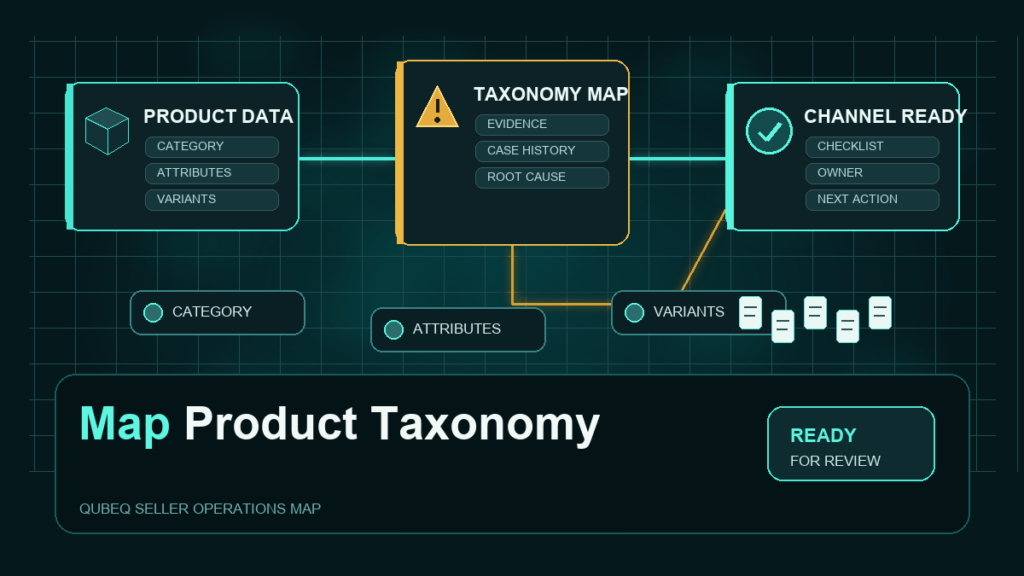
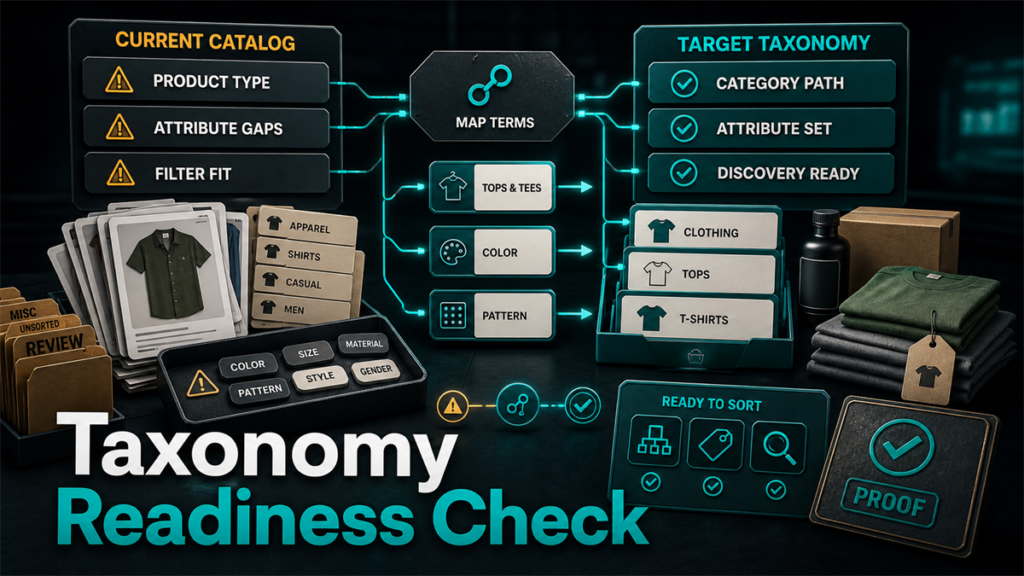
Shopify product taxonomy readiness starts before a merchant connects a single channel. If product categories, category metafields, and variant logic are weak, those gaps usually show up later as missing attributes, inconsistent filters, and channel data problems that are harder to clean up.
Key Takeaways
- Shopify's standard product taxonomy helps merchants organize products in a more channel-ready way.
- Product category and product type are not the same thing, and treating them like the same field creates confusion later.
- Category metafields help add structured product details that support better filtering and cleaner channel data.
- Variant relationships should align with the category and attribute model rather than sit outside it.
- The safest cleanup path starts with category discipline before bulk edits and channel syncs.
What Taxonomy Readiness Actually Means
In Shopify, product category is a structured classification based on Shopify's standard taxonomy. Product type is a separate custom field. That distinction matters because category affects which standardized attributes become available, while product type is often more of an internal organizational label.
That means taxonomy readiness is not just about picking a label that feels close enough. It means asking:
- Is this product assigned to the most accurate category for its main function?
- Are the category-linked attributes detailed enough to describe the item clearly?
- Do variant options line up with the way the category is structured?
If those answers are weak, the catalog usually becomes harder to use across search surfaces and channels.
The Three Layers Merchants Should Review
Product category
A strong category gives Shopify a better structural understanding of the item. That structure can affect search filters, tax handling, and how products are prepared for certain channels.
Category metafields
Category metafields are where the catalog starts becoming more descriptive. Instead of leaving product detail trapped in unstructured copy, merchants can attach more specific attributes to the product record.
Variant alignment
Variant options should support the product's real differences, not work against them. If color, size, material, or other options are loosely structured, category-linked data becomes harder to trust.
Where Merchants Usually Go Wrong
They leave products uncategorized or loosely categorized
That may feel harmless while the store is small, but it creates more work later.
They treat product type as the main structured field
It is useful internally, but it is not a substitute for standardized category logic.
They skip attributes because the listing already "looks fine"
A product page can look acceptable to a human while still being weak as a structured product record.
A Practical Taxonomy Review Checklist
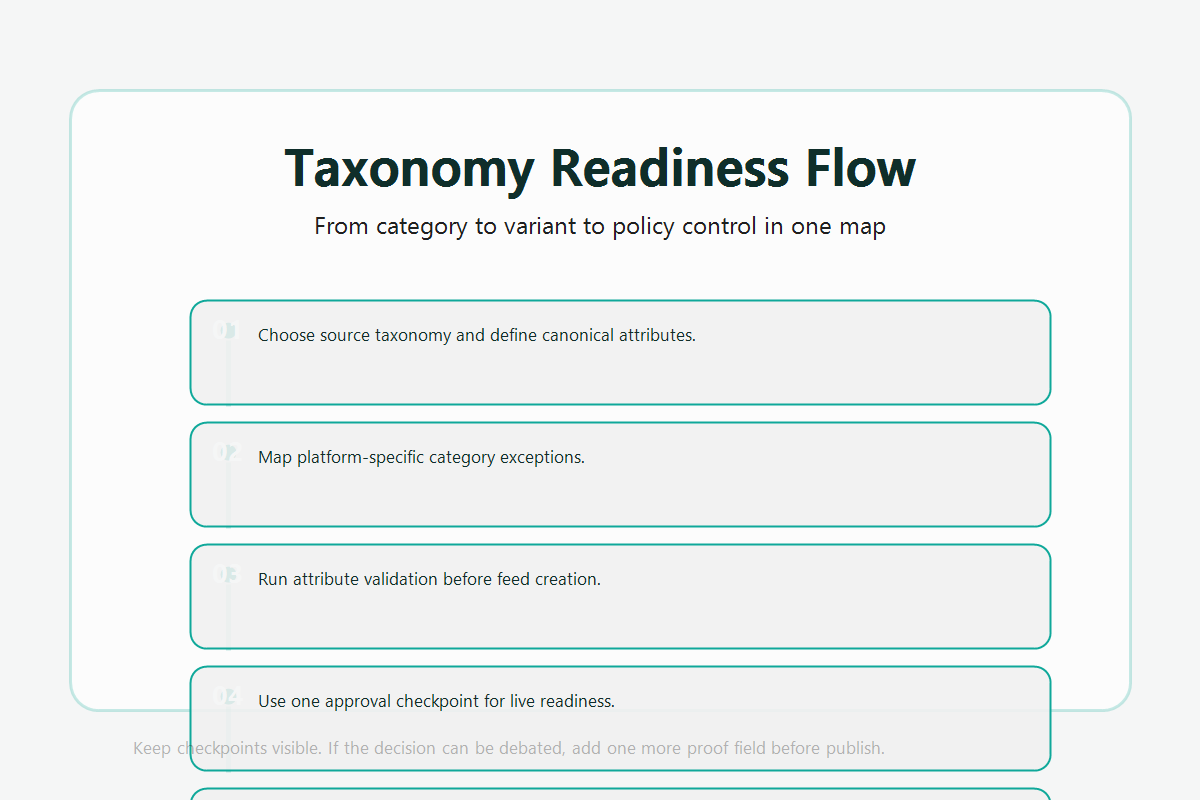
- Review the current category for products with the most channel importance.
- Confirm whether category metafields exist and whether they are actually filled with useful data.
- Check that variant options support the category instead of fighting it.
- Fix the main category structure before pushing broader channel or feed changes.
- Bulk-edit only after the mapping logic is clear.
Scenario: The Store Looked Clean but The Data Was Thin
A merchant had a polished storefront and assumed the catalog was ready for channel expansion. But once the team started looking at product records more closely, they found a lot of internal naming and very little structured consistency. Categories were broad, attributes were sparse, and several variants were effectively carrying information that should have been in a more standardized field.
The issue was not presentation. It was structure. After the merchant tightened categories and filled the relevant metafields more deliberately, downstream channel work became much easier to reason about.
FAQ
Is product category the same as product type in Shopify?
No. Product category is standardized taxonomy. Product type is a custom organizational field.
Do category metafields matter if the product page already looks good?
Yes. They help turn the product into a stronger structured record for filtering and channels.
Should every product have the most specific category possible?
It should have the most accurate category for its main function.
Can taxonomy cleanup wait until after channel expansion?
It can, but the cleanup usually becomes harder and noisier later.
What is the biggest readiness mistake?
Treating category selection like a minor admin detail instead of a core data-structure decision.
Stronger Channel Data Starts With Stronger Product Structure
Shopify product taxonomy readiness matters because category, attributes, and variants become the foundation for everything that follows. If your team is trying to clean up that structure before broader channel work continues, Qubeq can help you think through those other marketplace operations. If you want help pressure-testing the product-data model, contact us here.