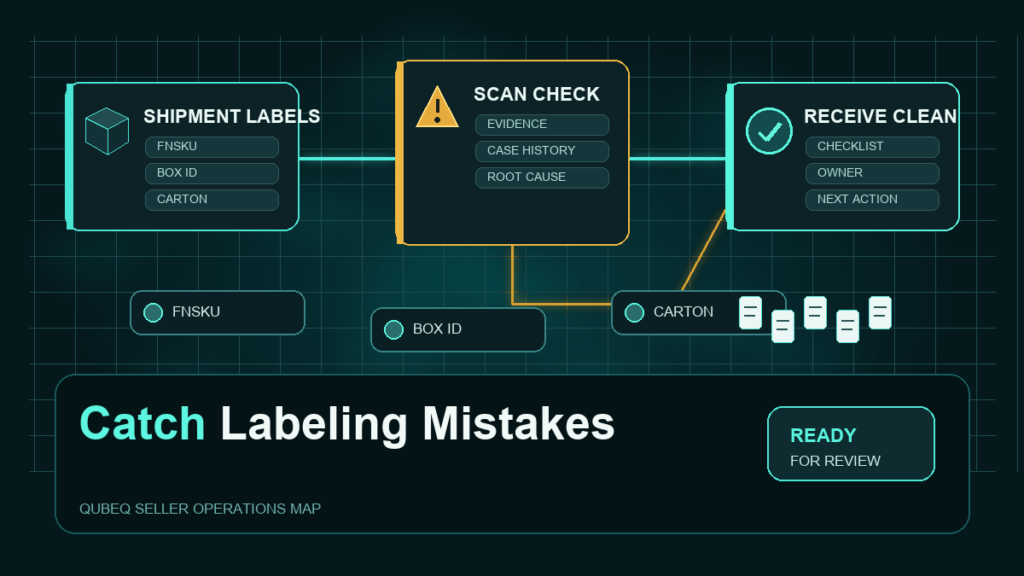
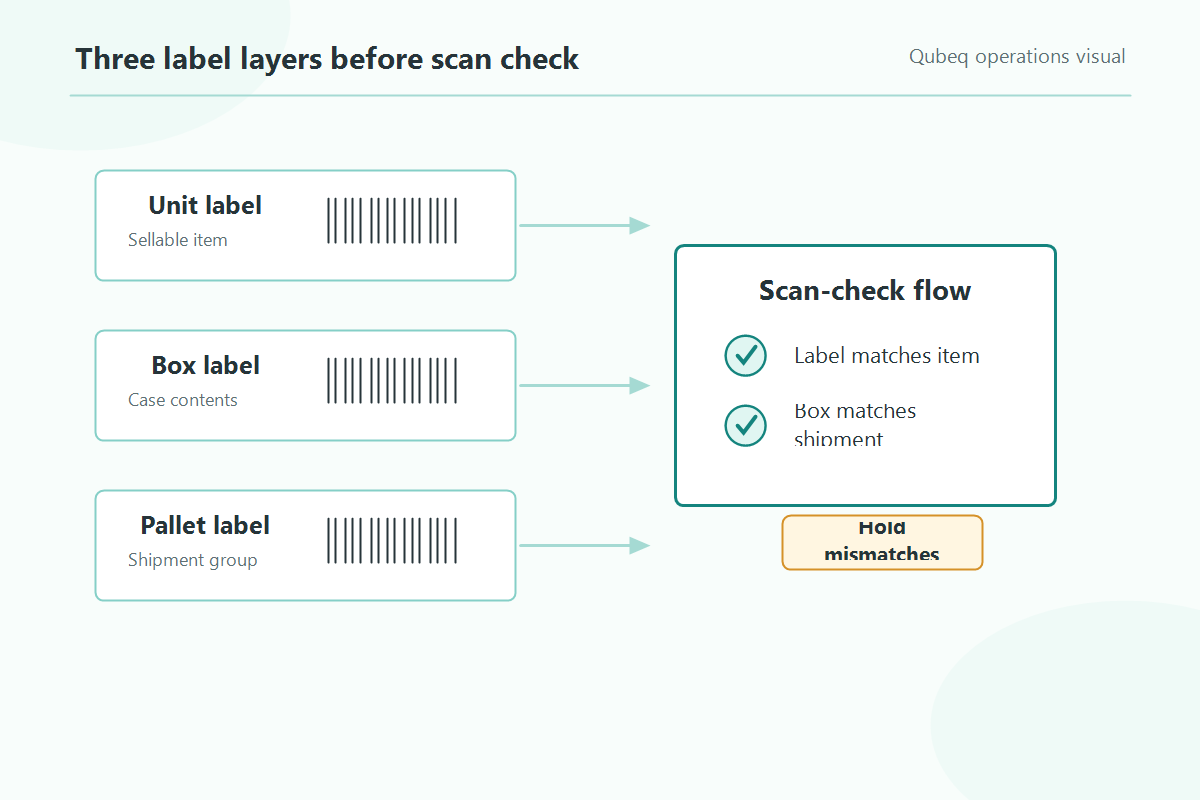
FBA labeling mistakes happen at three layers, unit, box, and pallet, and each layer fails differently: a wrong FNSKU misreceives units into the wrong listing, a swapped box label turns into a phantom shortage, and a missing pallet label parks your freight in a receiving queue. Most labeling losses are process losses, and the same five-minute QA routine at pack-out prevents nearly all of them.
Key Takeaways
- Unit labels (FNSKU) decide which listing receives your units; box and pallet labels decide whether and where the shipment gets processed.
- The expensive mistakes are misidentification, not missing labels: a scannable wrong label does more damage than an unscannable right one.
- Labeling defects can trigger unplanned service fees, receiving delays, and discrepancies that look like shortages but are actually misreceives.
- Old barcodes left visible next to new labels are a classic silent failure; current FBA guidance covers which codes must be covered.
- A pack-out QA routine (scan-verify one unit per SKU per box, label boxes at sealing) catches the errors that matter.
The Three Label Layers
Unit labels: the FNSKU
The FNSKU barcode maps a physical unit to your specific offer. Units in commingled-eligible categories aside, the FNSKU is how Amazon knows the unit is yours and which SKU it belongs to. Label content, size, and placement requirements follow the current FBA labeling guidance, so verify specifics there; the operational rules that do not change are that the code must be scannable, correct for the product inside, and not competing with other visible barcodes.
Box labels
Each box carries a shipment-specific label tying it to your shipment and, where box content data exists, to its declared contents. Box labels are generated per box; they are not interchangeable, which is exactly how swapping them creates per-box discrepancies.
Pallet labels
Palletized freight needs pallet-level labels per current requirements (typically on multiple sides). Missing or wrong pallet labels slow the dock, and a pallet that cannot be associated with your shipment is a delay at best.
The Error Families and What They Cost
Wrong FNSKU on the unit
The unit scans into someone else's listing or your wrong SKU. Costs: your stock appears short (a discrepancy you may chase as a shortage claim and lose), another SKU appears over, and buyer-facing mix-ups follow if the wrong listing ships. This is the most expensive labeling mistake because everything downstream trusts the scan.
Unscannable or low-quality labels
Smudged thermal prints, low-contrast inkjet labels, labels over seams or curves. Costs: manual handling at receiving, potential unplanned service fees per the current fee schedule, and slower check-in.
Old barcodes left exposed
A new FNSKU applied next to a still-visible manufacturer UPC invites the wrong scan. Current guidance specifies which existing barcodes must be covered; the operational rule is one scannable identity per unit.
Swapped or reprinted box labels
Box 3's label on box 4 produces offsetting per-box discrepancies: one box short, one box over. With box content data submitted, this surfaces as data mismatches; without it, as confusing receive counts. Either way it can look like a claimable shortage that is not one.
Missing or wrong pallet labels
Freight delays, dock refusals in bad cases, and shipments that sit unworked while everything else in your plan ages.
Expiration labeling gaps
Date-sensitive products carry their own labeling rules. Missing or wrong expiration formats cause receiving exceptions and can route sellable stock to unsellable status.
The Pack-Out QA Routine
- Print labels from the shipment workflow at pack-out time, not from old files. Stale label files are how wrong FNSKUs escape.
- Scan-verify one unit per SKU per box: scan the applied label, confirm the SKU it resolves to matches the physical product.
- Cover legacy barcodes per current guidance before the new label goes on, not after.
- Label boxes at sealing, one box open at a time. Swaps happen when labels are printed in a stack and applied in a batch.
- Photograph labeled boxes (and pallet faces) before handoff. Thirty seconds of photos turns receiving disputes into evidence-backed cases.
- For prep centers and suppliers who label for you, send the label files with a one-page spec and require the same scan-verify step; their mistakes arrive as your fees.
Mini-Scenario: The Shortage That Was a Covered-Label Problem
A beauty brand's shipment received 60 units short on one SKU and 60 over on a discontinued sister SKU. The team prepared a shortage claim, then checked the pack-out photos: the supplier had applied new FNSKU labels directly over the old SKU's labels, but on one carton the new labels covered the wrong code, leaving the old FNSKU exposed and scannable. Receiving scanned what it could read. The fix was a removal-and-relabel cycle plus a supplier spec change requiring legacy codes covered first, new label second, scan-verify third. The claim that would have been filed, and denied, never went out.
FAQ
What happens if my FNSKU label is wrong?
Units scan into the wrong listing, creating offsetting discrepancies and possible buyer-facing mix-ups. Fixing it after receiving usually means removal orders and relabeling, so unit-level scan-verify at pack-out is worth the time.
Do I have to cover the manufacturer barcode?
Current FBA guidance specifies which existing barcodes must be covered when an FNSKU is applied. The safe operational rule is one scannable identity per unit; verify the current requirement wording before printing your SOP.
What are unplanned prep and labeling fees?
Charges Amazon may apply when units arrive needing labeling or prep that was not done. Treatment and amounts follow the current fee schedule.
Why does my shipment show short on one SKU and over on another?
That offset pattern usually means misidentification, not loss: wrong FNSKUs or swapped box labels. Check labeling evidence before filing a shortage claim.
Can my prep center handle labeling?
Yes, and many do it well, but their errors arrive as your fees and discrepancies. Send exact label files, require legacy-code coverage and scan-verification, and audit with photos.
Make Labels Boring Again
Labeling is the cheapest place in the FBA pipeline to be careless and the cheapest to fix. If your shipments keep collecting unplanned service fees, offset discrepancies, or receiving delays, Qubeq can audit the pack-out and prep handoff, rebuild the labeling SOP, and turn the recurring fees and false shortages into a closed issue.