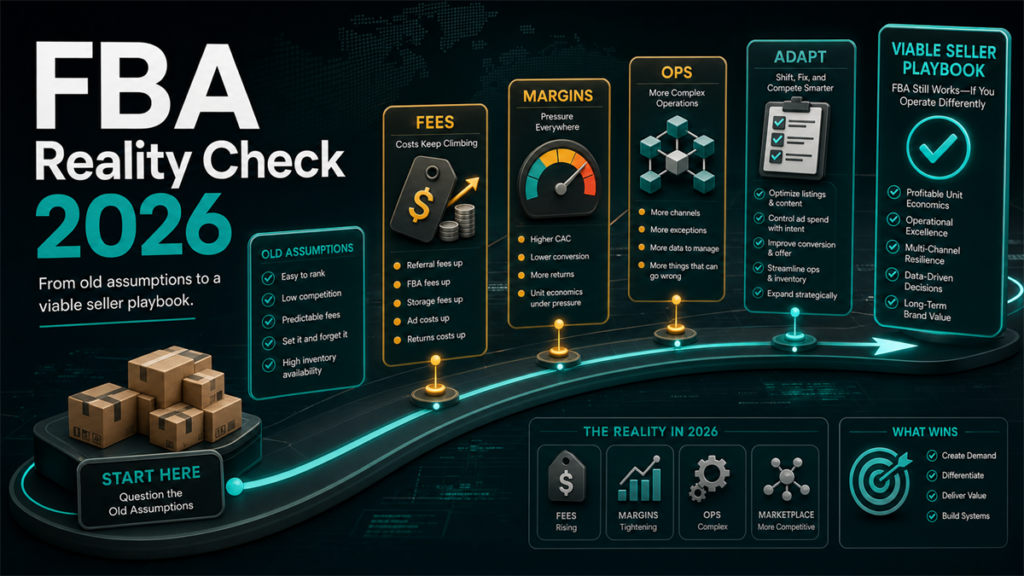
If you are asking "is Amazon FBA dead," the short answer is no. Amazon FBA is not dead in 2026. But the version of FBA where sellers could source a generic product, slap on a label, and profit on autopilot is gone for good. FBA still works when sellers manage contribution margin at the SKU level, maintain catalog quality, control inventory exposure, and run advertising with discipline.
Key Takeaways
- FBA remains profitable for the majority of sellers, but margins are tighter due to fee increases and higher ad costs.
- Low-skill, low-margin, copycat private label selling is the part that stopped working, not FBA itself.
- Profitability now depends on SKU-level economics: product cost, referral fees, fulfillment fees, storage exposure, ad spend, and return rates.
- Amazon's fee structure has become more complex, with sellers needing to watch fulfillment, storage, inbound placement, aged inventory, and returns-related costs.
- Sellers who treat FBA as an operational discipline, not a passive income stream, still build real businesses on the platform.
Why People Say FBA Is Dead
The "FBA is dead" narrative picks up every year, and there are real pressures behind it.
Competition increased. More sellers compete for the same search placements, and global sellers from manufacturing hubs list products at aggressive price points. For sellers without differentiation, the result is a race to the bottom on price.
Advertising costs can climb quickly in competitive categories. For products with thin margins, PPC can consume most or all of the profit if campaigns are not tied to SKU-level contribution margin.
Fees got more complex. Sellers now need to account for fulfillment fees, monthly storage fees, aged inventory surcharges, inbound placement service fees, low-inventory-level fees where applicable, returns processing, removal, disposal, and other product-specific costs. The exact amount depends on product size, weight, category, inventory age, services used, and Amazon's current fee schedule.
Enforcement tightened. Account health metrics, listing compliance, and product safety requirements carry more weight. Sellers who operated loosely face suspensions and listing removals more frequently.
These pressures are real. But they do not mean FBA is dead. They mean FBA matured into a business that requires operational skill.
What the Data Actually Shows
The available data paints a different picture from the doom narrative.
Industry surveys continue to show that many Amazon sellers report profitability, but the exact percentages vary by survey, seller type, category, and methodology. Treat those numbers as directional context, not a guarantee. A seller's actual result depends on product economics, execution quality, inventory discipline, advertising efficiency, and account health.
Third-party sellers continue to represent the majority of units sold on Amazon. Amazon's marketplace infrastructure depends on third-party sellers, and the company continues investing in fulfillment capacity, supply chain services, and seller tools.
The pattern is clear: FBA works for sellers who run it like a real business. The sellers who struggle are the ones who never calculated their true per-unit economics before launching.
The Real Problem: SKU-Level Economics
The difference between a profitable FBA seller and a struggling one almost always comes down to SKU-level contribution margin.
Most sellers who claim FBA is dead never tracked their real costs. They looked at selling price minus product cost and called the difference "profit," ignoring referral fees, fulfillment fees, storage costs, inbound shipping, advertising spend, return costs, and overhead.
A proper SKU-level profit calculation includes selling price, minus referral fee, minus FBA fulfillment fee, minus monthly storage fees, minus inbound shipping and prep costs, minus COGS (product, packaging, labeling), minus advertising cost per unit, minus return and refund allowance, and minus any applicable surcharges or service fees such as aged inventory, low-inventory-level, removal, disposal, returns processing, or inbound placement fees.
When the number that remains is positive and large enough to absorb normal variance, the product works. When it is razor-thin or negative, no amount of optimization will fix it.
Mini-Scenario
A seller launches a kitchen product with what looks like a comfortable gap between product cost and selling price. But after referral fees, FBA fulfillment, storage, inbound shipping, advertising, returns, and a small allowance for operational variance, the true contribution margin may be much thinner than expected. One spike in return rate or a slight increase in ad cost can push the product to breakeven. The seller who ran these numbers before ordering inventory made a different sourcing decision. The seller who did not is now asking whether FBA is dead.
What Actually Works on FBA in 2026
FBA is not a passive income model. It is a fulfillment infrastructure that works when the seller operates with discipline across five areas.
1. Product Selection with Margin Built In
Products need enough margin to absorb referral fees, fulfillment costs, advertising, storage, returns, and variance. Sellers who succeed avoid products where the landed cost leaves no room for Amazon fees, PPC, returns, and normal operating mistakes. Products that are too cheap, too heavy, too bulky, too fragile, or too easy to copy are structurally difficult to profit from on FBA.
2. Catalog and Listing Quality
Listings must be complete, accurate, keyword-optimized, and compliant. This is not a one-time SEO task. Amazon's search algorithm, AI shopping assistants, and compliance checks all evaluate listing quality continuously. Sellers with suppressed listings, broken variation structures, or inaccurate product data lose organic visibility and face enforcement risk.
3. Inventory Discipline
Inventory management directly affects profitability. Overstocking burns cash through storage fees and aged inventory risk. Understocking can reduce sales velocity, strain ranking, and create avoidable fulfillment issues. Sellers need accurate demand forecasting, replenishment cycles, and a habit of checking Amazon's current inventory fee rules before sending stock.
4. Advertising Efficiency
Sellers cannot afford to run campaigns without monitoring TACoS (Total Advertising Cost of Sales) at the SKU level. Profitable sellers allocate ad spend to products that convert, prune keywords that waste money, and treat advertising as a measurable cost center rather than a growth lever they hope will "pay for itself."
5. Compliance and Account Health
Amazon's enforcement of product compliance, listing accuracy, and account health metrics is tighter than in previous years. Sellers who ignore performance notifications, ship non-compliant products, or accumulate intellectual property complaints face account-level risk. Staying on top of Account Health Dashboard metrics is a baseline operational requirement, not an optional task.
When FBA Is Not the Right Fit
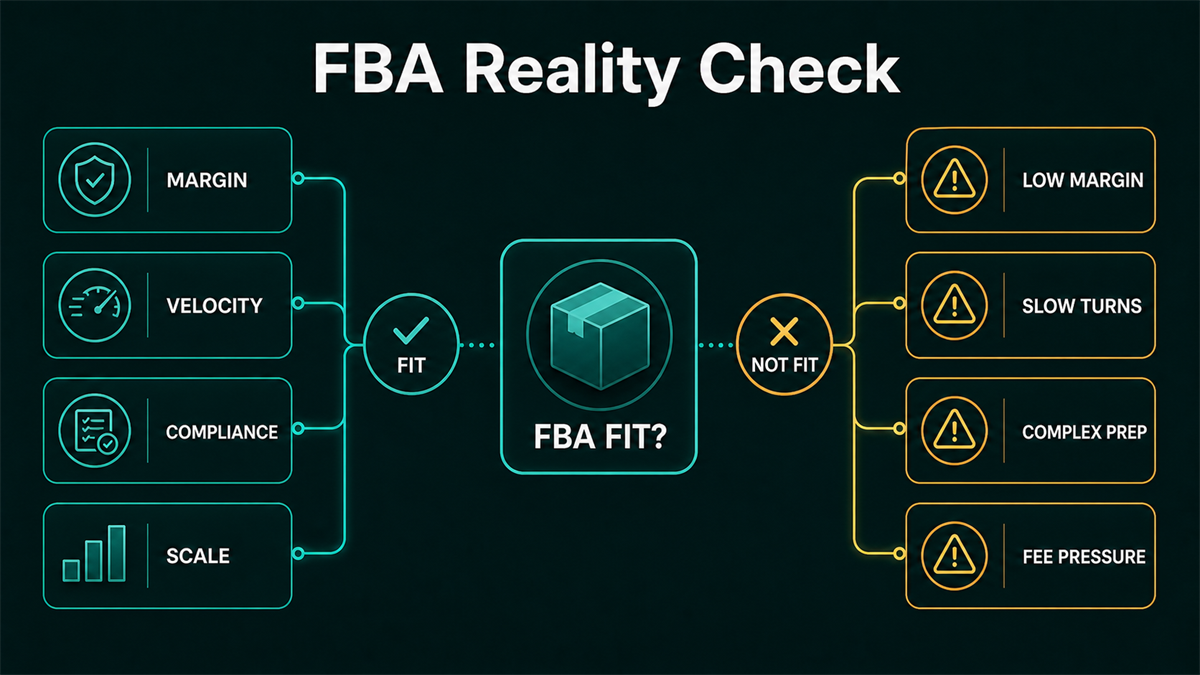
FBA is not the best fulfillment choice for every product. Consider alternatives (FBM, 3PL, or a hybrid model) when the product is oversized or heavy and FBA fulfillment fees consume too much margin, the product is slow-moving and storage exposure creates aged inventory risk, the product has a high return rate in categories where Amazon's returns processing adds significant per-unit cost, or the product requires special handling, temperature control, or compliance steps that FBA does not support well.
Amazon's own Revenue Calculator and the FBA fee schedule are the starting points for this comparison. Sellers should verify current fee rates directly in Seller Central, as rates change and vary by product size, weight, and category.
FAQ
Is Amazon FBA still profitable in 2026?
Yes, for sellers who manage their costs and choose products with enough margin. Industry surveys suggest many Amazon sellers report profitability, but those numbers should be treated as survey context, not a promise. Profitability depends on product selection, SKU-level cost control, and operational discipline.
How much does it cost to start selling on Amazon FBA?
Startup costs vary widely. At minimum, sellers need a seller account, product inventory, inbound shipping, and enough budget for initial advertising and operational mistakes. Realistic starting budgets for a single product launch depend on product cost, order quantity, testing strategy, and category requirements.
What are the biggest Amazon FBA fees in 2026?
The largest fee categories for most sellers are referral fees, FBA fulfillment fees, monthly storage fees, inbound shipping or placement-related costs, and advertising. Aged inventory surcharges, returns processing fees, removal fees, disposal fees, and category-specific costs can also matter depending on the product and operation.
Is private label still viable on Amazon?
Private label selling still works when the product is differentiated, the brand is real, and margins support the full cost stack. Generic, undifferentiated private label products with no brand story or product improvement face intense competition and compressed margins.
Should I use FBA or FBM?
The answer depends on the product. FBA offers Prime eligibility, Amazon-handled customer service, and returns processing, which can improve conversion rates. FBM can be more cost-effective for oversized, slow-moving, or low-margin products where FBA fees consume too much margin. Many sellers use a hybrid approach.
Next Steps for Sellers
FBA is not dead. But the approach that worked in 2018 or 2020 will not work in 2026. The sellers who succeed now are the ones who calculate contribution margin before ordering inventory, keep their catalog clean and compliant, manage inventory levels to avoid both stockouts and storage penalties, and run advertising with measurable efficiency targets.
If your Amazon operations need a review, whether it is catalog errors, broken variation structures, compliance issues, or margin leaks you cannot find, Qubeq can audit the account and identify the operational bottlenecks before they compound.